




Volume 180 - Issue 10
Homocysteine and vitamin status in older people in Perth
Authors: Leon A Flicker, Samuel D Vasikaran, Jenny Thomas, John G Acres, Paul E Norman, Konrad Jamrozik, Nicola T Lautenschlager, Peter J Leedman and Osvaldo P Almeida
Med J Aust 2004; 180 (10): 539-540. || doi: 10.5694/j.1326-5377.2004.tb06061.x
Published online: 17 May 2004
Published online: 17 May 2004
Leon A Flicker,* Samuel D Vasikaran,† Jenny Thomas,‡ John G Acres,§ Paul E Norman,¶ Konrad Jamrozik,** Nicola T Lautenschlager,†† Peter J Leedman,‡‡ Osvaldo P Almeida§§
* Professor of Geriatric Medicine, ‡ Research Nurse, School of Medicine and Pharmacology, § Research Fellow, School of Medicine and Pharmacology and School of Psychiatry and Clinical Neurosciences, ¶ Associate Professor of Surgery, †† Senior Lecturer in Psychiatry of Old Age, ‡‡ Professor of Medicine, §§ Professor of Psychiatry of Old Age; University of Western Australia, Royal Perth Hospital, Box X2213, Perth, WA 6000. † Head, Department of Core Clinical Pathology and Biochemistry, Royal Perth Hospital, Perth, WA. ** Professor of Primary Care Epidemiology, Imperial College London, London, UK. leonflicATcyllene.uwa.edu.au
To the Editor: Elevated levels of homocysteine (Hcy) have recently been associated with increased risk of vascular events1 and dementia.2 The clearance of Hcy is dependent on three vitamins — folate, B6, and B12. Vitamin B12 deficiency has been described in older people for over 40 years,3 and may have wide-ranging effects through this vitamin’s influence on Hcy. The aims of this study were to examine serum B12 and folate status, and their relationships with plasma Hcy concentrations, in community-dwelling healthy older people living in Perth.
Older men and women were recruited from two different sources: 299 men aged 75 years and over were recruited from a large population-based study of screening for abdominal aortic aneurysm,4 where 70% of those invited joined the project; and we recruited 273 community-dwelling women aged 70 years and over through advertisements. Exclusion criteria for both groups included significant cognitive impairment, severe physical illness and current use of B-group vitamin supplements. The Human Research Ethics Committee at the University of Western Australia approved the study, and all participants provided informed consent.
Fasting total plasma Hcy, serum B12 and folate concentrations were measured in all participants, and serum creatinine concentration was measured in the men only to calculate glomerular filtration rate (cGFR). For analyses, the variable plasma Hcy was heavily skewed to the right and natural logarithmic transformation was used. Pearson’s product moment correlations were calculated for univariate analyses of continuous variables.
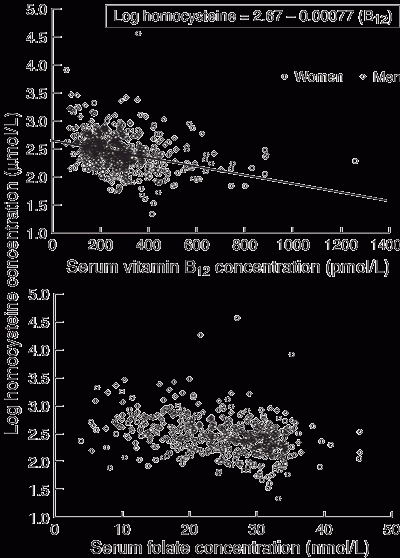
Descriptive statistics are presented in Box 1. Fourteen per cent and 1% of the men, and 6% and 1% of the women, were deficient in B12 and folate, respectively. Hcy concentrations above upper reference limits (15 μmol/L for men and 13 μmol/L for women) were found in 24% of both men and women. There were significant (P < 0.001) positive correlations between age and log Hcy concentration for men (r = 0.23; 95% CI, 0.12–0.33) and women (r = 0.25; 95% CI, 0.13–0.36), inverse correlations between B12 and log Hcy concentrations for men (r = – 0.25; 95% CI, – 0.14 to – 0.35) and women (r = – 0.30; 95% CI, – 0.19 to – 0.41), and inverse correlations between folate and Hcy concentrations for men (r = – 0.43; 95% CI, – 0.33 to – 0.52) and women (r = – 0.28; 95% CI, – 0.16 to – 0.39). Plots of log Hcy against B12 and folate concentrations for all participants are presented in Box 2. Under multiple regression, the association of B12 and folate concentrations with log Hcy concentration remained after adjustment for age and cGFR in men only; beta values (SE) were:
– 0.00060 (0.00011) for B12 concentration;
– 0.0155 (0.0017) for folate concentration;
– 0.0029 (0.0008) for cGFR; and
0.012 (0.005) for age.
In this sample there were high prevalences of B12 deficiency and hyperhomocysteinaemia. Although the prevalence of folate deficiency was substantially lower, there were still moderate inverse associations between serum folate and Hcy concentrations. Unfortunately, vitamin B12 deficiency of this kind may not be universally corrected with small doses of oral supplements,5 and this has intensified concerns about precipitating neurological complications by population-based folate supplementation.6 There is a need for intervention studies of B-group supplements to evaluate whether the risks associated with hyperhomocysteinaemia can be ameliorated.
1: Demographic characteristics, serum B12 and folate, and plasma homocysteine in 299 older men and 273 older women
|
Men |
Women |
|||||||||
|
Mean (SD) |
Range |
Mean (SD) |
Range |
|||||||
Age (years) |
78.9 (2.8) |
68–86 |
74.8 (4.4) |
70–92 |
|||||||
Weight (kg) |
78.4 (1.2) |
50.6–119.5 |
69.3 (1.3) |
39.0–120.0 |
|||||||
Height (cm) |
171 (6.5) |
150–197 |
159 (6.7) |
132–176 |
|||||||
Body mass index (kg/m2) |
26.6 (3.5) |
16–37 |
27.4 (5.3) |
17–52 |
|||||||
Ever smoked |
66% |
|
41% |
|
|||||||
Ever drank alcohol |
95% |
|
66% |
|
|||||||
Serum folate (nmol/L) |
24.3 (7.6) |
5.5–45.3 |
25.3 (7.6) |
3.9–45.2 |
|||||||
Serum B12 (pmol/L) |
254.5 (116.7) |
57–890 |
313.5 (158.7) |
59–1270 |
|||||||
Plasma Hcy (μmol/L) |
13.50 (5.3) |
6.7–70.5 |
11.46 (6.8) |
3.8–96 |
|||||||
Glomerular filtration rate (mL/min) |
78.3 (16.3) |
35.8–142.4 |
|
|
|||||||
SD = standard deviation. Hcy = homocysteine. RI = reference interval. |
|||||||||||
Acknowledgements
This work was supported by grants from the National Health and Medical Research Council of Australia, and untied research grants from Pfizer CVL, Australian Rotary Health Research Fund and the Australasian Menopause Society. We are grateful to the men and women who participated in this study.
References
- Hankey GJ, Eikelboom JW. Homocysteine and vascular disease. Lancet 1999; 354: 407-413. CHDECCBH
- Seshadri S, Beiser A, Selhub J, et al. Plasma homocysteine as a risk factor for dementia and Alzheimer’s disease. N Engl J Med 2002; 346: 476-483. i1083211
- Cape RDT, Shinton NK. Serum vitamin B12 concentration in the elderly. Geronontologia Clinica 1961; 3: 163-172. i1083213
- Jamrozik K, Norman PE, Spencer CA, et al. Screening for abdominal aortic aneurysm: lessons from a population-based study. Med J Aust 2000; 173: 345-350. i1083215
- Seal EC, Metz J, Flicker L, Melny J. A randomised, double blind, placebo controlled study of oral vitamin B12 supplementation in elderly patients with subnormal or borderline serum vitamin B12 concentrations. J Am Geriatr Soc 2002; 50: 146-151. i1083217
- Reynolds EH. Benefits and risks of folic acid to the nervous system. J Neurol Neurosurg Psychiatry 2002; 72: 567–571. i1083219
Beyond Fibrosis Stratification: Integrating Behavioural, Metabolic and Policy-Level Interventions in Metabolic Dysfunction-Associated Steatotic Liver Disease
Yousef Hakimi, Prarthana Thiagarajan, Michael Braude
Fatty Liver Disease in Australia: A Narrative Review on the Epidemiology, Natural History, Prognostication and Management in People With Metabolic Dysfunction
Karl Vaz, Daniel Clayton-Chubb, William W. Kemp, Stuart K. Roberts, Ammar Majeed
When ‘Liver Enzymes’ Are Not Hepatic: Late-Onset Pompe Disease
Shauna Madigan, Georgina England, Wayne Rankin
Fatty Liver Disease in Australia: A Narrative Review on the Epidemiology, Natural History, Prognostication and Management in People With Metabolic Dysfunction
Karl Vaz, Daniel Clayton-Chubb, William W. Kemp, Stuart K. Roberts, Ammar Majeed
The early implementation phase of the Omega‐3 Test‐and‐Treat Program for reducing the risk of preterm birth, South Australia, 2021–22: an implementation evaluation study
Karen P Best, Celine Northcott, Lucy A Simmonds, Philippa Middleton, Lisa N Yelland, Vanessa Moffa, Khoa Lam, Penelope Coates, Cornelia Späth, Carol WK Siu, Karen Glover, Rhiannon Smith, Robert Gibson, Maria Makrides
Cause‐specific mortality among Queensland people with cirrhosis, by cirrhosis aetiology and decompensation status, 2007–22: a retrospective cohort study
Vikas Bhasker, Jessica R Fong, Paul J Clark, Gunter F Hartel, Richard Skoien, James O’Beirne, Elizabeth E Powell, Patricia C Valery