




Volume 179 - Issue 11
The Fiji School of Medicine postgraduate training project
Authors: Gordon J A Clunie, Eddie McCaig and Wame Baravilala
Med J Aust 2003; 179 (11): 631-632. || doi: 10.5694/j.1326-5377.2003.tb05724.x
Published online: 1 December 2003
Published online: 1 December 2003
A long and proud history of health education in the Fiji Islands started in 1885 with the founding of the Suva Medical School, which became the Central Medical School in 1929 and the Fiji School of Medicine (FSM) in 1961.
Today, FSM provides training in medicine and a wide range of other healthcare disciplines, including dentistry, pharmacy, physiotherapy, radiography, medical laboratory technology, dietetics and environmental health. Students come not only from the Fiji Islands, but from all Pacific Island countries (a population of about seven and a half million people).
A particular problem has been that formal postgraduate training and continuing professional development have not been available for its graduates, forcing many Pacific Island practitioners to undertake specialist training overseas, with many choosing not to return to the Pacific. Thus, the Pacific Island countries and FSM itself have been heavily dependent on transient expatriate practitioners for delivery of care and medical education. Valuable though the contribution of such expatriates has been, it cannot substitute for local graduates.
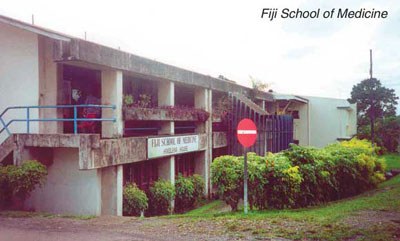
To address these and other issues, a Fiji School of Medicine Development Plan was developed in 1994 and endorsed by the Government of Fiji. A major recommendation was that “an effective postgraduate training program, and preferably one utilising the resources of Fiji and the Pacific Island countries, is the key to the revitalisation of FSM.”
This was followed in 1995 by a meeting on Yanuca Island in Fiji, sponsored by the World Health Organization, involving consultants and government representatives from all Pacific Island countries. This meeting recommended establishing diploma and masters courses in anaesthesia, internal medicine, surgery, obstetrics and gynaecology, child health and population health.
The Fiji government then requested, in discussion with the Australian Agency for International Development (AusAID), that FSM be included in the bilateral program of assistance between the two countries. In May 1997, AusAID appointed the Royal Australasian College of Surgeons (RACS) to manage the 5-year project with a budget of A$5.5 million, in partnership with the Royal Australasian College of Physicians and its Division of Paediatrics, the Australian and New Zealand College of Anaesthetists, the Australian Society of Anaesthetists, the Royal Australian and New Zealand College of Obstetrics and Gynaecology and the Universities of Otago and Melbourne.
The aim of the project was to establish a postgraduate training program at FSM, involving local curriculum development to make it more relevant, and to reduce (although probably not eliminate) the need for doctors to travel to other countries for specialist training.
Each of the five disciplines was to offer a 1-year diploma, giving a theoretical and practical background sufficient for providing care in Pacific Island countries with populations too small to support fully trained specialists. This diploma would also act as the introductory year for a 3-year masters program for those showing particular aptitude, and who wished to proceed to full specialist practice in larger Pacific Island countries.
Selection into the diploma program would require a minimum 3–4 years’ experience after graduating from medical school, and support from the relevant Pacific Island Country authority. Progression from the diploma to the masters program would depend on achievement of a high standard during the course and examination.
The FSM faculty was strengthened by the appointment of additional staff in each of the five disciplines, one of whom was appointed Coordinator of Postgraduate Studies (W B). These were supported by long-term advisers from Australia or New Zealand to interact with local staff in each of the five disciplines. Advisers spent full-time attachments in Suva for 18 months to 3 years, depending on the state of development of the specialty.
The project was launched on 5 May 1997. The appointment of long-term advisers and local counterparts followed rapidly, and teaching began formally in all disciplines in 1998.
In anaesthesia, a pre-existing diploma established with the help of the Australian Society of Anaesthetists was adapted to the more practically oriented and problem-based format used in all five disciplines. In paediatrics and obstetrics and gynaecology, FSM was able to build on diplomas from the University of Otago, which had been offered through the distance mode. In surgery, informal postgraduate teaching and course development had commenced in 1996.
The agreed format for the curriculum was a series of modules designed to provide detailed learning objectives, with core and reference materials to allow the trainees to adopt a problem-solving approach to learning and clinical practice. The content was clearly defined at the diploma level in recognition of the fact that this might be the only formal training for trainees, in particular, from the smaller Pacific Island countries, and emphasis was given to the need for life-long learning and continuous professional development. At the masters level, subspecialty teaching was provided by visiting medical staff from Australia and New Zealand, who spent 2-week periods at FSM for direct teaching and to help develop the modules. A specific requirement for each masters trainee was the completion of a research project, supervised by staff in the discipline and the Research Director at FSM.
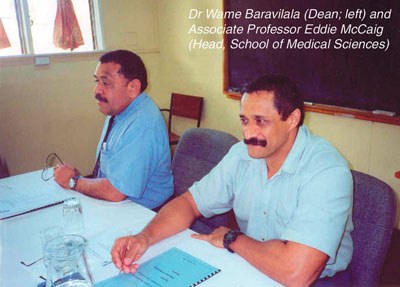
In Suva, trainees in the diploma and masters program undertook clinical duties at the Colonial War Memorial Hospital. Diploma candidates from other Pacific Island countries were able to undertake their initial studies in their own country, provided there were adequate local facilities and clinical and academic supervision, with the last three months of the course undertaken in Suva for intense supervision and preparation for the examinations. Masters candidates are all trained in Suva, with an additional 3–4 months on attachment in Australia or New Zealand.
Distance learning for postgraduate education and continuing professional development is a major issue. In 2002, FSM identified “flexible learning”, a process that is learner-focused, and, with the help of the University of the South Pacific and Professor Ian Rouse of Curtin University, is developing a Resource Centre that will collate all paper-based and electronic-based resources, improve delivery of internal services and coordinate workshops on flexible learning for staff at FSM. Distance learning should become more widely available in the future, as more and more FSM-trained specialists in general return to their own environments.
Graduates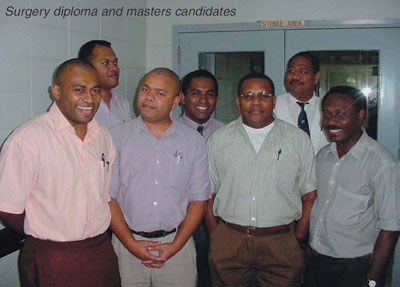
In 1999 the University of the South Pacific, a distinct entity which awards MB BS degrees to FSM graduates, approved the awarding of a Master of Medicine (MMed) degree after review by independent external reviewers, and subject to a further review in the final year of the first cohort (2001). This was completed satisfactorily in August 2001, noting that the programs were “soundly based and well balanced in terms of targeted acquisition of appropriate expert knowledge, technical capacity, life-learning skills and problem solving ability”. It was noted that the academic level of the MMed degree was rightly set at a level which was equivalent to other MMed degrees in the South-East Asian area. The diploma remains an award made by FSM itself.
By the end of 2002, 74 diplomas had been awarded (anaesthesia, 16; internal medicine, 13; obstetrics and gynaecology, 8; paediatrics, 17; surgery, 16; community and hospital practice, 4) and 14 candidates had completed the Master of Medicine degree (anaesthesia, 1, internal medicine, 3; obstetrics and gynaecology, 4; paediatrics, 2; surgery, 4). Of these graduates, 68 with diplomas and 12 masters graduates were practising in Pacific Island countries.
Conclusions
Within 5 years the FSM postgraduate training project, established with funds provided by AusAID, has facilitated the development of a viable and now largely self-sustaining program for postgraduate medical education for the Pacific Islands. All strategies for implementation have been fulfilled, although continuing support from authorities and individuals from countries such as Australia and New Zealand will be necessary if these achievements are to be sustained and advanced. A memorandum of understanding is under discussion between FSM and AusAID to facilitate such support.
Acknowledgements
The authors wish to acknowledge the major contributions made by the long-term advisers and local counterparts in the five disciplines (anaesthesia— Karl Alexander, Bruce Lister, Wayne Morris and Sereima Bale; internal medicine — Rex Hunton, Robert Moulds, Kimberley Oman and Joji Malani; paediatrics — Alan Rubin and Elizabeth Rodgers; obstetrics and gynaecology — Thomas Fiddes, Wame Baravilala and Bipin Gupta; surgery — Frank Piscioneri, Vernon Marshall and Eddie McCaig) as well as visiting medical specialists too numerous to name individually. Excellent administrative support was provided at RACS by Prue Walters, Margaret Gosling, Sara Lee and Roger Southern; at FSM by Aqela Cakabau; and at AusAID by Paul Kelly, Maryann Athaide and Annette Checksfield.
Dousing the burning inequity of global warming for people experiencing homelessness
Timothy English, Alejandro Vásquez Hernández, Glenn Miller, Nuala Fogarty, Charles Cosgrove, Paul Rosenthal, Matthew Larkin, Jon Swain, Danielle Austin, Jo River
The contribution of evidence‐based practice and the practice‐based evidence approaches to contemporary Australian psychology: implications for culturally safe practice
Paul Gray (Wiradjuri), Dawn Darlaston‐Jones, Pat Dudgeon AM (Bardi), Kate Derry, Joanna Alexi, William Smith (Wiradjuri and Wemba Wemba), Tanja Hirvonen (Jaru and Bunuba), David Badcock, Shraddha Kashyap, Belle Selkirk (Noongar)
Explaining risk in chronic conditions: the Yolŋu science of signs
Emma Haynes, Alison Mitchell, Minitja Marawili (Yolŋu), Dawn C Bessarab (Bardi)
Is it time to retire the label “CALD” in public health research and practice?
Sabine Allida, Della Maneze
What do Aboriginal people in the Northern Territory value during the operation journey? A qualitative study
Edith B Waugh, Marita Hefler, Sophie Pascoe, Mark Mayo, Matthew JL Hare, David A Story, Neil Wilkshire, Peter Henwood, David Croker, Jampijinpa Ross
Fulfilling First Nations health, cultural safety and equity accreditation standards in primary medical education: reflections from a First Nations desktop review team
Paul Saunders, Nicole Mercer, Maria Mackay, Ian Lee, Madelyne Hudson‐Buhagiar, Miriam Cavanagh, Emma Milliss, Melody Muscat, Kathleen Martin, Adam Shipp, Melissa Johnson, Belinda Gibb