




Volume 178 - Issue 7
Beware the zebra
Author: Pedita S Rowe
Med J Aust 2003; 178 (7): 360. || doi: 10.5694/j.1326-5377.2003.tb05245.x
Published online: 7 April 2003
Published online: 7 April 2003
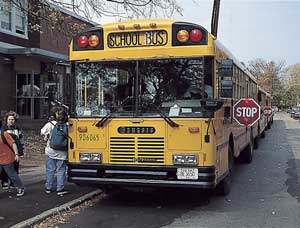
Photograph courtesy Ray Sherman
To the Editor: I read with interest the entry in "In other Journals" entitled "Beware the zebra".1 It described a study in the United States (reported in JAMA)2 which found that elderly people were more likely to be struck by a motor vehicle when crossing at a marked crossing than at an unmarked site! Personal observation after a year of living and working in the States has led me to be no longer surprised by such a report.
There is what I believe to be a culturally different attitude to road safety here. There seems to be a general belief by pedestrians that cars will stop if they walk out on to the road — often without looking. This is more so at marked crossings, where I can attest to the findings of the article that "nearly 40% of pedestrians incorrectly believed that traffic must stop for a pedestrian who is on the curb waiting to cross at a marked crosswalk."
I believe that this perception may have been ingrained from an early age — US school buses have stop signs which appear when the bus stops, so that traffic behind the bus, alongside and in the opposing lanes has to stop while children are getting on or off the bus and then crossing the road. There is little attempt by the schoolchildren to "look both ways", as we were taught when growing up. This, I think, leads to a misperception that traffic will stop for all pedestrians, who may feel even more entitled at a marked crossing to cross without looking.
Since the report may have horrified some readers, I thought it might be worth providing a little local experience on the subject!
References
- Beware the zebra [In other journals]. Med J Aust 2003; 178: 90.<eMJA full text>
- Koepsell T, McCloskey L, Wolf M, et al. Crosswalk markings and the risk of pedestrian–motor vehicle collisions in older pedestrians. JAMA 2002; 288: 2136-2143. i1082264
Designing Housing to Reduce Overcrowding-Related Harms: Rheumatic Heart Disease as the Canary in the Coal Mine
Simon Quilty, Veronica Matthews, Angus Baumann, James Marangou, Bo Remenyi, Gavin Wheaton, Serena Morton Nabanunga, Norman Frank Jupurrurla, Simon Robinson, Steve Mintern, Cary Duffield, Joshua R. Francis, Paul C. Memmott
Australian Climate Leadership in 2026: COP-Out or Step-Up for Health?
Catherine G. A. Pendrey, Angie Bone, Aletha Ward, Francis Nona, Michelle Isles, Paul M. Kelly, Nicholas J. Talley
The impact of the Breast Screen NSW transition from film to digital mammography, 2002–2016: a linked population health data analysis
Rachel Farber, Nehmat Houssami, Katy J L Bell
Shifting focus to adolescent wellbeing and inclusive participation in the digital age
Allyson R Todd, Elena Wang, Stephanie R Partridge
The CURE Asthma roadmap
Gary P Anderson, Anthony Flynn, Phil G Bardin, John D Blakey, Shyamali C Dharmage, Paul Foster, Peter G Gibson, Adam Jaffe, Alan James, Christine R Jenkins, Sundram Sivamalai, Peter D Sly, Guy B Marks, Vanessa M McDonald, Judy Wetttenhall
Protecting public interest journalism as a public health good
Bronwyn Fredericks, Neha Lalchandani, Melissa A Sweet, Alex Cramb, Carmel Williams