




Volume 177 - Issue 1
Howard Florey, Alexander Fleming and the fairy tale of penicillin
Authors: Ivo D Vellar, Thomas B Hugh, Peter D Goldsworthy and Alexander C McFarlane
Med J Aust 2002; 177 (1): 52-53. || doi: 10.5694/j.1326-5377.2002.tb04642.x
Published online: 1 July 2002
Published online: 1 July 2002
To the Editor: The patronising article by Goldsworthy and McFarlane on the discovery of penicillin1 depicts the popular heroic view of Alexander Fleming as a myth, but also promulgates myths of its own.
Their description of the Fleming saga is historically accurate. Fleming searched for an answer to the riddle of infection, and, to paraphrase Pasteur, chance in the form of a spore of a rare subtype of Penicillium favoured his prepared mind. Whether or not the spore came through an open window is irrelevant, but the windows in Fleming's laboratory — now preserved as a museum (pictured) — could be opened3 and probably were on occasion, as Fleming was a heavy smoker.
Fleming perceived the significance of inhibition (or, more correctly, lysis) of staphylococcal colonies, named the active agent "penicillin" and studied its effect on animals. Goldsworthy and McFarlane are "astonished" that he failed to inject it into infected animals to investigate its therapeutic effect, but the reason is simple: Fleming discovered that penicillin was rapidly inactivated by serum, dashing his hopes for its use as a systemic agent.3 Although he met opposition from his chief, Almroth Wright (known to his students as "Almost Right"), who rejected the view that penicillin might be a useful therapeutic agent, it is absurd to say that Fleming was "a victim of the pessimistic mind-set against toxic chemical antimicrobials". His confidence in its lack of toxicity led him, in 1929, to use penicillin to treat pneumococcal conjunctivitis in one of his assistants, with dramatic success.2
Site of Fleming's laboratory
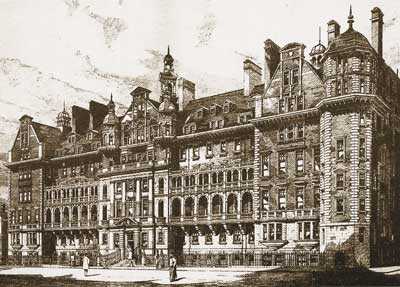
The Clarence Wing, St Mary's Hospital, London, in 1910.
Fleming's laboratory, where penicillin was discovered in 1928,
was on the third floor of the tower on the right. The windows of
the laboratory could be opened by an internal system of ropes
and pulleys, but a more likely source of the Penicillium spore
was a dumb-waiter shaft communicating with a mycology
laboratory on the floor below.2
To say that "Fleming had little idea what to do with his mould apart from dabbing it on infected wounds" unfairly trivialises his actions after the discovery. In addition to clinical and animal studies, he had the mould identified, deposited a culture with the collection held by the Medical Research Council and published his observations. He set two researchers to work purifying the active principle of the mould broth, and established that penicillin was soluble in alcohol and that its stability was pH-dependent. He also developed an assay for penicillin and defined the range of organisms that were sensitive to it. He sent cultures of the penicillin-producing strain to many laboratories, including Oxford, where that very culture later provided the starting point for Chain and Florey's work.
Fleming's subsequent work on penicillin was stalled by his lack of biochemical expertise; he was unable to overcome the difficulties of purification and stabilisation.2 Fleming is recorded as saying, "It's up to the chemists now, I'm no chemist".2 It is quite untrue that "he then effectively forgot about it for 13 years". Although Fleming ceased clinical work on penicillin in 1934, he continued with laboratory studies. A contemporary at St Mary's Hospital, Dr A G Cross, recalled that in the 1930s "penicillin was on his mind all the time and in the minds of those who worked with him".2
Fleming had his faults, but the genius of his prepared mind did indeed present humanity with a fairy tale come true. Perhaps Ernst Chain, who did not particularly like Fleming, should have the last word: "There is no doubt that this discovery, which changed the history of medicine, has justly earned [Fleming] a position of immortality."2
Prisoner of war pathology in Changi, 1942–1945
Kate Ariotti, Elizabeth Roberts‐Pedersen
Should medical eponyms continue to be used in everyday practice?
Leya Nedumannil, Diana Lewis
100 years on: the first use of insulin in Australia
Sophie Templer
Reflections on the life and career of Professor Dame Valerie Beral AC DBE FRS FRCOG FMedSci (1943–2022)
Karen Canfell, Bette Liu, Emily Banks
The Honourable Dr Donald James Grimes AO
Michael Kirby, Patti Warn
From wipeout to drill out: a history of exostosis management and Australian surfing
Alon Taylor, Hannah North, Narinder P Singh, Paul A Fagan