




Medical education
Lessons from practice
Volume 218 - Issue 11
Seven vessel spontaneous coronary artery dissection and concurrent transient global amnesia after an emotional trigger
Authors: Nikolaos Papadopoulos, Ashleigh Dind, Karam Alzuhairi and Peter Caspari
Med J Aust 2023; 218 (11): 503-504. || doi: 10.5694/mja2.51974
Published online: 19 June 2023
Published online: 19 June 2023
A 60-year-old woman presented to the emergency department with confusion and memory loss on the day of her father’s death
Clinical record
A 60‐year‐old woman presented to the emergency department with confusion and memory loss on the day of her father's death. She could not recall her father's death despite being reminded. She complained of a frontal headache and epigastric pain. Her medical history included hypertension, Hashimoto thyroiditis and paroxysmal atrial fibrillation.
On initial examination, she was tachycardic, normotensive and afebrile. She was alert but confused, with no focal neurological signs. Her cardiovascular examination was normal.
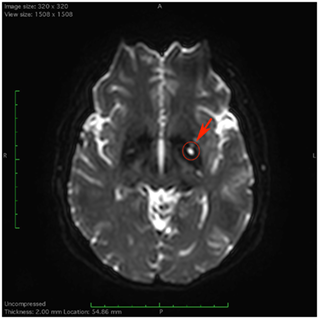
Initial biochemistry showed a troponin I level of 4500ng/L (reference range, <10ng/L). Her electrocardiogram showed sinus tachycardia with subtle, dynamic ST depression inferolaterally. Echocardiography showed no regional wall motion abnormalities (Supporting Information video 1). Magnetic resonance imaging of the brain demonstrated diffusion restriction in the hippocampus, characteristic of transient global amnesia (TGA) (Box). The patient was treated with clopidogrel, metoprolol and therapeutic enoxaparin. She did not receive aspirin owing to prior anaphylaxis to ibuprofen.
The following day, when her cognition had normalised, she experienced sudden chest pain. Her troponin I level rose to 24000ng/L. Computed tomography coronary angiography (CTCA) detected no abnormality. Given the clinical presentation, a coronary angiogram was done, showing spontaneous coronary artery dissection (SCAD) in seven arteries or branches (Supporting Information video 2, video 3 and video 4). The right posterolateral artery, a branch of the posterior descending artery, three obtuse marginal branches, the distal circumflex and distal left anterior descending artery were dissected. The first obtuse marginal was occluded and probed unsuccessfully. There was TIMI (thrombolysis in myocardial infarction) grade 3 flow in all other vessels. Other causes such as embolism and Takotsubo cardiomyopathy were considered, but the angiographic appearance was diagnostic of SCAD.
A workup of any underlying cause of SCAD was unrevealing. Her connective tissue screen was normal, blood pressure was well controlled with ramipril, and she had no evidence of fibromuscular dysplasia on computed tomography imaging. She was managed with long term clopidogrel and metoprolol.
The patient has been asymptomatic on her medication regime for three years with no SCAD recurrence to date. A follow‐up stress echocardiogram a few months after discharge showed no ischaemia.
Discussion
SCAD is the spontaneous separation of the layers of the coronary arterial wall, which leads to compromised myocardial blood flow.1 SCAD is being increasingly recognised. It is estimated that 2–4% of all acute coronary syndrome (ACS) is caused by SCAD. In the subgroup of women aged under 50 years with ACS, SCAD is estimated to be the cause in 35%. Multivessel SCAD is not often recognised, quoted at an incidence of 5–13%.1 It is also likely to be increasingly reported due to greater awareness of the diagnosis and improved diagnostic techniques including intravascular imaging.
SCAD can be associated with underlying fibromuscular dysplasia, pregnancy, connective tissue diseases and inflammatory diseases.2,3 Precipitants (identified by over 50% of patients) include intense exercise, emotional stress, labour, stimulant use and repetitive Valsalva manoeuvres.3
Both SCAD and TGA can be triggered by emotional stress. TGA is a clinical syndrome characterised by acute onset of anterograde amnesia. Sudden memory loss lasts an average of six hours, then completely resolves.4
SCAD often occurs in distal coronary vessels, which are poorly seen on CTCA compared with invasive coronary angiography.1,3 Our patient's SCAD occurred in distal or branch vessels, hence it was unsurprising that the pathology was not well seen on CTCA. Given an increasing tendency to investigate cases with only CTCA to avoid instrumentation of the coronaries and the risk of iatrogenic dissection, it is essential that clinicians choose their investigations carefully to ensure the correct diagnosis.
This case also illustrates the need to maintain a broad differential in complex presentations. The patient's memory loss was the predominant feature, but her epigastric pain and tachycardia pointed to the need for cardiac investigations. Recognising atypical symptoms is particularly important with female patients, who may experience cardiac pain differently, and suffer from more additional symptoms like dyspnoea and lightheadedness, compared with men.5 Fortunately, our patient's tachycardia, electrocardiography and troponin rise shed light on the significance of her previously overlooked epigastric pain.
This is a novel case of concurrent triple vessel SCAD and TGA, which to our knowledge has not been previously reported. It provides insight into adrenergic and hormonal triggers of SCAD. Current SCAD management is based on expert opinion and not randomised control trials. We hope that greater awareness and improved case identification will enable future research to determine evidence‐based interventional and pharmacological treatment. This case illustrates the need for detailed clinical assessment in the face of multiple presenting complaints and reinforces the need to interpret test results in context, keeping the limitations of the test in mind.
Lessons from practice
- Spontaneous coronary artery dissection (SCAD) is an uncommon cause of acute coronary syndrome in the general population but is more common in middle aged women who may present with atypical symptoms.
- SCAD and transient global amnesia can both be triggered by emotional stress.
- Investigation and management of SCAD includes early coronary angiography, antiplatelet therapy, and beta blockade.
- Conservative management allows for angiographic healing in most patients over months, but percutaneous coronary intervention and coronary artery bypass grafting may be considered when continued ischaemia or haemodynamic instability are present.
Competing interests
No relevant disclosures.
References
- Hayes SN, Kim ESH, Saw J, et al. Spontaneous coronary artery dissection: current state of the science: a scientific statement from the American Heart Association. Circulation 2018; 137: e523‐e557.
- Motreff P, Souteyrand G, Dauphin C, et al. Management of spontaneous coronary artery dissection: review of the literature and discussion based on a series of 12 young women with acute coronary syndrome. Cardiology 2010; 115: 10‐18.
- Saw J, Aymong E, Sedlak T, et al. Spontaneous coronary artery dissection: association with predisposing arteriopathies and precipitating stressors and cardiovascular outcomes. Circ Cardiovasc Interv 2014; 7: 645‐655.
- Arena JE, Rabinstein AA. Transient global amnesia. Mayo Clin Proc 2015; 90: 264‐272.
- DeVon HA, Mirzael S, Zegre‐Hemsey J. Typical and atypical symptoms of acute coronary syndrome: time to retire the terms? J Am Heart Assoc 2020; 9: e015539.
Provenance: Not commissioned; externally peer reviewed.
Fatty Liver Disease in Australia: A Narrative Review on the Epidemiology, Natural History, Prognostication and Management in People With Metabolic Dysfunction
Karl Vaz, Daniel Clayton-Chubb, William W. Kemp, Stuart K. Roberts, Ammar Majeed
Sex Differences in Management and Outcomes of People With ST-Elevation Myocardial Infarction, New South Wales, 2011–2020: A Retrospective Cohort Study
Adam C. Livori, Jedidiah I. Morton, Dianna J. Magliano, Jonathan E. Shaw
Rethinking Rheumatic Fever Diagnosis: Progress, Pitfalls and the Path Towards a Definitive Test
Anna P. Ralph, Rachel Webb, Tom Parks, Nicole J. Moreland, Asha C. Bowen, Benjamin Jones, Emma Ndagire, Andrea Z. Beaton
Sex Differences in Management and Outcomes of People With ST-Elevation Myocardial Infarction, New South Wales, 2011–2020: A Retrospective Cohort Study
Samia Kazi, Simone Marschner, Clara K. Chow
Distribution of Cardiovascular Disease Risk Based on the Updated 2023 Guideline-Recommended Australian Cardiovascular Disease Risk Algorithm and Comparison With the 2012 Algorithm: An Observational Study
Nina Lazarevic, Meghana Bhat, Grace Joshy, Danielle C. Butler, Mark Woodward, Anushka Patel, Rod T. Jackson, Garry Jennings, Rosemary Wyber, Ellie Paige, Emily Banks
They Brought the Hospital to Me
Hugh N. Burrill