




Volume 217 - Issue 3
Black hairy tongue: a spooky sign associated with penicillin therapy
Authors: Dennis A Nowak and Benjamin E Nowak
Med J Aust 2022; 217 (3): 132-132. || doi: 10.5694/mja2.51636
Published online: 1 August 2022
Published online: 1 August 2022
A 21-year-old man noticed a blackish discoloration of the tongue at day 6 of oral penicillin intake following the extraction of retained molars
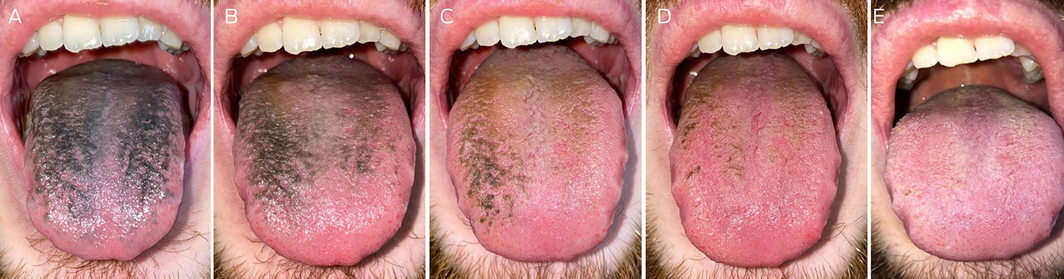
A 21‐year‐old man noticed a blackish discoloration of the tongue (Figure, A) at day 6 of oral penicillin intake following the extraction of retained molars. Penicillin was discontinued. Fungal and bacterial cultures of a tongue swab were unremarkable. The discolouration disappeared within 10days after discontinuation of penicillin and tongue brushing (Figure, B–E). Black hairy tongue is a rare side effect of penicillin medication.1,2 It is characterised by hypertrophy and elongation of filiform papillae causing a brownish or greyish‐black darkening.1,2,3 The syndrome is associated with several causative factors including poor oral hygiene, tobacco use and antibiotic agents.2,3 Differential diagnoses include acanthosis nigricans and food colouring. Black hairy tongue is generally reversible and causes no long term sequelae.1,2,3
Competing interests
No relevant disclosures.
References
- Wolfson SA. Black hairy tongue associated with penicillin therapy. J Am Med Assoc 1949; 140: 1206‐1208.
- Ren J, Zheng Y, Du H, et al. Antibiotic‐induced black hairy tongue: two case reports and a review of the literature. J Intern Med Res 2020; 48: 300060520961279.
- Hamad Y, Warren DK. Black hairy tongue. N Engl J Med 2018; 379: e16.
Watchful Waiting Compared With Immediate Antibiotics for Urban Aboriginal and Torres Strait Islander Children With Uncomplicated Acute Otitis Media (WATCH): A Non-Inferiority Randomised Controlled Trial
Jennifer S. Reath, Hasantha Gunasekera, Sanja Lujic, Amanda J. Leach, Letitia Campbell, Robyn Walsh, Tim Usherwood, Geoffrey K. Spurling, Claudette A. Tyson, Deborah A. Askew, Kelvin Kong, Chelsea J. Watego, Peter Morris, Wendy Hu, Penelope A. Abbott
Climate and environmental crisis: effects on ear and hearing health in Australia and for Aboriginal and Torres Strait Islander peoples
Georgia M Tongs (Wiradjuri), Isabella Ludbrook, Jennifer H Martin, Robert Eisenberg, Kelvin M Kong (Worimi)
The New South Wales Pharmacy Trial for herpes zoster: on the nose?
Christian P Pappas, Timothy R Holmes, Minas T Coroneo
Antibiotics or watchful waiting for acute otitis media in urban Aboriginal and Torres Strait Islander children?
Valerie M Swift, Christopher G Brennan‐Jones
The views of parents and carers on managing acute otitis media in urban Aboriginal and Torres Strait Islander children: a qualitative study
Jennifer S Reath, Sarah O'Brien, Letitia Campbell, Hasantha Gunasekera, Claudette A Tyson, Deborah A Askew, Wendy Hu, Tim Usherwood, Kelvin Kong, Peter Morris, Amanda J Leach, Robyn Walsh, Penelope A Abbott
Routine ear health and hearing checks for Aboriginal and Torres Strait Islander children aged under 6 years attending primary care: a national consensus statement
Samantha Harkus, Vivienne Marnane, Isabel O'Keeffe, Carmen Kung, Meagan Ward, Neil Orr, John Skinner, Kelvin Kong, Lose Fonua, Michelle Kennedy, Mary Belfrage