




Volume 214 - Issue 4
The value proposition of investigator‐initiated clinical trials conducted by networks
Authors: The joint ACTA/ACSQHC Working Group
Med J Aust 2021; 214 (4): 159-161.e1. || doi: 10.5694/mja2.50935
Published online: 15 February 2021
Published online: 15 February 2021
Investigator‐initiated trials run by clinical trial networks provide net economic benefits to health systems
Delivery of optimal health care relies on evidence from randomised clinical trials, among other factors, to inform best practice. While the generation of such evidence requires resources, both national and international assessments of health and economic benefits resulting from medical research indicate large returns on investment.1,2,3 In Australia, during the decade 2006–2015, more than 10 000 clinical trials were conducted through Australian clinical trials networks (CTNs), including more than 5 million participants, ranking Australia in the top tier of clinical trial activity.4 Industry‐funded clinical trials accounted for an estimated $930 million of the total $1.1 billion spent annually on clinical trials, with National Health and Medical Research Council (NHMRC) funding accounting for about $164 million annually.4 While the proportion of funding for non‐industry‐sponsored investigator‐initiated clinical trials (IITs) is relatively small, these studies account for more than half of Australia’s clinical trial activity.4 This study funding balance is similar to what is reported elsewhere.5
In Australia, IITs conducted by Australasian CTNs have had a major impact on the improvement of health care quality and outcomes around the world.6,7 IITs are designed and conducted by independent clinicians and academic researchers to generate clinical evidence to improve health care. Benefits are multilayered and not restricted to the discovery of new therapies. Much of the benefit comes from identifying and addressing uncertainty in existing practices; evaluating a range of treatment options that address key unanswered questions free of commercial imperatives, identifying alternative and potentially more efficient diagnostic strategies; and identifying more effective models of care or expensive interventions that are no more active than the lower cost alternative.
Australasia has large, geographically dispersed CTNs across multiple clinical areas,8 with many more having been launched since the original report (personal communication Australian Clinical Trials Alliance [ACTA]). Between one‐quarter and one‐third of all Australian Government‐funded NHMRC support for clinical trials between 2004 and 2014 was awarded to IITs conducted by an established CTN.8 CTNs ensure clinically important, high priority and relevant research questions are appropriately conducted and provide efficiency through established infrastructure. Within Australasia, CTNs are widely regarded as key drivers of innovation and represent good value for public investment.8
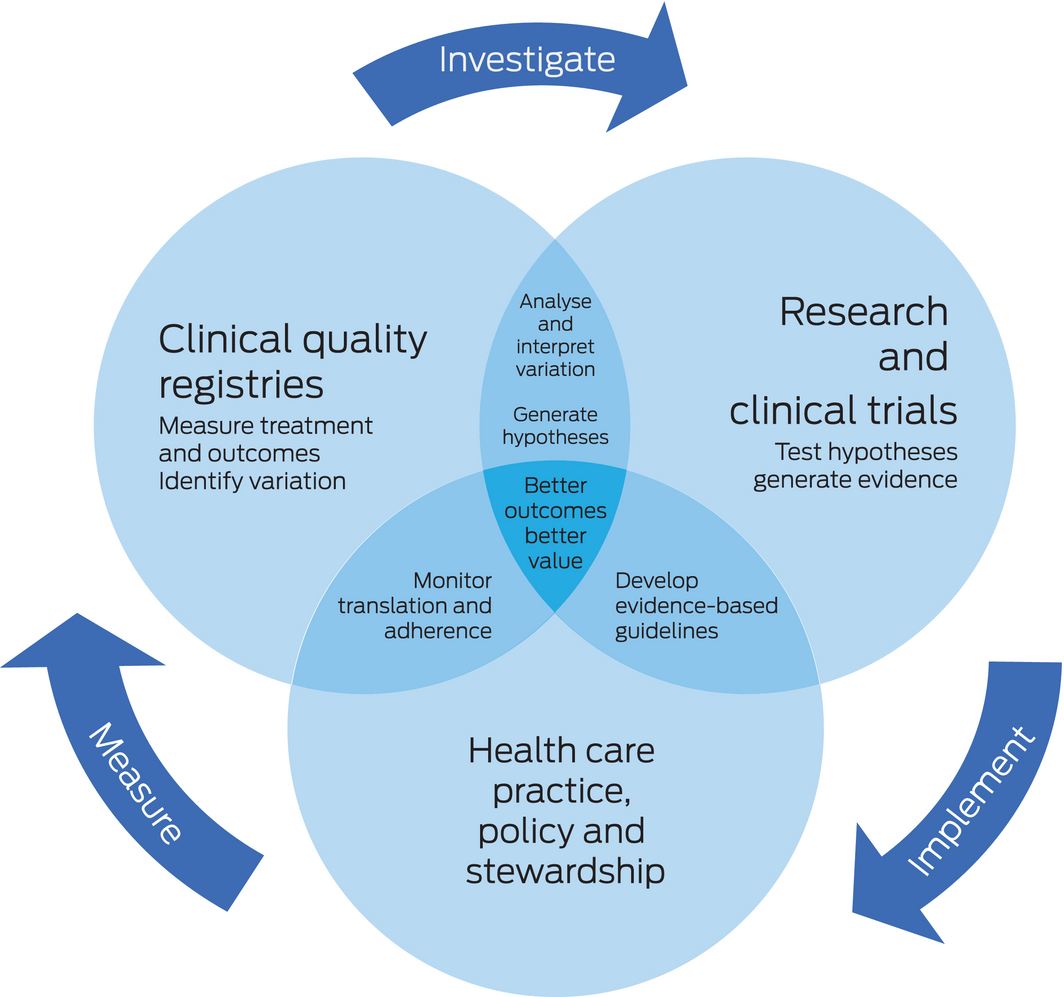
Although the Australian Government invests in IITs and the CTNs that coordinate them, their value has not been well characterised. Governments are increasingly looking to systematically integrate activities that generate high quality evidence (such as IITs) with other aspects of the health care system (such as measurement of health outcomes or development of safety and quality policies) to build self‐improving, sustainable systems (Box). Understanding the potential return on investment is therefore paramount.
In 2015, ACTA and the NHMRC profiled 37 established CTNs in Australia.8 Subsequently, a cost–benefit analysis for the profiled networks was calculated for those that i) were operational for more than 10 years; ii) had conducted more than five high impact peer‐reviewed IITs where an influence (or potential influence) on clinical practice and/or policy were identified (maturity); iii) received a significant proportion of funding from Australian funders (local investment); and iv) were available to participate (feasibility) in this analysis.9
Three CTNs that had conducted a total of 25 IITs were included in the analysis: the Australasian Stroke Trials Network (ASTN), the Interdisciplinary Maternal Perinatal Australasian Collaborative Trials (IMPACT) Network, and the Australian and New Zealand Intensive Care Society Clinical Trials Group (ANZICS CTG). Gross economic benefits across these CTNs were almost $2 billion, with the majority due to improvements in patient health outcomes ($1.4 billion), and 30% due to avoided health service costs — $453 million from the difference in outcomes and $127 million from differences in service costs. Gross costs, which included the cost of running the CTN, coordinating centre costs and the cost of running the entire IIT program in each CTN, were about $335 million, with most of those costs being for the IIT program itself (accounting for 73% of total costs). The benefit to cost ratio was 5.8:1 if findings from the 25 IITs were implemented in 65% of the eligible Australian population for one year.9
Similar findings have been reported internationally, with studies in the United States reporting a benefit to cost ratio of 4.2:1 over 10 years.3 In the United Kingdom, randomised clinical trials funded under the National Institute for Health Research health technology assessment program were expected to have a net benefit of £3 billion, with just 12% of this benefit required to cover the costs for all research undertaken.10
In the Australian analysis, funding provided to run a portfolio of IITs did not cover the total costs within either a CTN or at an individual IIT level, and in‐kind support was relied upon to make up the shortfall. The NHMRC funding received by all Australasian CTNs between 2004 and 2014 was represented by just 9% of the $2 billion gross benefit.9 The magnitude of avoided health care costs appears large, reflecting the size of health care expenditure. The Australian analysis highlighted the importance of in‐kind support within CTNs not only to sustain the viability of the CTNs but for their ability to conduct individual IITs.9 The total quantum of site level, in‐kind support could not be quantified accurately during the study. However, this support was described as being finite, at capacity in many instances, and at risk of exhaustion. From a sustainability perspective, the reliance on in‐kind support is concerning, and undermines the timeliness, volume and international competitiveness of clinical research in Australasia. Anecdotal evidence from interviews suggested that site level in‐kind support represents up to a 50% increase in trial funding.
Late‐phase IITs conducted by CTNs deliver better health outcomes and health service value through a variety of mechanisms. Importantly, IITs play a critical role in addressing clinically significant questions, influencing guidelines, and identifying ways to improve safety and quality and opportunities for more efficient resource use. As stated in a scoping review, IITs “can also yield a substantial knowledge return on investment for hospitals and institutions that actively engage in trials, including the following: more skilled clinicians and increased research capacity, improved patient outcomes, and better health system performance. Also, the difference in cost of care for trial and non‐trial patients can be negligible”.11
Large increases in the benefit to cost ratio could be realised through relatively small increases in implementation rates. Research to identify the barriers and enablers of trial implementation should allow IITs to be translated more effectively into frontline health care delivery. But, intuitively, the conduct of potentially practice‐changing IITs through CTNs is likely to enhance implementation rates, as these virtual, nationwide consortia of clinicians are likely to involve a majority of the relevant clinical community. Hence, the reasonable assumption that clinicians who participate in IITs are more likely to implement trial results in their own practice and to translate new knowledge to their clinical colleagues.
What we do not yet know is the extent to which IITs translate into routine practice. This is rarely measured or monitored in Australia. Measures of implementation should be incorporated routinely into IIT design, particularly for randomised clinical trials that are arguably more likely to result in clinically significant and potentially practice‐changing findings.
Notwithstanding the clear economic benefit demonstrated for the 25 trials conducted by the selected group of three CTNs, it might be possible to reduce trial costs further. The overall cost of trials is a complex, multilayered issue, particularly as small pilot studies are often required to demonstrate the feasibility of recruitment. But combined with the push to answer key questions more quickly especially for the seriously or critically ill patients, such considerations have been drivers in implementing newer adaptive trial designs, which have flexible sample sizes that might reasonably be expected to reduce clinical trial costs.12
The analysis conducted of the three selected CTNs represents the first such analysis conducted of the role of CTNs in the Australian health sector. Despite the limitations of the analysis, it is clear further investment in existing CTNs, as well as therapeutic areas for which there are no CTNs at present, is warranted. This needs to be done in a manner that seeks operational efficiencies, including consolidation of infrastructure and the means to ensure engagement with geographically dispersed health services to improve patient access to trials across communities.11
In conclusion, there is potentially enormous, and arguably untapped, value in investing in IITs conducted by CTNs, as they provide net benefits to health care systems. However, the exact return on investment is contingent on the level of implementation. Further work in this regard is warranted.
So, where to from here? High quality health systems are reliant on a strong clinical trials sector. In particular, the role of IITs run by CTNs is paramount in order to address clinically important questions, especially those that relate to health care variation. Clinical trial infrastructure needs to be strengthened, and we must endeavour to reduce reliance on in‐kind funding to ensure that the sector remains viable. Finally, we must strive to maximise implementation of trial findings to optimise current investment in the sector.
Competing interests
Charlotte Ramage reports consulting fees from Australian Clinical Trials Alliance during the conduct of the study. Julie Bernhardt reports personal fees from Dart Neuroscience, outside the submitted work. Ben Mol reports personal fees from Guerbet; he has received research funding from Guerbet and Merck, has been a member of the ObsEva advisory board and holds stock options for ObsEva, outside the submitted work. Neil Soderlund reports consultancy fees from Australian Commission on Safety and Quality in Health Care during the conduct of the study. John Zalcberg reports investments in GW Pharmaceuticals, Aimmune, Vertex, Alnylam, BioMarin, Gilead, Moderna, Concert Pharmaceuticals, Madrigal Pharmaceuticals, MyoKardia, Orphazyme, CRISPR, Myovant, Frequency Therapeutics, Global Blood Therapeutics, uniQure, Sangamo Biosciences, Acceleron, Zogenix; grants and personal fees from Pfizer; grants, personal fees and non‐financial support from Merck Serono; grants and personal fees from Specialized Therapeutics; personal fees from Targovax, Halozyme, Gilead Sciences, Sirtex Medical, and Lipotek; personal fees and non‐financial support from MSD; grants from Bayer, Roche, BMS, Baxalta/Shire, Lilly, and Boehringer‐Ingelheim; grants and non‐financial support from AstraZeneca; non‐financial support from Deciphera, outside the submitted work. He is Chair at Australian Clinical Trials Alliance, and Co‐Chair at National Oncology Alliance and at All.Can Australia.
Acknowledgements
The joint ACTA/ACSQHC Working Group (article authors): Rhiannon Tate (Monash University, VIC), Emma Britton (Australian Commission on Safety and Quality in Healthcare [ACSQHC], NSW), Steve Webb (Monash University, VIC), Charlotte Ramage (Quantium Health, VIC), Julie Bernhardt (Florey Institute of Neuroscience and Mental Health, VIC), Alan Cass (Menzies School of Health Research, NT), Craig J French (Western Health, VIC), Katie Groom (University of Auckland, New Zealand), Robert Herkes (ACSQHC, NSW), Catherine Katz (ACSQHC, NSW), Ben W Mol (University of Adelaide, SA), R John Simes (NHMRC Clinical Trials Centre, NSW), Neil Sonderlund (Quantium Health, VIC), Belinda E Butcher (WriteSource Medical and UNSW Sydney, NSW), and John R Zalcberg (Monash University, VIC). The Australian Clinical Trials Alliance (ACTA) acknowledges operational funding from the Australian Government’s Medical Research Future Fund. Ben Mol reports an investigator grant (GNT1176437) from the National Health and Medical Research Council (NHMRC).
References
- Lateral Economics. The economic value of Australia’s investment in health and medical research: reinforcing the evidence for exceptional returns, October 2010. https://lateraleconomics.com.au/wp-content/uploads/2014/02/The-Ec-Value-of-Austs-Invmt-in-Med-Research.pdf (viewed Dec 2020).
- Australian Society for Medical Research. Extrapolated returns from investment in medical research future fund (MRFF). Canberra: Deloitte Access Economics, 2014. https://asmr.org.au/wp-content/uploads/library/ASMR%20Deloittee%20Report_MRFF.pdf (viewed Dec 2020).
- Johnston SC, Rootenberg JD, Katrak S, et al. Effect of a US National Institutes of Health programme of clinical trials on public health and costs. Lancet 2006; 367: 1319–1327.
- Askie LM, Hunter KE, Berber S, et al. The clinical trials landscape in Australia. 2005–2016. Sydney: Australian New Zealand Clinical Trials Registry, 2017. http://www.anzctr.org.au/docs/ClinicalTrialsInAustralia2006-2015.pdf (viewed Dec 2020).
- Hakoum MB, Jouni N, Abou‐Jaoude EA, et al. Characteristics of funding of clinical trials: cross‐sectional survey and proposed guidance. BMJ Open 2017; 7: e015997.
- Simes J, Morton R. Strategies for supporting trials of high value. ACTA 2016 National Summit; Melbourne (Australia), Nov 24, 2016. http://www.clinicaltrialsalliance.org.au/wp-content/uploads/2016/12/1-ACTA2016_Simes.pdf (viewed Dec 2020).
- Pham CT, Karnon JD, Middleton PF, et al. Randomised clinical trials in perinatal health care: a cost‐effective investment. Med J Aust 2017; 207: 289–293. https://www.mja.com.au/journal/2017/207/7/randomised-clinical-trials-perinatal-health-care-cost-effective-investment
- Australian Clinical Trials Alliance, National Health and Medical Research Council. Report on the activities and achievements of clinical trials networks in Australia 2004–2014. Melbourne: NHMRC, 2015. https://www.australianclinicaltrials.gov.au/sites/default/files/files/Report%20on%20the%20Activities%20%20Achievements%20of%20Clinical%20Trials%20Networks%20in%20Australia.pdf (viewed Dec 2020).
- Australian Commission on Safety and Quality in Health Care. Economic evaluation of investigator‐initiated clinical trials conducted by networks. Final report. Sydney: ACSQHC, 2017. https://www.safetyandquality.gov.au/publications-and-resources/resource-library/economic-evaluation-investigator-initiated-clinical-trials-conducted-networks-final-report (viewed Dec 2020).
- Guthrie S, Hafner M, Bienkowska‐Gibbs T, Wooding S. Returns on research funded under the NIHR Health Technology Assessment (HTA) Programme: economic analysis and case studies [Doc. No. RR‐666-DH]. Santa Monica, CA: RAND Corporation, 2015. https://www.rand.org/pubs/research_reports/RR666.html (viewed Dec 2020).
- Bentley C, Cressman S, van der Hoek K, et al. Conducting clinical trials‐costs, impacts, and the value of clinical trials networks: a scoping review. Clin Trials 2019; 16: 183–193.
- Hornberger J, Eghtesady P. The cost–benefit of a randomized trial to a health care organization. Control Clin Trials 1998; 19: 198–211.
Provenance: Not commissioned; externally peer reviewed.
Interpreting Australian Stillbirth Rate Trends: Implications for Surveillance and Continuous Quality Improvement
Aleena M. Wojcieszek, Kirstine Sketcher-Baker, Christine Andrews, Michael Coory, Imogen Kettle, Melissa Malivoire, David Ellwood, Vicki Flenady
Paracetamol in Pregnancy: Uncertain Evidence, Certain Consequences
David J. Tunnicliffe, Miranda Cumpston, Debra Kennedy, Margie Danchin, Armando Teixeira-Pinto
Fatty Liver Disease in Australia: A Narrative Review on the Epidemiology, Natural History, Prognostication and Management in People With Metabolic Dysfunction
Karl Vaz, Daniel Clayton-Chubb, William W. Kemp, Stuart K. Roberts, Ammar Majeed
Birth prevalence, clinical sequelae, and management of congenital cytomegalovirus infections in Australia, 1999–2023: a national prospective study
Ece Egilmezer, Suzy M Teutsch, Carlos Nunez, Stuart T Hamilton, Adam W Bartlett, Pamela Palasanthiran, Elizabeth J Elliott, William D Rawlinson
The number of cancer‐related deaths that could be attributable to spatial disparities in survival in Australia, 2010–2019: a retrospective population‐based cohort study
Charlotte K Bainomugisa, Jessica Cameron, Paramita Dasgupta, Peter Baade
Mandatory research projects during medical specialist training in Australia and New Zealand
Paulina Stehlik, Caitlin Brandenburg, David A Henry