




Volume 213 - Issue 6
Artificial intelligence in health care: preparing for the fifth Industrial Revolution
Authors: Joseph JY Sung, Cameron L Stewart and Ben Freedman
Med J Aust 2020; 213 (6): 253-255.e1. || doi: 10.5694/mja2.50755
Published online: 7 September 2020
Published online: 7 September 2020
AI has arrived, with the potential for enormous change in the delivery of health care, but are we ready?
Artificial intelligence (AI) is the trigger for the next great transformation of society: the fifth Industrial Revolution. AI has already arrived in health care, but are we ready for the kind of changes that it will introduce? In this article, we map out the current areas where AI has begun to permeate and make predictions about the kind of changes it will make to health care.
Definition of AI
AI comprises any digital system “that mimics human reasoning capabilities, including pattern recognition, abstract reasoning and planning”.1 It includes the concept of machine learning, where machines are able to learn from experience in ways that mimic human behaviour, but with the ability to assimilate much more data and with potential for greater accuracy and speed. Machine learning is a research field that has seen recent advances due to exponential increases in computing power (a phenomenon known as Moore's law), algorithmic coding that mimics the human cognitive process (deep learning), and access to large, linked sources of big data. The scope of AI can be specific, performing narrowly defined tasks (narrow AI) such as image interpretation, or more general, applying knowledge and skills in different contexts (general AI) such as making a diagnosis and predicting disease outcome. On the other hand, machine learning can also be designated “supervised”, in which a dataset is provided for the algorithm to evaluate its performance, or “unsupervised”, in which the machine is allowed to extract unknown potential features in developing an algorithm.
The arrival of AI into current practice
AI, machine learning, and deep neural network tools can assist medical decision making and management, and have already permeated into at least three different levels:
- AI‐assisted image interpretation;
- AI‐assisted diagnosis; and
- AI‐assisted prediction and prognostication.
From diagnosing retinopathy to cardiac arrhythmias, from screening for skin cancer to breast cancer, from predicting outcome of stroke to self‐management of chronic diseases, AI and machine learning devices can replace many time‐consuming, labour‐intensive, repetitive and mundane tasks of clinicians and give possible suggestions of management plans (Box 1).2,3,4,5,6,7 While the advancement and new capabilities and opportunities are exciting, the responsibility and liability issues of AI‐assisted clinical diagnosis and management need much deliberation.
AI‐assisted image interpretation
One of the major advances in AI is pattern recognition enhancing image‐based diagnosis in radiology, pathology and endoscopy. AI‐assisted image analysis aids the detection of adenoma and polyps during colonoscopy. It can even provide optical biopsy to determine the nature of lesions with implications of treatment.8 Wireless capsule endoscopy is a groundbreaking advance in medical technology, allowing painless examination of the gut, reaching areas where conventional endoscopes cannot reach. However, reading thousands of images produced by the capsule is extremely time‐consuming. Deep neural network systems trained to read images of capsule endoscopy can scan thousands of pictures within minutes to reduce the burden of time and energy for gastroenterologists and also minimise the chance of missing significant lesions.9 Similarly, systems have been trained to read echocardiographic images to provide physiological measurements within seconds, and to read coronary computed tomography angiography images to determine coronary calcification, coronary stenosis severity, and functional haemodynamic effects of the stenosis.
AI‐assisted diagnosis
The diagnosis of many conditions (eg, acute or old myocardial infarction) and arrhythmias (eg, atrial fibrillation and ventricular tachycardia) can be made by experts reading electrocardiograms (ECGs) according to well established rules. Application of such rules in algorithms have allowed computers to make these diagnoses automatically in ECG machines for many years, but the diagnoses are subject to verification by physicians using the same rules. AI using machine learning and deep neural network can do the same from raw ECG data, but does not rely on the same rules, and thus can do much more than conventional ECG analysis. In the most basic AI formulation, diagnoses of important cardiac arrhythmias from a single lead rhythm strip or continuous single lead ECG recordings were made by machine learning using deep neural network algorithms with greater accuracy than an individual cardiologist and similar to a consensus panel of cardiologists.10 Where AI excels, however, is in discerning patterns not apparent to the experts, such that current or future paroxysmal atrial fibrillation can be diagnosed from an ECG in sinus rhythm,11 and asymptomatic left ventricular dysfunction can be diagnosed by a 12‐lead ECG.12
AI‐assisted prediction and prognostication
AI may predict the occurrence of certain diagnoses and prognosticate clinical outcomes of patients based on clinical datasets, genomic information and medical images. Cardiologists have developed algorithms to assess the risk of cardiovascular disease and claimed that their prediction is superior to existing scoring systems. Gastroenterologists have also developed AI models to predict recurrence of bleeding and requirement of surgery in patients with gastrointestinal bleeding.13 Combining genomic, epigenetic and metagenomic data with biochemical and lifestyle information using machine learning will be a very powerful tool in medicine. However, mechanisms or reasons for reaching the machine decision may not be comprehensible to clinicians. The integration of various datasets in multilayer informatics could take prediction, prognostication and prevention of diseases to new levels that cannot be achieved by conventional statistical models. This capability, if validated in properly designed studies, will offer new dimensions to personalised medicine.
Preparing for the future of AI
Health disparities, excluded populations and data biases
The quality of AI in health care is dependent on the quality of the data on which it is based. Algorithms are being developed and validated on data generated by health care systems where current practices may already be inequitable. A system built on poor quality, biased data will reflect those problems (“garbage in, garbage out”). If a health care system has excluded populations of patients, the structural inequalities of health care will be repeatedly reinforced by the AI. This is a not a new problem and we must do better science and be awake to the limits of data quality and evidence‐based medicine.
Data sovereignty and stewardship
AI is built on access to big data. Big data in health care is primarily generated by public health systems, funded by the public for the public. Increasingly, claims over the health data generated by these public systems are being contested.14 There was enormous public outcry over the use of British National Health System data by Google‐owned DeepMind, a company creating an AI‐based smartphone application for kidney disease. Many were angry about the private use of public data, when there was little public control over what would happen to the data or what benefit was being provided back to the National Health System.14 Issues of data sovereignty therefore threaten the existence of effective AI. Patient data should not be provided to technology giants without a good governance structure to protect data sovereignty.
Changing standards of care
An immediate issue for the use of AI is the question of how it will transform standards of care. Common law jurisdictions judge health professions, by and large, by measuring performance against competent professional practice as set by the professions themselves. If AI keeps its promise of benefit and it is integrated more into practice, standards of care must require AI use, and traditional forms of therapeutics will be forced to change. We will see a time when all medicine and allied health work as a team with AI. Those who refuse to partner with AI might be replaced by it.
Legal responsibility for AI‐caused injury
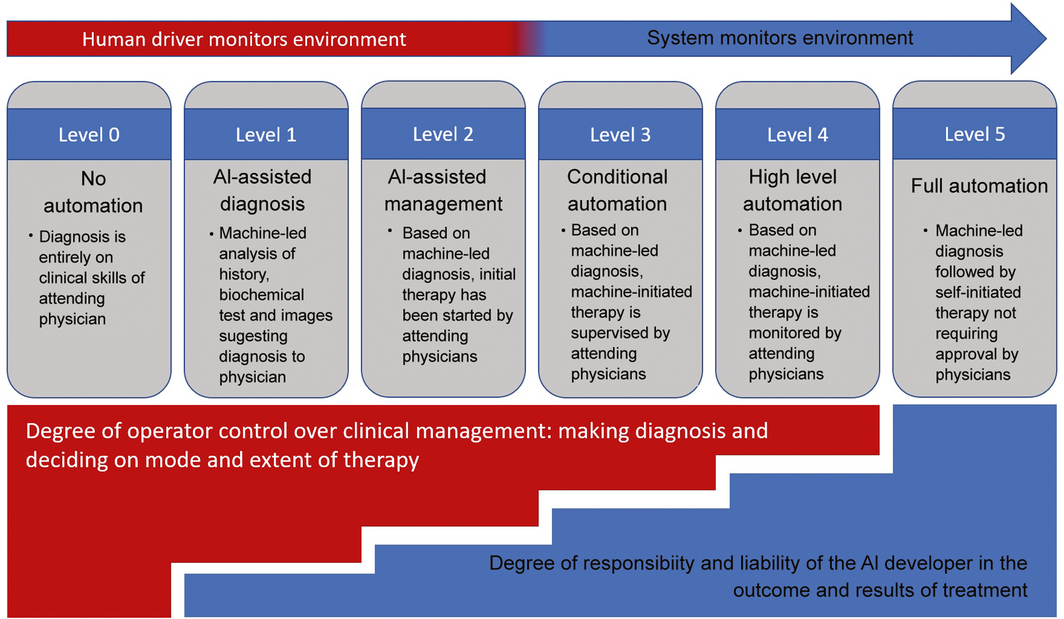
AI promises to massively reduce the occurrence of iatrogenic harms via increasing the quality of decision making, but the continued existence of AI‐related injury is easy to foresee. As machine algorithms improve themselves without human intervention, making the “black box” more opaque, regulatory agencies such as the Australian Therapeutic Goods Administration and the United States Food and Drug Administration need to refine their regulations. To the extent that AI continues to play a role in assisting clinical management, questions of responsibility for harm should be determined by ordinary rules of product liability. It is likely that courts will determine some of these liability questions by using analogies with vicarious liability — an employer is responsible for the negligence of the staff when the injury occurs in the course of the staff's employment. A doctor using AI should be responsible for AI decisions made in the course of treatment, especially if the doctor retains the power to make the final decision regarding treatment. But as AI takes on more autonomous decision making, it might be argued by some doctors that they should not be responsible for that which they cannot control. Similarly, it seems unfair for doctors to be held responsible for an AI decision when they are unable to deduce how and why that decision was made. Such matters are outside the scope of clinicians’ expertise and best dealt with legally as a product liability claim. A stepwise gradation model of shared responsibility between the human doctor and the machine in diagnosis and clinical management has been proposed15 (Box 2).
Conclusions
Before AI tools can be put into daily use in medicine, data quality and ownership, transparency in governance, trust‐building in black box medicine, and legal responsibility for mishaps are some of the hurdles that need to be resolved. Much effort is needed to translate algorithms into problem solving tools in clinical settings and demonstrate improvement in clinical outcomes with saving of resources.
Box 1 – Examples of artificial intelligence (AI) permeation into clinical practices of different specialties
|
|
Clinical management |
AI capability |
|||||||||||||
|
|
|||||||||||||||
|
Diabetic retinopathy2 |
Detection of early changes in fundi of patients with diabetes |
Reading the retina and blood vessels to identify patients at risk of developing complicated diabetic retinal disease |
|||||||||||||
|
Breast cancer3 |
Diagnosis of early breast cancer based on mammography |
Reading mammographic pictures to detect early malignant transformation in breast cancer screening |
|||||||||||||
|
Skin cancer4 |
Diagnosis of skin cancer by its clinical morphology |
Identification of skin cancer by pictures and classification of types of skin neoplasia |
|||||||||||||
|
Cerebrovascular disease5 |
Predicting outcome after a cerebrovascular accident |
Predicting the outcome (mobility, morbidity and mortality) of stroke 90 days after the event |
|||||||||||||
|
Non‐communicable chronic diseases6 |
Monitoring of diabetes and heart failure in primary care setting |
Assisting patients monitoring of blood pressure and blood glucose at home and transmitting information to family medicine clinics |
|||||||||||||
|
Heart failure7 |
Predicting the clinical outcome of patients with heart failure |
Predicting in‐hospital mortality among patients with heart disease based on echocardiography |
|||||||||||||
|
|
|||||||||||||||
|
|
|||||||||||||||
Competing interests
No relevant disclosures.
References
- Scott IA, Cook D, Coiera EW, Richards B. Machine learning in clinical practice: prospects and pitfalls. Med J Aust 2019; 211: 203–205. https://www.mja.com.au/journal/2019/211/5/machine-learning-clinical-practice-prospects-and-pitfalls
- Gulshan V, Peng L, Coram M, et al. Development and validation of a deep learning algorithm for detection of diabetic retinopathy in retinal fundus photographs. JAMA 2016; 316: 2402–2410.
- Rodríguez‐Ruiz A, Krupinski E, Mordang J, et al. Detection of breast cancer with mammography: effect of an artificial intelligence support system. Radiology 2019; 290: 305–314.
- Esteva A, Kuprel B, Novoa RA, et al. Dermatologist‐level classification of skin cancer with deep neural networks. Nature 2017; 542: 115–118.
- Zihni E, Madai VI, Livne M, et al. Opening the black box of artificial intelligence for clinical decision support: a study predicting stroke outcome. PLoS One 2020; 15: e0231166.
- Ciccone MM, Aquilino A, Cortese F, et al. Feasibility and effectiveness of a disease and care management model in the primary health care system for patients with heart failure and diabetes (Project Leonardo). Vasc Health Risk Manag 2010; 6: 297–305.
- Kwon JM, Kim KH, Jeon KH, Park J. Deep learning for predicting in‐hospital mortality among heart disease patients based on echocardiography. Echocardiography 2019; 36: 213–218.
- Byrne MF, Chapados N, Soudan F, et al. Real‐time differentiation of adenomatous and hyperplastic diminutive colorectal polyps during analysis of unaltered videos of standard colonoscopy using a deep learning model. Gut 2019; 68: 94–100.
- Ding Z, Shi H, Zhang H, et al. Gastroenterologist‐level identification of small‐bowel diseases and normal variants by capsule endoscopy using a deep‐learning model. Gastroenterology 2019; 157: 1044–1054.
- Hannun AY, Rajpurkar P, Haghpanahi M, et al. Cardiologist‐level arrhythmia detection and classification in ambulatory electrocardiograms using a deep neural network. Nat Med 2019; 25: 65–69.
- Attia ZI, Noseworthy PA, Lopez‐Jimenez F, et al. An artificial intelligence‐enabled ECG algorithm for the identification of patients with atrial fibrillation during sinus rhythm: a retrospective analysis of outcome prediction. Lancet 2019; 394: 861–867.
- Attia ZI, Kapa S, Lopez‐Jimenez F, et al. Screening for cardiac contractile dysfunction using an artificial intelligence‐enabled electrocardiogram. Nat Med 2019; 25: 70–74.
- Shung D, Au B, Taylor R, et al. Validation of a machine learning model that outperforms clinical risk scoring systems for upper gastrointestinal bleeding. Gastroenteroly 2020; 158: 160–167.
- Ballantyne A, Stewart C. Big data and public‐private partnerships in healthcare and research: the application of an ethics framework for big data in health and research. Asian Bioeth Rev 2019; 11: 315–326.
- Poon NC, Sung JJ. Self‐driving cars and AI‐assisted endoscopy: Who should take the responsibility when things go wrong? J Gastroenterol Hepatol 2019; 34: 625–626.
Linked content
-
MJA Perspective: Use of artificial intelligence in skin cancer diagnosis and management
-
InSight+: AI in health care: Australia in danger of lagging behind
Provenance: Commissioned; externally peer reviewed.
Using generative artificial intelligence in clinical practice: a narrative review and proposed agenda for implementation
Ian A Scott, Sandeep Reddy, Tanya Kelly, Tim Miller, Anton Vegt
The CURE Asthma roadmap
Gary P Anderson, Anthony Flynn, Phil G Bardin, John D Blakey, Shyamali C Dharmage, Paul Foster, Peter G Gibson, Adam Jaffe, Alan James, Christine R Jenkins, Sundram Sivamalai, Peter D Sly, Guy B Marks, Vanessa M McDonald, Judy Wetttenhall
CURE Asthma: a unique opportunity for Australia
Anthony Flynn, Wendy Edmondson, Alan James, Caroline Lodge, Vanessa M McDonald, Christine R Jenkins, John Blakey, Gary P Anderson
Evidence from Australian cohort studies about asthma trajectories and transitions across the life course: a narrative review
Caroline Lodge, Xin Dai, Ingrid A. Laing, Michael P Menden, Anthony Flynn, Gary P Anderson, Sarath Ranganathan, Shyamali C Dharmage
Technological advances in the search for a CURE for asthma
Sara Quon, Timothy M Johanson, Ridhima Wadhwa, Alen Faiz, Anthony Flynn, Gary P Anderson, Amanda J Cox, Nicholas P West, Michael P Menden, Rhys S Allan
Protecting public interest journalism as a public health good
Bronwyn Fredericks, Neha Lalchandani, Melissa A Sweet, Alex Cramb, Carmel Williams