




Volume 213 - Issue 6
Impact of bushfire smoke on respiratory health
Authors: Vivek Dharwal, Keshav R Paudel and Philip M Hansbro
Med J Aust 2020; 213 (6): 284-284.e1. || doi: 10.5694/mja2.50754
Published online: 21 September 2020
Published online: 21 September 2020
To the Editor: The incidence of bushfires, forest fires and wildfires, is increasing globally. Epidemiology shows that individuals with chronic respiratory diseases are most affected with increased hospitalisations. However, the impacts or safe exposure levels of bushfire smoke are not well known.1 We were recently awarded the Medical Research Future Fund's Bushfire Impact Research grant 2020 and in this project we will address the following questions:
- How does bushfire smoke exposure affect respiratory health?
- How does it exacerbate chronic respiratory diseases and affect different age groups?
- What are the impacts on cells, tissues and molecular pathways?
- How can we target the effects therapeutically?
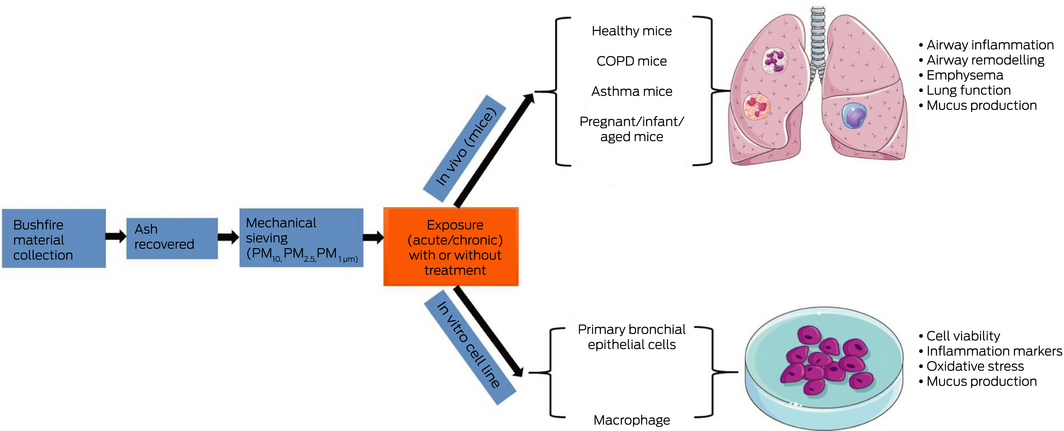
Bushfire smoke is a complex mix of inspirable particles, volatile organics, aldehydes, carbon monoxide, and particulate matter (PM).2 Although extensive research evaluating the effects of bushfire smoke has not been carried out, studies utilising cigarette smoke or vehicular PM10−2.5 show that exposure to these insults induces lung inflammation and oxidative stress, and promotes the progression of chronic respiratory diseases.3,4,5 Further, in vitro studies with healthy human fibroblasts and bronchoepithelial cells show that bushfire smoke affects pathways including oxidative stress, barrier function, innate defence, and autophagy.6 Accordingly, we plan to expose mice to the different PM particles from bushfire smoke and will elucidate the acute and prolonged effects on lung inflammation, airway remodelling and lung function. In addition, by using our mouse model of chronic respiratory diseases (chronic obstructive pulmonary disease, asthma) and mice at different ages (pregnant, infant, aged), we will assess the impact of bushfire smoke on predisposition, pathogenesis and progression of chronic respiratory diseases. We will use advanced molecular and multi‐omics (single cell/tissue sequencing, proteomics, epigenetics) technology to elucidate cell and tissue responses. Furthermore, we will define therapeutic avenues for prevention and treatment (antioxidants, metabolic modulators) (Box).
The outcomes of this project will inform the development of safe exposure guidelines and define preventive/treatment measures. Moreover, we will address evidence gaps related to harmful health effects of hazardous bushfire smoke exposure which we hope will aid government and health agencies to design appropriate policies, prevention measures, and treatment strategies to deal with future bushfire smoke events.
Competing interests
No relevant disclosures.
References
- Morgan G, Sheppeard V, Khalaj B, et al. Effects of bushfire smoke on daily mortality and hospital admissions in Sydney. Australia. Epidemiology 2010; 21: 47–55.
- De Vos AJBM, Reisen F, Cook A, et al. Respiratory irritants in Australian bushfire smoke: air toxics sampling in a smoke chamber and during prescribed burns. Arch Environ Contam Toxicol 2009; 56: 380–388.
- Jones B, Donovan C, Liu G, et al. Animal models of COPD: What do they tell us? Respirology 2017; 22: 21–32.
- Hirota JA, Gold MJ, Hiebert PR, et al. The nucleotide‐binding domain, leucine‐rich repeat protein 3 inflammasome/IL-1 receptor I axis mediates innate, but not adaptive, immune responses after exposure to particulate matter under 10 mum. Am J Respir Cell Mol Biol 2015; 52: 96–105.
- Yue W, Tong L, Liu X, et al. Short term Pm2.5 exposure caused a robust lung inflammation, vascular remodeling, and exacerbated transition from left ventricular failure to right ventricular hypertrophy. Redox Biol 2019; 22: 1–7.
- Capistrano SJ, Zakarya R, Chen H, Oliver BG. Biomass smoke exposure enhances rhinovirus‐induced inflammation in primary lung fibroblasts. Int J Mol Sci 2016; 17: 1403.
Designing Housing to Reduce Overcrowding-Related Harms: Rheumatic Heart Disease as the Canary in the Coal Mine
Simon Quilty, Veronica Matthews, Angus Baumann, James Marangou, Bo Remenyi, Gavin Wheaton, Serena Morton Nabanunga, Norman Frank Jupurrurla, Simon Robinson, Steve Mintern, Cary Duffield, Joshua R. Francis, Paul C. Memmott
Australian Climate Leadership in 2026: COP-Out or Step-Up for Health?
Catherine G. A. Pendrey, Angie Bone, Aletha Ward, Francis Nona, Michelle Isles, Paul M. Kelly, Nicholas J. Talley
The impact of the Breast Screen NSW transition from film to digital mammography, 2002–2016: a linked population health data analysis
Rachel Farber, Nehmat Houssami, Katy J L Bell
Shifting focus to adolescent wellbeing and inclusive participation in the digital age
Allyson R Todd, Elena Wang, Stephanie R Partridge
The CURE Asthma roadmap
Gary P Anderson, Anthony Flynn, Phil G Bardin, John D Blakey, Shyamali C Dharmage, Paul Foster, Peter G Gibson, Adam Jaffe, Alan James, Christine R Jenkins, Sundram Sivamalai, Peter D Sly, Guy B Marks, Vanessa M McDonald, Judy Wetttenhall
Protecting public interest journalism as a public health good
Bronwyn Fredericks, Neha Lalchandani, Melissa A Sweet, Alex Cramb, Carmel Williams