




Volume 213 - Issue 2
Demonstrating the mechanism of electrical alternans in cardiac tamponade: “the swinging heart”
Authors: Jeet Ram Kashyap and Suraj Kumar
Med J Aust 2020; 213 (2): 66-66. || doi: 10.5694/mja2.50687
Published online: 20 July 2020
Published online: 20 July 2020
A 52-year-old man presented with fever and progressive dyspnoea
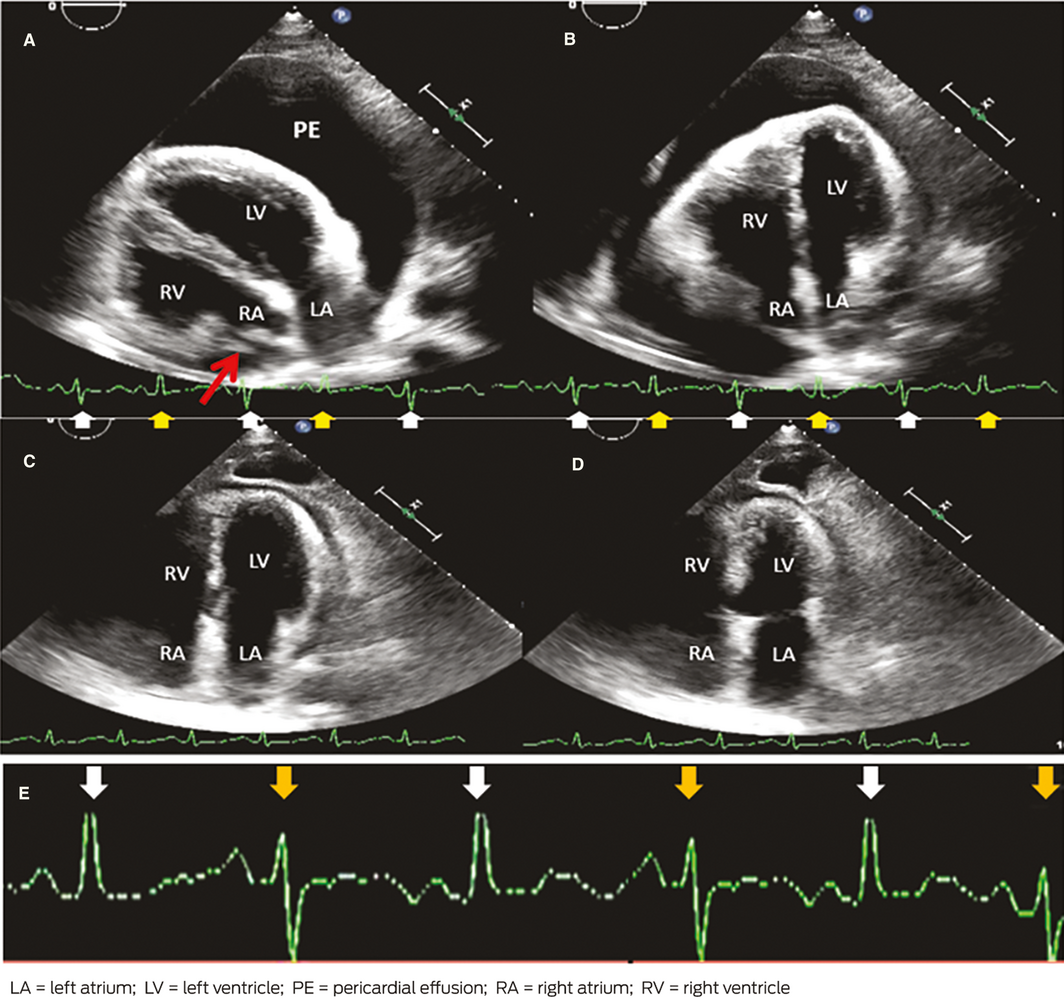
A 52‐year‐old man presented with fever and progressive dyspnoea. He had a respiratory rate of 36 breaths per minute, pulse rate 126 beats per minute, blood pressure 96/56 mmHg, raised jugular venous pressure with prominent x‐descent, significant pulsus paradoxus and distant heart sounds. Echocardiography revealed a large pericardial effusion with tamponade (Figure, A, red arrow), a “swinging heart” (Figure, A and B, and Supporting Information), and electrical alternans (Figure, E, alternate white and yellow arrows). Electrical alternans is characterised by alternating QRS amplitude on surface electrocardiogram. It typically occurs in cardiac tamponade due to the swinging motion of the heart. However, it may be seen in Wolff–Parkinson–White syndrome, ventricular tachycardia, accelerated idioventricular rhythm, and supraventricular tachycardia. Immediate pericardiocentesis of haemorrhagic fluid relieved his tamponade (Figure, C and D). The analysis of the fluid suggested possible tubercular aetiology, hence he was given antitubercular treatment.
Competing interests
No relevant disclosures.
Fatty Liver Disease in Australia: A Narrative Review on the Epidemiology, Natural History, Prognostication and Management in People With Metabolic Dysfunction
Karl Vaz, Daniel Clayton-Chubb, William W. Kemp, Stuart K. Roberts, Ammar Majeed
Sex Differences in Management and Outcomes of People With ST-Elevation Myocardial Infarction, New South Wales, 2011–2020: A Retrospective Cohort Study
Adam C. Livori, Jedidiah I. Morton, Dianna J. Magliano, Jonathan E. Shaw
Rethinking Rheumatic Fever Diagnosis: Progress, Pitfalls and the Path Towards a Definitive Test
Anna P. Ralph, Rachel Webb, Tom Parks, Nicole J. Moreland, Asha C. Bowen, Benjamin Jones, Emma Ndagire, Andrea Z. Beaton
Sex Differences in Management and Outcomes of People With ST-Elevation Myocardial Infarction, New South Wales, 2011–2020: A Retrospective Cohort Study
Samia Kazi, Simone Marschner, Clara K. Chow
Distribution of Cardiovascular Disease Risk Based on the Updated 2023 Guideline-Recommended Australian Cardiovascular Disease Risk Algorithm and Comparison With the 2012 Algorithm: An Observational Study
Nina Lazarevic, Meghana Bhat, Grace Joshy, Danielle C. Butler, Mark Woodward, Anushka Patel, Rod T. Jackson, Garry Jennings, Rosemary Wyber, Ellie Paige, Emily Banks
They Brought the Hospital to Me
Hugh N. Burrill