




Volume 210 - Issue 11
Early success with room for improvement: influenza vaccination of young Australian children
Authors: Frank H Beard, Alexandra J Hendry and Kristine Macartney
Med J Aust 2019; 210 (11): 484-486.e1. || doi: 10.5694/mja2.50141
Published online: 29 April 2019
Published online: 29 April 2019
Correction(s) for this article:
Erratum | Published online: 3 February 2020
As the influenza vaccine is given annually within a relatively short time frame, there are unique challenges to achieving coverage similar to other childhood vaccines
Immunisation providers should offer annual influenza vaccination for children aged 6 months to 5 years and report it to the Australian Immunisation Register
Influenza is an acute viral respiratory infection that causes a substantial number of hospitalisations and deaths each year in Australia.1 While influenza‐related mortality is highest in older adults, each year, a small number of deaths occur in young children, including in otherwise healthy children.1,2,3 Hospitalisation rates for influenza are highest in young children, with annual rates about 200 per 100 000 in children aged 0–5 months, and 100 per 100 000 in those aged 6–23 months.1 The hospitalisation rate in children aged 2–4 years, at 40 per 100 000, is similar to that in adults aged 65 years or over.1 These figures likely underestimate the true burden of disease due to underascertainment, particularly of influenza‐related complications, including secondary bacterial infection and exacerbation of existing medical conditions such as chronic lung disease.4 The Australian immunisation handbook strongly recommends that children aged 6 months to less than 5 years should receive annual influenza vaccination, with two doses in the first year of vaccination.5 However, the influenza vaccine is only funded under the National Immunisation Program (NIP) for children in this age group who are Aboriginal or Torres Strait Islander or who have medical conditions that increase the risk for severe influenza.6 All influenza vaccines registered in Australia are inactivated vaccines.5
Western Australia has funded influenza vaccination for all children aged 6 months to less than 5 years since 2008.6 Following the record high influenza season in Australia in 2017,7 the Australian Capital Territory, New South Wales, South Australia, Queensland, Victoria and Tasmania also funded influenza vaccination programs for this age group in 2018, providing near universal free vaccine.6
In 2017, the coverage of at least one dose of influenza vaccine for children aged 6 months to less than 5 years recorded in the Australian Immunisation Register (AIR) was 5.0% for non‐Indigenous children nationally, and was highest in WA at only 11.8%. For Indigenous children, the national coverage was 14.9% and was low in all jurisdictions except the Northern Territory at 60.1%.8 To assess the impact of the new state and territory programs on influenza vaccination coverage, we obtained approval from the Australian Government Department of Health and state and territory government health department representatives and analysed de‐identified AIR data as at 30 September 2018. Influenza vaccine coverage estimates for children aged 6 months to less than 5 years were calculated using the number of children with at least one dose of influenza vaccine recorded on the AIR between 1 April and 30 September 2018 as numerator, and the number of AIR‐registered children in this age group as denominator.
National influenza vaccine coverage for young children increased in 2018, reaching 25.6% overall and 29.5% in Indigenous children (Box), which represents a fivefold increase for non‐Indigenous children and a twofold increase for Indigenous children compared with 2017.8 Uptake was greatest from late April to late May and then levelled off substantially. The greater vaccination activity in infants aged 6 months to under one year in subsequent months, compared with other age groups, may reflect the vaccination of newly eligible children; that is, children turning 6 months old. The highest coverage was in the 6 months to under one year age group (37% overall, 39% in Indigenous children) and one to under 2 years (30% overall, 34% in Indigenous children). Coverage also varied between jurisdictions, with the ACT having the highest overall coverage (43%) and the NT having the highest coverage in Indigenous children (61%) (Box, inserts). Coverage in non‐Indigenous children in the NT — the only jurisdiction where influenza vaccination was not funded for all children in 2018 — increased from 4.3% in 20178 to 7.2% in 2018 (data from the analyses for this article, not shown), a less than twofold increase compared with the fivefold increase seen elsewhere. Among children aged 6 months to less than 5 years who were recorded as having received at least one dose of influenza vaccine in 2018, over 80% (68% for Indigenous children) were recorded for the first time as recipients, of whom 64% (49% for Indigenous children) were recorded as having received the recommended second dose.
In summary, widespread state‐ and territory‐funded universal influenza vaccination programs for children aged 6 months to less than 5 years in 2018 resulted in a substantial increase in vaccine coverage in both non‐Indigenous and Indigenous children, with Indigenous children coverage increasing in all jurisdictions except the NT, where it was already relatively high. Universal vaccination programs are known to achieve higher coverage than targeted programs.8 However, the increase in coverage may also be partly due to heightened awareness of influenza after the severe 2017 season. It will be of interest to see whether increases are sustained in 2019 given the milder 2018 season. Influenza vaccine coverage in 2018 was still considerably lower than that for routine NIP‐funded vaccines.8 As the influenza vaccine is given annually within a relatively short time frame, there are unique challenges to achieving similar coverage to other childhood vaccines. However, higher uptake than that documented here is certainly achievable. In the United States, where influenza vaccination has been recommended and funded for children aged 6 months to under 5 years since 2006, coverage of at least one dose of influenza vaccine was over 67% from 2011 to 2017 (annual range, 67.6–70.4%).9 In the United Kingdom, where a program for children aged 2 years and above has been in place since 2013, coverage in children aged 2 to under 4 years in the 2014–2015 season was 57.0% for children with high risk medical conditions and 41.8% for other children,10 and 62.6% for 4‐year‐olds in the 2017–2018 season.11 Coverage for at least one dose of influenza vaccine in the WA‐funded program for children aged 6 months to less than 5 years also reached about 60% in 2008 and 2009, before falling sharply after the temporary suspension of influenza vaccination for young children nationwide in 2010 due to an increase in febrile reactions subsequently linked to a single (now withdrawn) vaccine brand.12,13
The influenza vaccine coverage estimates presented here may underestimate true coverage to some degree due to under‐reporting to the AIR. However, high demand for vaccines and measures to promote reporting to the AIR may have improved reporting relative to previous seasons. Unlike most other childhood vaccines, immunisation providers do not receive payments for influenza vaccination notifications to the AIR. Practice management software compatibility and data transfer issues also contribute to under‐reporting of vaccines to the AIR,14 and may be particularly important in relation to the influenza vaccine. In addition, despite recommendations to enter all vaccines administered onto the AIR, anecdotal evidence suggests that some providers may omit to do so specifically for the influenza vaccine. This is a missed opportunity to record a preventive health measure that is important at both individual care and population health levels.
The knowledge and attitudes of both parents and immunisation providers in Australia to influenza and the influenza vaccine have been identified as barriers to achieving better vaccine uptake in young children.15,16 These barriers include insufficient awareness of potential severity of disease, uncertainty regarding the safety and effectiveness of the influenza vaccine, and concerns about increased numbers of childhood vaccines, as well as practical barriers to accessing immunisation services.15,16 Negative publicity about the influenza vaccine, particularly related to the 2010 temporary suspension of the program, has also been identified as an issue.13,15 The impact of this suspension was particularly prominent in WA due to the high coverage achieved under the WA‐funded program at that time.13 This likely remains a key contributor to WA having the lowest coverage (19%) of any jurisdiction in 2018. Appropriate communication strategies targeting both the public and providers are needed to address these concerns.
Extensive ongoing surveillance data have demonstrated that the influenza vaccines used in Australia have an excellent safety profile.17,18,19 These include data from the Therapeutic Goods Administration Adverse Events Monitoring System and AusVaxSafety, a program that sends SMS‐based surveys 3 days after vaccination to individuals or their caregivers across Australia to track any vaccine reactions, and posts safety surveillance results online each week (www.AusVaxSafety.org.au).17,18,19 In 2017, 73 892 responses to AusVaxSafety surveys after influenza vaccination were received, including 6180 relating to children aged 6 months to less than 5 years.19 While there are limited data on efficacy of inactivated influenza vaccines in young children from randomised controlled clinical trials,20 numerous observational studies suggest that children aged less than 5 years gain similar levels of protection as older children and adults.21 However, protection varies considerably between seasons, with all‐age vaccine effectiveness estimates in Australia ranging from 35% to 68% for general practice presentation with influenza (2012–2018), and from 13% to 58% for hospitalisation due to influenza (2013–2018).7 While the effectiveness of the influenza vaccine is moderate compared with many other vaccines, influenza vaccination remains the best available preventive measure to reduce morbidity and mortality in this vulnerable group. Vaccinating young children has also been shown to indirectly protect household members and may also protect the wider community.22
Therefore, in line with current recommendations,5 we encourage all Australian immunisation providers to incorporate the following into their practice:
- offer ready access to annual influenza vaccination for all children aged 6 months to less than 5 years, ensuring that a second dose is received in the first year of vaccination;
- provide evidence‐based information on the benefits of influenza vaccination, addressing any potential misconceptions; and
- ensure that all vaccinations given, including all influenza vaccines, are reported to the AIR.
Now that Australia has joined other high income nations in offering funded influenza vaccination to young children (noting that the NT will fund the vaccine for all children aged 6 months to less than 5 years in 2019),23 it is important to ensure continuing efforts to provide comprehensive information on the benefits and safety of vaccination, and improve uptake to achieve maximal impact for both children and their families.
A nationally consistent approach could potentially reduce confusion among providers and parents around the importance of influenza vaccination for children. If the influenza vaccine could be included on the NIP for all young children, this may also contribute to facilitating higher uptake. Inclusion on the NIP requires an application to, and positive recommendation from, the Pharmaceutical Benefits Advisory Committee (PBAC), which has not yet occurred. Assessment by the PBAC includes a particular focus on cost‐effectiveness24 and is informed by robust data on disease burden and program costs and benefits, both direct to individuals and to the broader community via herd protection. Of note, the Australian Technical Advisory Group on Immunisation, which provides technical advice to the PBAC, recently recommended the mathematical modelling of influenza disease burden and assessment of the potential impact of a range of influenza immunisation strategies.25 This modelling is currently underway26 and should provide important data to assist in the further evaluation of influenza vaccination for children in the near future.
Box – Australian cumulative coverage estimates* of at least one dose of influenza vaccine from the Australian Immunisation Register in 2018 (1 January to 30 September) for children aged 6 months to less than 5 years, by age group, for all children (A) and Indigenous children (B) and by jurisdiction (inserts), assessed at 30 September 2018
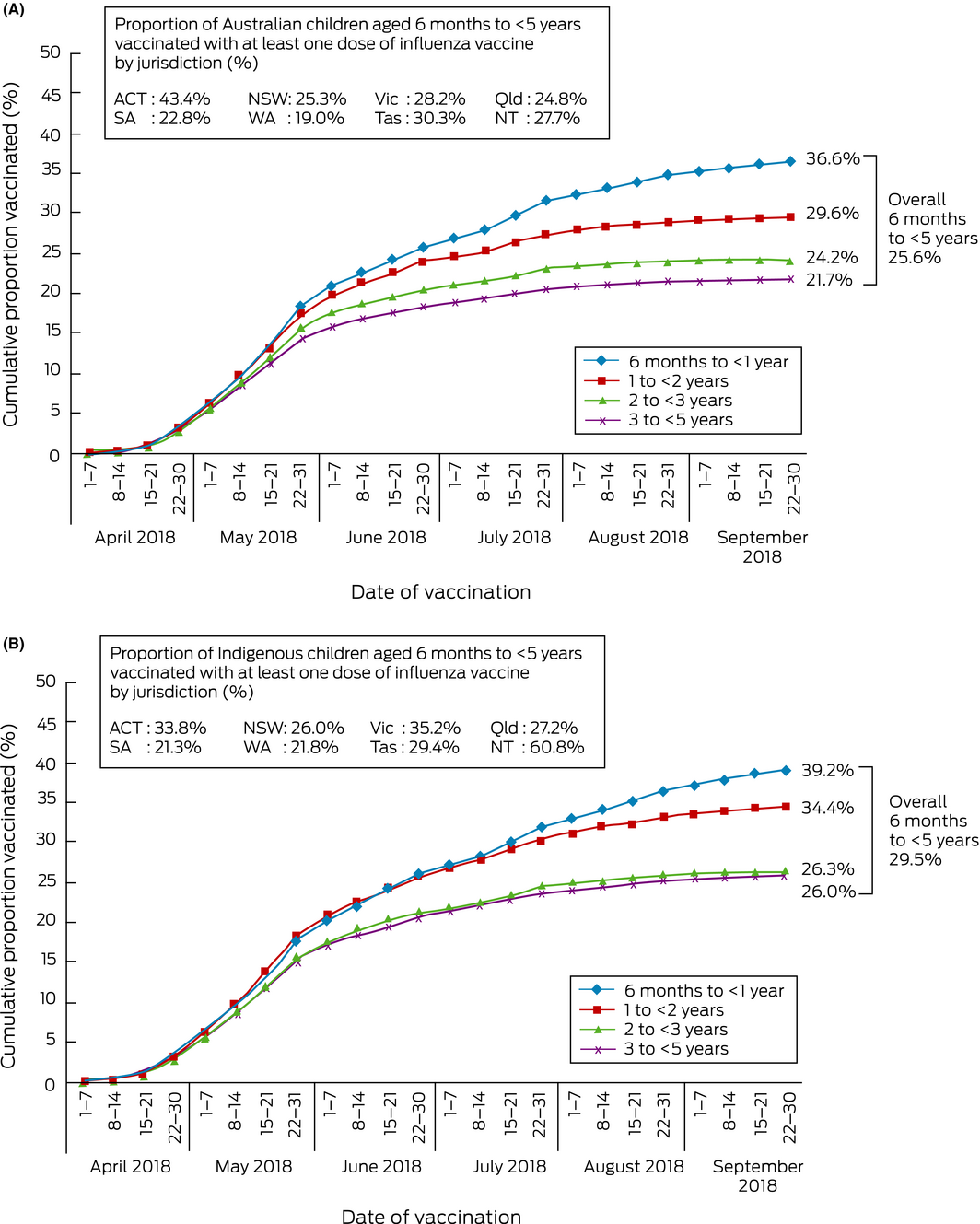
ACT = Australian Capital Territory. NSW = New South Wales. NT = Northern Territory. Qld = Queensland. SA = South Australia. Tas = Tasmania. Vic = Victoria. WA = Western Australia. * Due to differences in the derivation of numerators and denominators, these estimates may vary from those published by state and territory health departments. ◆
Competing interests
No relevant disclosures.
References
- Li‐Kim‐Moy J, Yin JK, Patel C, et al. Australian vaccine preventable disease epidemiological review series: influenza 2006 to 2015. Commun Dis Intell Q Rep 2016; 40: E482–E495.
- Blyth CC, Macartney KK, McRae J, et al. Influenza epidemiology, vaccine coverage and vaccine effectiveness in children admitted to sentinel Australian hospitals in 2017: results from the PAEDS‐FluCAN Collaboration. Clin Infect Dis 2019; 68: 940–948.
- Phillips A, Beard F, Macartney K, et al. Vaccine‐preventable child deaths in New South Wales from 2005 to 2014: how much is preventable? J Paediatr Child Health 2018; 54: 356–364.
- Beard F, McIntyre P, Gidding H, Watson M. Influenza related hospitalisations in Sydney, New South Wales, Australia. Arch Dis Child 2006; 91: 20–25.
- Australian Technical Advisory Group on Immunisation (ATAGI). Australian immunisation handbook. Canberra: Australian Government Department of Health, 2018. https://immunisationhandbook.health.gov.au (viewed Nov 2018).
- National Centre for Immunisation Research and Surveillance. Significant events in influenza vaccination practice in Australia. 2018. http://www.ncirs.org.au/sites/default/files/2018-11/Influenza-history-July-2018.pdf (viewed Nov 2018).
- Australian Government Department of Health. 2018 Influenza season in Australia: a summary from the National Influenza Surveillance Committee. 2017. http://www.health.gov.au/internet/main/publishing.nsf/Content/cda-surveil-ozflu-flucurr.htm/$File/2018-Season-Summary.pdf (viewed Nov 2018).
- Hull B, Hendry A, Dey A, et al. Annual immunisation coverage report 2017. Sydney: National Centre for Immunisation Research and Surveillance, 2018. http://www.ncirs.org.au/sites/default/files/2018-12/2017%20Coverage%20Report_FINAL_2.pdf (viewed Jan 2019).
- Centers for Disease Control and Prevention. Estimates of flu vaccination coverage among children — United States, 2017–18 flu season. CDC, 2018. https://www.cdc.gov/flu/fluvaxview/coverage-1718estimates-children.htm (viewed Jan 2019).
- Rajaram S, Steffey A, Blak B, et al. Uptake of childhood influenza vaccine from 2012–2013 to 2014–2015 in the UK and the implications for high‐risk children: a retrospective observational cohort study. BMJ Open 2016; 6: e010625.
- Public Health England. Seasonal influenza vaccine uptake in children of primary school age: winter season 2017 to 2018. Crown, 2018. https://assets.publishing.service.gov.uk/government/uploads/system/uploads/attachment_data/file/710482/Seasonal_influenza_vaccine_uptake_in_children_of_primary_school_age_winter_season_2017_to_2018.pdf (viewed Jan 2019).
- Armstrong PK, Dowse GK, Effler PV, et al. Epidemiological study of severe febrile reactions in young children in Western Australia caused by a 2010 trivalent inactivated influenza vaccine. BMJ Open 2011; 1: 2010–000016.
- Blyth CC, Richmond PC, Jacoby P, et al. The impact of pandemic A(H1N1)pdm09 influenza and vaccine‐associated adverse events on parental attitudes and influenza vaccine uptake in young children. Vaccine 2014; 32: 4075–4081.
- Dalton L, Meder K, Beard F, et al. Australian Immunisation Register data transfer study — stage 2 final report. Sydney: National Centre for Immunisation Research and Surveillance, 2018. http://www.ncirs.org.au/sites/default/files/2018-12/2018%20AIR%20data%20tranfer%20report_FINAL_0.pdf (viewed Jan 2019).
- Biezen R, Grando D, Mazza D, Brijnath B. Why do we not want to recommend influenza vaccination to young children? A qualitative study of Australian parents and primary care providers. Vaccine 2018; 36: 859–865.
- Royal Children's Hospital Melbourne. RCH National Child Health Poll – flu vaccine: parents’ plans for the 2018 season. Melbourne: RCH, 2018. https://www.rchpoll.org.au/wp-content/uploads/2018/05/20180517_Flu-vaccine-Parents-plans-for-the-2018-season_Report.pdf (viewed Jan 2019).
- Pillsbury A, Cashman P, Leeb A, et al. Real‐time safety surveillance of seasonal influenza vaccines in children, Australia, 2015. Euro Surveill 2015; 20: 1560–7917.
- Pillsbury A, Quinn H, Cashman P, et al. Active SMS‐based influenza vaccine safety surveillance in Australian children. Vaccine 2017; 35: 7101–7106.
- Pillsbury AJ, Glover C, Jacoby P, et al. Active surveillance of 2017 seasonal influenza vaccine safety: an observational cohort study of individuals aged 6 months and older in Australia. BMJ Open 2018; 8: e023263.
- Jefferson T, Rivetti A, Di Pietrantonj C, Demicheli V. Vaccines for preventing influenza in healthy children. Cochrane Database Syst Rev 2018; (2): CD004879.
- Sullivan SG, Price OH, Regan AK. Burden, effectiveness and safety of influenza vaccines in elderly, paediatric and pregnant populations. Ther Adv Vaccines Immunother 2019; 7: 2515135519826481.
- Yin JK, Heywood AE, Georgousakis M, et al. Systematic review and meta‐analysis of indirect protection afforded by vaccinating children against seasonal influenza: implications for policy. Clin Infect Dis 2017; 65: 719–728.
- Northern Territory Government. Flu vaccination. Northern Territory Government of Australia, 2019. https://nt.gov.au/wellbeing/healthy-living/immunisation/flu-vaccination (viewed Mar 2019).
- Nolan TM. The Australian model of immunization advice and vaccine funding. Vaccine 2010; 28(Suppl): A76–A83.
- Australian Technical Advisory Group on Immunisation. ATAGI bulletin. Canberra: Australian Government Department of Health, 2016. https://beta.health.gov.au/resources/publications/atagi-bulletin-for-the-59th-meeting-18-19-february-2016 (viewed Mar 2019).
- Telethon Kids Institute. Mathematical modelling to inform national seasonal influenza vaccination policy. Perth: Telethon Kids Institute, 2019. https://www.telethonkids.org.au/our-research/early-environment/infection-and-vaccines/infectious-diseases-epidemiology/mathematical-modelling-to-inform-national-seasonal (viewed Mar 2019).
Linked content
-
MJA Podcast: Dr Frank Beard
-
InSight+: Flu season: data mount but path remains a mystery
Provenance: Not commissioned; externally peer reviewed.
Costs of Delivering the Hep B PAST Model of Care in Remote Australia: A Retrospective Pre–Post Study
Hoa Nguyen, Anh Le Tuan Nguyen, Paula Binks, Melita McKinnon, Emily Vintour-Cesar, Karen Wills, Nicola Stephens, Benjamin Cowie, Joshua S. Davis, Yuejen Zhao, Peter Nihill, Julie A. Campbell, Andrew J. Palmer, Jane Davies, Barbara de Graaff
Buruli Ulcer Acquired From Ringtail Possum Rescue
Daniel P. O'Brien, Naomi Clarke, Sara Bonnici, Mohammad A. Hussain
Q Fever Visceral Abscesses After Contact With Native Australian Marsupials
Samantha J. Laws, Enzo Binotto, James Stewart, Jennifer Ho, Trent Yarwood, Josh Hanson, Simon Smith
Hospital-Admitted Injection-Related Infections Among Incarcerated People Who Inject Drugs in Australia: A Retrospective Cohort Study
Andrew Palmer, Matthew Carter, Jeremy Yeo, Cecilia Shim, Jason Connor, Jeremy Hayllar, Gerald Holtmann, Naomi Moy, Elliott G. Playford, Naomi Runnegar, Paul J. Clark
The Live Attenuated Influenza Vaccine in Australia: An Additional Tool for Influenza Prevention
Cyra Patel, Alexis Pillsbury, Tran Nguyen, Xia Wang, Helen E. Quinn, Clayton K. Chiu, Allen C. Cheng, Katie L. Flanagan, Zhicheng Wang
Reflex Testing for Hepatitis D Infection: A Unique Opportunity to Reduce Hepatitis D-Related Chronic Liver Disease Deaths in Australia
Jessica Howell, Lauren Andersson, Miriam T. Levy, James O'Beirne, Leon Adams, Katharine Irvine, Avik Majumdar, Golo Ahlenstiel, Kathy Jackson, Krispin Hajkowicz, Joseph Doyle, Jane Davies, Sarah Cherian, Wayne Dimech, Alexander J. Thompson