




Reflection
Medical history
Volume 209 - Issue 5
Vale New Medical School (the Blackburn Building), University of Sydney
Author: Catherine E Storey
Med J Aust 2018; 209 (5): 199-201. || doi: 10.5694/mja18.00038
Published online: 27 August 2018
Published online: 27 August 2018
More than a building: a change in direction of medical education
More than a building: a change in the direction of medical education
The “New Medical School” (the Blackburn Building) of the Sydney Medical School awaits demolition. By the end of 2018, it will be gone without trace. The building already stands empty, the many colonies of researchers decanted to other sites; the students have long since departed for shiny new learning spaces befitting a 21st century medical education.
My student recollections of the building from the early 1970s are hazy. I do recall that after the pre-clinical years of the “old medical school”, the New Medical School represented a rite of passage into the world of clinical medicine and patients — at last. It was here, at the Medical Society at the end of the long basement corridor, that students purchased their new white coats, Littman stethoscopes, torches, pins — all the accoutrements for the clinical years.
I recall the Pathology Museum, with its shelves of bottles holding captive distorted bits of diseased anatomy in discoloured fluid: almost indistinguishable to me, but there was always the chance of meeting one of them in an exam.
What is surprising is that I knew nothing at the time of the extraordinary history of this building. This was more than just a structure; it was an experiment in medical education. Opened in 1933, it changed the direction of medical teaching at the University of Sydney.
The history
The building opened with great fanfare on 28 September 1933, but its history began some decades earlier. 1919 had been a challenging year for the Medical Faculty. Students and teachers were returning to their civilian lives after long years on foreign battlefields. The first year enrolment was 218; the Medical School was at capacity, and the finances of the University were severely limited.
In New York, the Rockefeller Foundation, founded in 1913, established its Division of Medical Education in 1919 in response to the 1910 Flexner report on medical education in North America, which promoted a new ideal for training doctors.1 Science was coming to the bedside, and the medical school prototype to which the Rockefeller Foundation aspired appreciated that science learned in the laboratory should inform medical teaching and medical practice. The Foundation decided that the model that would best facilitate these changes to teaching involved close physical and intellectual collaboration between university, teaching hospital, and laboratory researchers. The Rockefeller Foundation was prepared to finance this shift by assisting strategically placed medical schools in various parts of the world to increase their resources and to improve their teaching and research programs. By the early 1920s, the General Education Board of the Foundation had distributed more than $15 000 000 in grants worldwide.2
In 1926, the University of Melbourne mounted an unsuccessful appeal for funding by the Rockefeller Foundation. With their main teaching hospital centrally located, some distance from the university, and a political impasse that prevented co-location, Melbourne fell short of the aspirations of the Flexner model.3
The local champion for the Sydney bid was Claude Witherington Stump (1891–1971), an Adelaide-born Edinburgh graduate already well known to the Rockefeller Foundation; in 1923, Stump had accepted the foundation chair of anatomy at the new Rockefeller-funded Medical School in Bangkok. In 1926, he returned to Australia, to the Department of Anatomy at the University of Sydney. It was in Sydney he met local industrialist George Bosch (1861–1934), who in 1927 provided the University with £22 000 to establish a chair in histology and embryology, which Stump accepted. In 1928, Bosch offered an additional £220 000 to create the first full-time chairs in medicine, surgery, and bacteriology. Because the University required a building to accommodate these new departments, Stump opened a campaign for obtaining additional resources from the Rockefeller Foundation. During the negotiations between the University of Sydney and the Foundation, Bosch and Stump met with its directors in New York at the beginning of 1930. Within a few months, the University received the very welcome news that the Foundation would provide the sum of £100 000 for clinical laboratories and new teaching facilities. The planned co-location of the New Medical School and the Royal Prince Alfred Hospital, the eagerness of the Faculty to embrace a new research philosophy, and the excellent candidates for the new chairs all influenced the Rockefeller Foundation in making their decision.4
The University appointed three highly credentialed professors of medicine, surgery and bacteriology: Charles Lambie, Harold Dew, and Hedley Wright.5 Charles Lambie, also an Edinburgh graduate and a contemporary of Stump, had an established track record of medical research in the recently funded Rockefeller laboratories at the Royal Infirmary of Edinburgh.6 Harold Dew was a Melbourne graduate with an international reputation after publishing his landmark volume on hydatid disease.7 Hedley Wright, yet another Australian-born Edinburgh graduate, was actively involved in research at University College, London (a recent recipient of a large Rockefeller grant) when he accepted the chair of bacteriology.8 Together, these men oversaw the construction of the New Medical School and a complete review of the medical curriculum that would incorporate the ideals of the Flexner model and remain in place, with only minor revisions, until 1974.
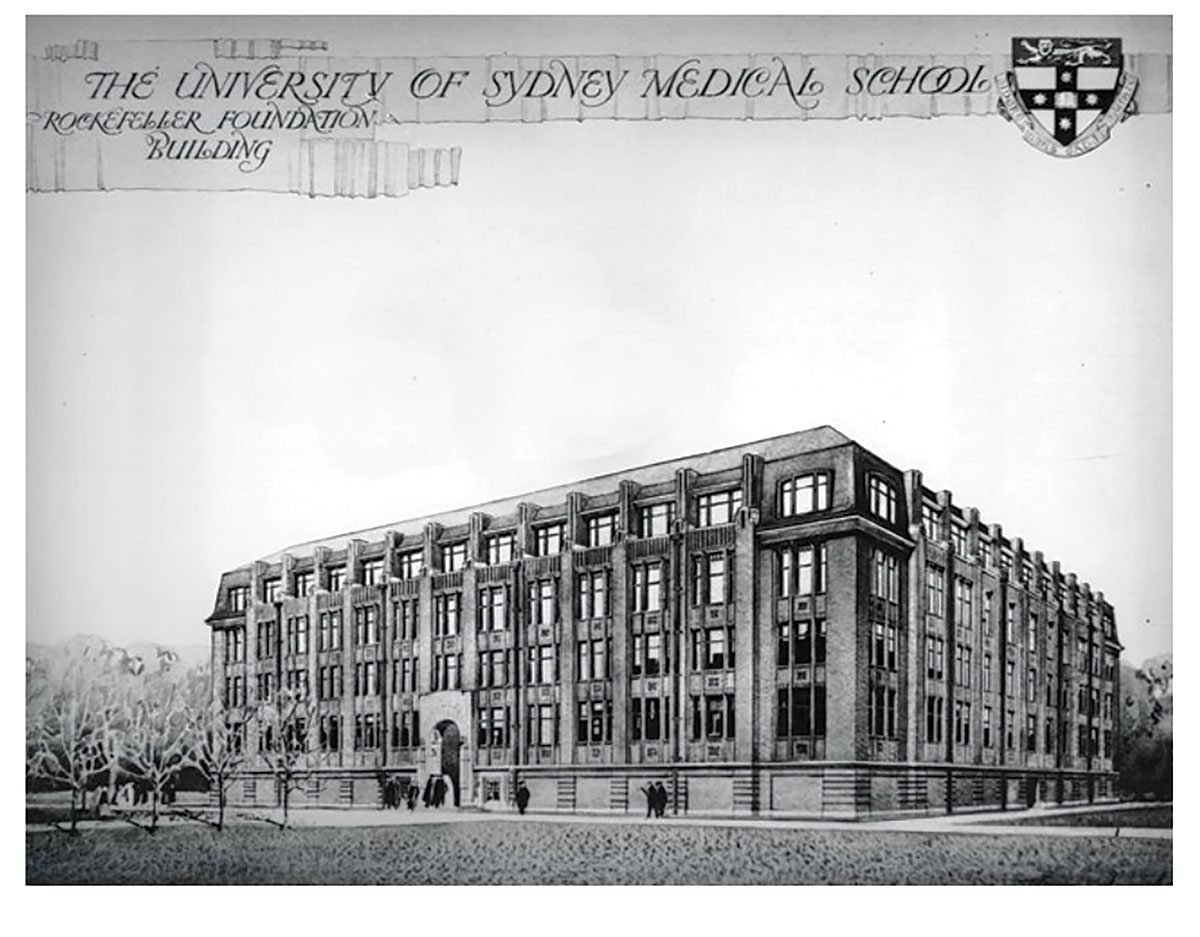
The government architect Evan Smith prepared the plans for the building, which included more than 120 laboratories, several large lecture theatres, demonstration rooms and classrooms, as well as administrative areas for the new departments. Smith planned the building with meticulous care, ensuring that it was a state-of-the-art facility with all the necessary architectural features and “ingenious equipment” for guaranteeing maximum comfort and practicability (Box 1).
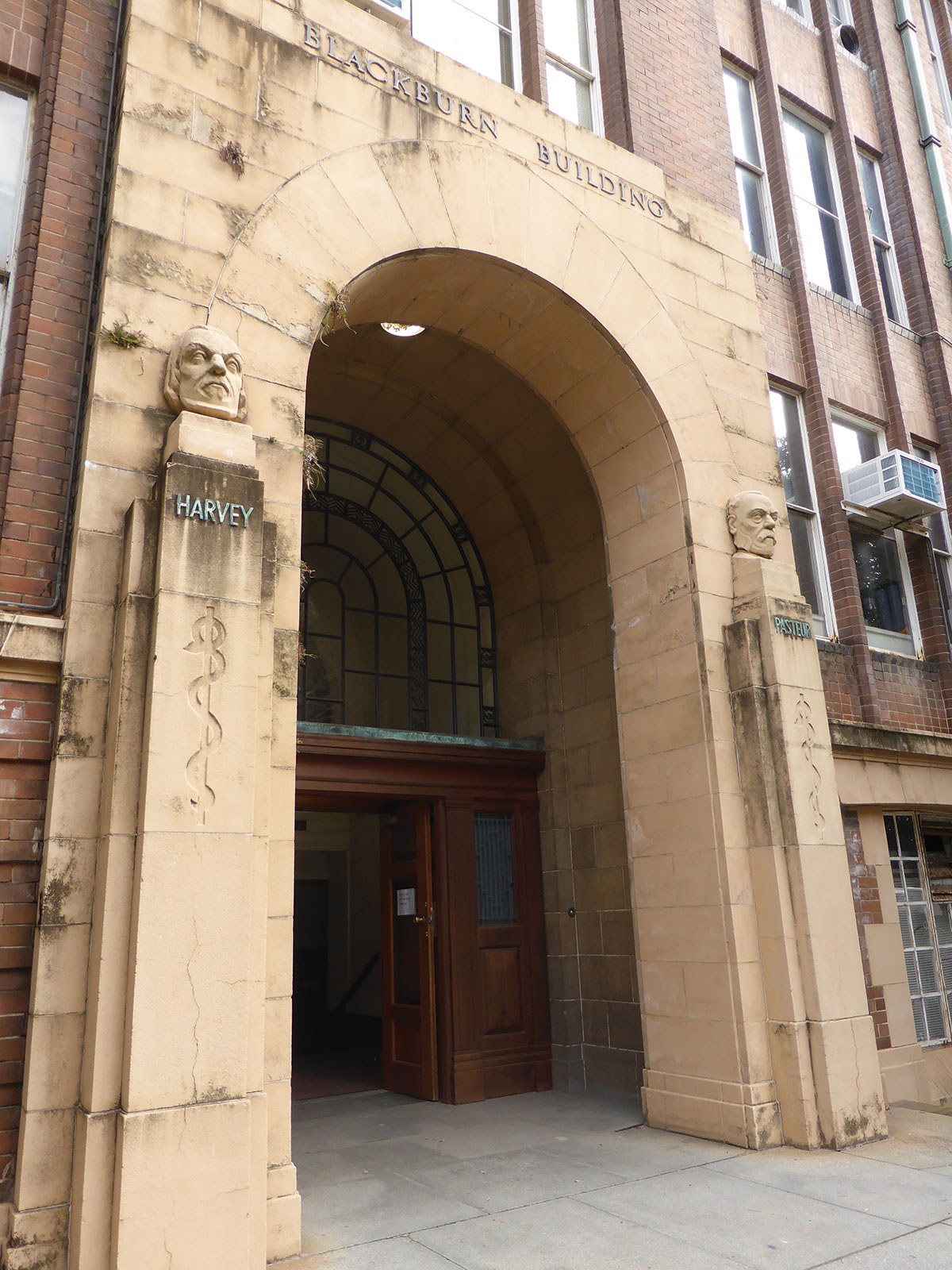
An austere portico dominated the main entrance on the western elevation (Box 2); it was designed to make a statement, although perhaps its message was lost on future generations of medical students. The carved heads of Harvey and Pasteur, sitting atop their pedestals, represented the new science and its relevance to clinical practice, so important to the design of this building. In 1960, the Senate resolved to name it in honour of Sir Charles Bickerton Blackburn, dean of the faculty during the problematic planning years of 1932–1935 and University Chancellor from 1941 until his retirement in 1964 at the age of 91. Although often referred to unofficially as the Rockefeller Building, the foundation did not sanction using its name on any buildings it supported financially.
From the outside, the building looked dark, functional, and unadorned, far removed from the Gothic style of the old medical school. Following its unveiling in 1933, the trade magazine Building lauded its construction and internal design.9 Two internal open courtyards maximised the lighting and ventilation of the laboratories, offices, library, and teaching spaces in a time before universal air conditioning. Evans inserted corridors that minimised the heat of the day in the laboratories, and all potentially disruptive student activities were restricted to the western aspect, away from the researchers and academics. The library and pathology museum filled the grand double-storey spaces in the central octagonal core. An elegant covered way known as the “Professor’s Walk”, demolished in the 1990s, linked the new medical school with the Royal Prince Alfred Hospital, providing the geographic and symbolic connection between university and teaching hospital so important to the Flexner model.
Progress
The building initially housed the departments of medicine, surgery, pathology, and bacteriology, with a small area for obstetrics. The plans included a darkroom and photographic equipment, a brand new non-transportable electrocardiograph machine, surgical dissection rooms, as well as the latest in experimental paraphernalia. A morgue, connected to the nearby viewing room in the Royal Prince Alfred Hospital chapel by a subterranean tunnel, ensured that students attended regular post mortem examinations.
Over the years, the original occupants diversified and evolved, and new specialties emerged. Within a few decades of its construction, the faculty again outgrew its facilities, and in the late 1960s the adjacent Bosch buildings provided new lecture theatres (Bosch 1A) and a teaching and research block (Bosch 1B). The library moved into the Bosch Building, and the old lecture theatres became redundant, but the vacated spaces were quickly reconfigured by ad hoc renovations to accommodate new interest groups.
The building has struggled to cope with the ever increasing demands placed upon it by a very different medical community to its original occupants of 1933. Its architect had designed these spaces for the isolated researcher, his test-tubes and fume cabinets, notebooks and journals. The model did not readily promote collegiality. The numbers of researchers have grown exponentially, and they now work in teams, connected with a complex technology infrastructure for which our original building was not designed.
The future?
The building will soon disappear, and in its place a new purpose-built facility designed for the 21st century health sciences will rise. The architects of the new building will design spaces that promote collaborative research and opportunities for interdisciplinary learning and research. From 2018, the old Faculty of Medicine will merge with other health disciplines in the new Faculty of Medicine and Health, and another phase of education will begin. Once again, a building will play an integral role in the restructuring of our medical education.
Competing interests
No relevant disclosures.
References
- Flexner A. Medical education in the United States and Canada: a report to the Carnegie Foundation for the advancement of teaching. New York: Carnegie Foundation for the Advancement of Teaching, 1910.
- Brown ER. Rockefeller medicine men: medicine and capitalism in America. Berkeley: University of California Press, 1979.
- Westmore A, Penington D. Courting the Rockefeller Foundation and other attempts to integrate clinical teaching, medical practice, and research in Melbourne. Health History 2009; 11: 62-91.
- Stump CW. The new building of the School of Medicine. Sydney University Medical Journal 1933; 27: 83-88.
- Young JA. Centenary book of the University of Sydney Faculty of Medicine. Sydney: Sydney University Press for University of Sydney Faculty of Medicine, 1984.
- Lawrence C. Rockefeller money, the laboratory, and medicine in Edinburgh 1919–1930: new science in an old country. Rochester: University of Rochester Press, 2005.
- Dew HR. Hydatid disease: its pathology, diagnosis and treatment. Sydney: Australasian Medical Publishing Company, 1928.
- Wright GP, McLeod JW, Stewart MJ. Hedley Duncan Wright. (Born 3rd March 1891. Died 9th September 1942). J Pathol 1943; 55: 113-124.
- The Rockefeller Foundation Medical School. First class planning and ingenious equipment. Building 1933; 53: 21-30.
Provenance: Not commissioned; externally peer reviewed.
Driving Implementation-Focused Change for Gender Equity in Medical Leadership: A Consensus-Based Priority-Setting Approach
Belinda Garth, Jenny Proimos, Thuy Vy Nguyen, Sally Cross, Sarah Whitelaw, Helena J. Teede
Advancing Gender Equality in Australian Healthcare Leadership: Why National Targets Matter and What It Means for Healthcare Employers
Belinda Garth, Nicole Pope, Jenny Proimos, Helena J. Teede
Centring Aboriginal and Torres Strait Islander Voices: A Framework for Culturally Safe and Racism-Free Healthcare
Elissa Elvidge, Roianne West, Karen Nicholls, Kiara Harvey, Yeena Thompson, Geraint B. Rogers, Yin Paradies
Medical Colleges Have an Obligation to Ensure Full Participation in Clinical Quality Registries
Robert J. Aitken, Julian A. Smith, Guy J. Maddern