




Volume 207 - Issue 7
Vertebroplasty for acute painful osteoporotic fracture
Authors: Paul Bird, Terrence Diamond and William A Clark
Med J Aust 2017; 207 (7): 279-281. || doi: 10.5694/mja16.01423
Published online: 2 October 2017
Published online: 2 October 2017
A recent trial provides high quality new evidence
A recent trial provides high quality new evidence
Reputation is an idle and most false imposition; oft got without merit and lost without deserving.
William Shakespeare Othello, act 2, scene 3 (Iago)
Reputation can be powerful. An individual of good reputation is trusted, respected, and sought for their opinion. Whether deserved or a “false imposition” is immaterial; it is the reputation that often guides the conclusion.
In medicine, procedures attain reputations. Some procedures acquire a positive reputation based on limited facts, so that the procedure is applied without evidence to support it.1 Alternatively, a procedure’s reputation may be tarnished before all the evidence is available, and a valuable intervention for patient wellbeing can be lost based on limited evidence.
We use scientific evidence rather than reputation alone to guide decisions about procedures. Evidence-based medicine incorporates clinical judgment with relevant scientific evidence to optimise decision making.2 It comprises judicious use of best evidence in making decisions about the care of individual patients. Integration is the key — we integrate clinical expertise with the best available external clinical evidence to make informed clinical decisions. When we see evidence that does not mirror our clinical experience we must confront it and, where necessary, provide robust evidence to support the challenge.
The fluctuating reputation of vertebroplasty provides a pertinent illustration of this concept.
Vertebroplasty first appeared in the 1980s, initially as a treatment for vertebral tumours.3 Within a decade, it was being widely implemented for osteoporotic compression fractures. Anecdotally, the procedure appeared to provide effective analgesia and rapidly gained good reputation. However, without high quality evidence to guide the appropriate placement of the intervention, there was a risk that the procedure may not be targeted appropriately in clinical practice.
Initial trials4-6 suggested a favourable effect of vertebroplasty, but the trials were small, mostly non-randomised and did not use a placebo-controlled design. Vertebroplasty nonetheless maintained a good reputation as a useful procedure to alleviate pain in osteoporotic fracture.
In 2009, two pivotal trials were published in the New England Journal of Medicine as companion articles.7,8 These were the first blinded trials, employing a placebo intervention as comparator, and showed no apparent benefit. The trials were methodologically superior to previous evidence. As a direct result of the trials and recommendations made by the researchers,9 the Medicare item number for the procedure was duly removed, and vertebroplasty was listed as a do-not-do treatment.10 The procedure lost its good reputation and was rarely offered to patients.
Further studies were undertaken as clinicians and researchers struggled to amalgamate their clinical experience with the results of the placebo-controlled trials. The Vertos II trial,11 published in 2010, provided open-label randomised trial evidence suggesting the efficacy of vertebroplasty. However, the lack of blinding as part of the protocol raised concerns about the robustness of the results.
The reputation of vertebroplasty as ineffective became the norm, although this did not seem to fit with the clinical scenarios playing out in clinician’s rooms and hospitals in south-eastern Sydney.6
Our clinical practice had been to offer vertebroplasty to patients with vertebral fractures of less than 6 weeks’ duration who had severe pain. Many of these patients had already been hospitalised with uncontrolled pain and disability, yet such inpatients were excluded from the 2009 trials. Our patient group seemed to benefit from the procedure, often dramatically. How could this marry with the highest level of evidence demonstrating no benefit of vertebroplasty when compared with placebo?
To investigate this apparent disparity, we began by reviewing the published evidence. As well as reviewing articles published before 2009, we meticulously examined the two placebo-controlled trials7,8 with reference to our own clinical experience.
Three important elements emerged. First, the trials enrolled patients with back pain of up to 12 months’ duration, with a median duration of 9–18 weeks. Only a small proportion of subjects had back pain for less than 6 weeks. Second, the mean volume of cement used in the trial was low — less than the minimum volume required to improve vertebral biomechanics in the thoracolumbar junction, the most common site of vertebral fractures.12 Third, there were no inpatients included in the trials — inpatients were specifically excluded in one trial7 and not reported in the other.8 Although the trials were rigorously conducted, they did not reflect the patient group that we were treating, nor the technical approach that we were using. The results were not generalisable, and these concerns were mirrored in editorials in major journals from other groups around the world.13,14
We hypothesised that vertebroplasty would be effective for patients with osteoporotic fractures of less than 6 weeks’ duration, who had severe, uncontrolled pain. To test our hypothesis, we replicated the methodology of the 2009 trials but with more specific patient selection and using higher viscosity polymethylmethacrylate in larger volumes.
The safety and efficacy of vertebroplasty for acute painful osteoporotic fractures (VAPOUR) trial15 set out with these specific primary objectives. The study design was agreed on by clinicians (aged care, rheumatology and endocrinology) involved in the care of patients with vertebral fractures, and interventional radiologists who performed the procedure routinely. Clinical epidemiologists and statisticians assisted in the process to ensure that the design was rigorous and that the study was appropriately powered.
The principal inclusion criteria were that symptom onset must be of less than 6 weeks’ duration and that the pain must be severe (defined by a numeric rating scale [NRS] score of at least 7 out of 10). Subjects were randomised to either vertebroplasty or a sham procedure. Vertebroplasty was performed using a vertebral fill (average cement volume, 7.5 mL) of almost three times the volume used in the 2009 trials.
Data were collected at baseline, 3 days, 14 days, 1 month, 3 months and 6 months. The primary outcome measure was the NRS score at 14 days after intervention. The primary endpoint was the proportion of patients with an NRS score < 4/10. Secondary outcome measures included the Roland–Morris Disability Questionnaire (RDQ),16 quality-of-life questionnaires (EQ-SD), analgesic consumption, duration of hospitalisation, and degree of fracture collapse.
Between November 2011 and December 2014, 120 patients were enrolled. Sixty-one patients were randomly assigned to vertebroplasty and 59 to placebo. Recruitment was aided by the fact that the procedure had ceased to be part of routine care and was not available outside of the trial.
There were clear primary outcome results. Vertebroplasty was superior to placebo for reducing pain associated with acute vertebral fracture. Significantly more patients in the vertebroplasty group had low pain scores (defined as an NRS score < 4/10) at all data collection time points after the procedure (Box 1). There were also positive secondary outcome benefits for the vertebroplasty group. There were clinically significant reductions in the secondary outcome measures (RDQ and EQ-SD) at 1 month (P = 0.02 and P = 0.04, respectively), and at the final data collection at 6 months (P = 0.002 and P = 0.012, respectively). Mean hospitalisation was reduced by 6 days, suggesting potential cost savings. There was a 36% reduction in the degree of vertebral body collapse at 6 months. This prevention of vertebral body collapse in part may explain the efficacy of vertebroplasty when the intervention is performed early. Analgesic use was less in the vertebroplasty group overall — this effect took time to become evident but was nonetheless apparent.
Importantly, two patients developed spinal cord compression from progressive collapse and retropulsion of vertebral fracture in the placebo group. Whether vertebroplasty would have prevented this complication is unknown, but it underlines that the untreated vertebral fracture can have serious consequences beyond the well documented morbidity associated with the event.
While the VAPOUR trial used similar methods to the previous blinded trials, the patient enrolment criteria and the technical approach of vertebral fill clearly distinguish it from these trials (Box 2). The previous trials provided good evidence of lack of efficacy for vertebroplasty with non-acute (defined as over 6 weeks’ duration) osteoporotic fractures in an outpatient population. The VAPOUR trial provides new, high quality evidence in patients with fractures of less than 6 weeks’ duration with severe pain, including hospital inpatients.
Vertebroplasty emerges from the VAPOUR trial as an effective treatment for acute vertebral fracture — with the caveat that the procedure should be performed within 6 weeks (and preferably within 3 weeks) of symptom onset, using a vertebral fill technique. The trial demonstrated that effective evidence-based medicine requires not only trial evidence, but trial evidence specific to the population under study; and that clinical expertise is an essential part of the paradigm. When there is disconnect between trial outcomes and clinical experience, we should examine the situation closely to determine the reason, or risk losing a valuable intervention.
A randomised placebo-controlled clinical trial is not a final verdict — it is part of a journey that should allow experienced clinicians to ask more questions in order to achieve the best outcome for their patients. The VAPOUR trial provides new evidence that vertebroplasty may be a useful intervention in patients with osteoporotic fractures of less than 6 weeks’ duration who have poorly controlled pain.
Box 1 – VAPOUR trial:15 proportion of patients with a numeric rated scale (NRS) pain intensity score < 4/10*
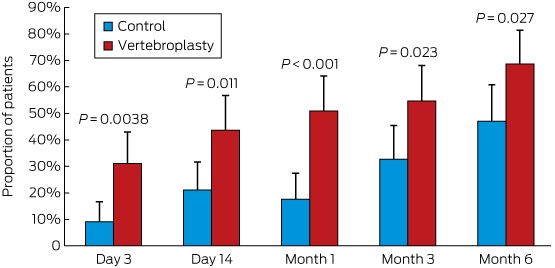
* Enrolment in the trial required an NRS score at baseline of ≥ 7/10. Vertical bars show 95% CIs. Primary outcome was the proportion of patients with an NRS pain score of < 4/10 at 14 days after procedure.
Box 2 – Comparison of blinded vertebroplasty trials
|
|
Kallmes et al (2009)7 |
Buchbinder et al (2009)8 |
VAPOUR trial (2016)15 |
||||||||||||
|
|
|||||||||||||||
|
Enrolment |
131 |
78 |
120 |
||||||||||||
|
Fracture duration |
< 12 months |
< 12 months |
< 6 weeks |
||||||||||||
|
Mean fracture duration, weeks (SD) |
23 (16) |
12 (11) |
3 (2) |
||||||||||||
|
NRS pain enrolment threshold |
> 3/10 |
Not specified |
≥ 7/10 |
||||||||||||
|
Hospitalised patients (at enrolment) |
0 (excluded) |
Not reported |
57% |
||||||||||||
|
Placebo |
Simulated vertebroplasty |
Simulated vertebroplasty |
Simulated vertebroplasty |
||||||||||||
|
Mean PMMA volume, mL |
2.6 |
2.8 |
7.5 |
||||||||||||
|
Crossover permitted |
Yes (at 1 month) |
No |
No |
||||||||||||
|
Primary endpoint |
Mean NRS pain score at 1 month |
Mean NRS pain score at 3 months |
Proportion of patients with an NRS pain score < 4/10 at 2 weeks |
||||||||||||
|
Trial outcome |
No evidence of benefit for vertebroplasty |
No evidence of benefit for vertebroplasty |
Vertebroplasty superior to placebo for patients with osteoporotic fractures < 6 weeks’ duration and poorly controlled pain |
||||||||||||
|
|
|||||||||||||||
|
NRS = numeric rated scale; PMMA = polymethylmethacrylate. |
|||||||||||||||
Competing interests
No relevant disclosures.
Acknowledgements
The VAPOUR trial is a clinician-initiated trial which was funded by an unrestricted educational grant from CareFusion Corporation. CareFusion Corporation had no role in the study design, data collection, data analysis, data interpretation or writing of the report.
References
- Thorlund JB, Juhl CB, Roos EM, Lohmander LS. Arthroscopic surgery for degenerative knee: systematic review and meta-analysis of benefits and harms. BMJ 2015; 350: h2747.
- Sackett DL, Rosenberg WM, Muir Gray JA, et al. Evidence based medicine: what it is and what it isn’t? BMJ 1996; 312: 71-72.
- Galibert P, Deramond H, Rosat P, Le GD. [Preliminary note on the treatment of vertebral angioma by percutaneous acrylic vertebroplasty] [French]. Neurochirurgie 1987; 33: 166-168.
- Cortet B, Cotten A, Boutry N, et al. Percutaneous vertebroplasty in the treatment of osteoporotic vertebral compression fractures: an open prospective study. J Rheumatol 1999; 26: 2222-2228.
- Voormolen MH, Lohle PN, Lampmann LE, et al. Prospective clinical follow-up after percutaneous vertebroplasty in patients with painful osteoporotic vertebral compression fractures. J Vasc Interv Radiol 2006; 17: 1313-1320.
- Diamond TH, Bryant C, Browne L, Clark WA. Clinical outcomes after acute osteoporotic vertebral fractures: a 2-year non-randomised trial comparing percutaneous vertebroplasty with conservative therapy. Med J Aust 2006; 184: 113-117.
- Kallmes DF, Comstock BA, Heagerty PJ, et al. A randomized trial of vertebroplasty for osteoporotic spinal fractures. N Engl J Med 2009; 361: 569-579.
- Buchbinder R, Osborne RH, Ebeling PR, et al. A randomized trial of vertebroplasty for painful osteoporotic vertebral fractures. N Engl J Med 2009; 361: 557-568.
- Buchbinder R, Osborne RH, Kallmes D. Vertebroplasty appears no better than placebo for painful osteoporotic spinal fractures, and has potential to cause harm. Med J Aust 2009; 191: 476-477.
- Duckett S, Breadon P, Romanes D. Identifying and acting on potentially inappropriate care. Med J Aust 2015; 203: 183.
- Klazen CA, Lohle PN, de Vries J, et al. Vertebroplasty versus conservative treatment in acute osteoporotic vertebral compression fractures (Vertos II): an open-label randomised trial. Lancet 2010; 376: 1085-1092.
- Boszczyk, B. Volume matters: a review of procedural details of two randomised controlled vertebroplasty trials of 2009. Eur Spine J 2010; 19: 1837-1840.
- Baerlocher M O, Munk PL, Liu D M. Trials of vertebroplasty for vertebral fractures. N Engl J Med 2009; 361: 2098; author reply 2099-2100.
- Noonan P. Randomized vertebroplasty trials: bad news or sham news? Am J Neuroradiol 2009; 30: 1808-1809.
- Clark W, Bird P, Gonski P, et al. Safety and efficacy of vertebroplasty for acute painful osteoporotic fractures (VAPOUR): a multicentre, randomised, double-blind, placebo-controlled trial. Lancet 2016; 388: 1408-1416.
- Roland M, Fairbank J. The Roland–Morris Disability Questionnaire and the Oswestry Disability Questionnaire. Spine 2000; 25: 3115-3124.
Linked content
-
MJA InSight: Vertebroplasty: back from the dead?
-
MJA Podcast: Professor Paul Bird
Provenance: Not commissioned; externally peer reviewed.
Reducing Nitrous Oxide Emissions Across the Melbourne Biomedical Precinct
Ross Robertson, Andrew Downey, Daryl Williams, Bjorn Makein, Ben Dunne, Tugce Ozturk, Ying Gu, Rebecca McIntyre
Greenhouse gas emissions associated with anaesthetic gases in Australia, 2002–2022: a retrospective descriptive analysis
Krista Verlis, Jessica F Davies, Forbes McGain, Hayden Burch, Alexandra L Barratt, Luise Kazda
Opioids and the challenges of managing chronic non‐cancer pain in rural Australia: a qualitative study
Jessica A Thomas, Jill Benson, Philip Davidson, Paul R Ward
Spinal cord stimulation patterns of care, re‐interventions, and costs for private health insurers, Australia, 2011–22: a retrospective observational study
Caitlin MP Jones, Christopher G Maher, Rachelle Buchbinder, Ian A Harris, Chung‐Wei Christine Lin, Christopher Hayes, Alexandra Gorelik
Prescription opioid supply‐restricting policies and hospital use by people prescribed opioid medications, Victoria, 2018–22: a controlled interrupted time series analysis
Suzanne Nielsen, Louisa Picco, Bosco Rowland, Nadine E Andrew, Taya A Collyer, Samanta Lalic, Rachelle Buchbinder, Christopher Pearce, J Simon Bell, Dan I Lubman, Ting Xia