




Volume 207 - Issue 7
Diagnosis and management of irritable bowel syndrome: a guide for the generalist
Authors: Ecushla C Linedale and Jane M Andrews
Med J Aust 2017; 207 (7): 309-315. || doi: 10.5694/mja17.00457
Published online: 2 October 2017
Published online: 2 October 2017
Irritable bowel syndrome (IBS) and other functional gastrointestinal disorders are so prevalent they cannot reasonably have their diagnoses and management based within specialty care
Summary
- Irritable bowel syndrome (IBS) and other functional gastrointestinal disorders (FGIDs) are so prevalent they cannot reasonably have their diagnoses and management based within specialty care. However, delayed diagnosis, lengthy wait times for specialist review, overinvestigation and lack of clear diagnostic communication are common.
- The intrusive symptoms of IBS and other FGIDs impair patient functioning and reduce quality of life, and come with significant costs to individual patients and the health care system, which could be reduced with timely diagnosis and effective management.
- IBS, in particular, is no longer a diagnosis of exclusion, and there are now effective dietary and psychological therapies that may be accessed without specialist referral.
- The faecal calprotectin test is widely available, yet not on the Medical Benefits Schedule, and a normal test result reliably discriminates between people with IBS and patients who warrant specialist referral.
Irritable bowel syndrome (IBS) and other functional gastrointestinal disorders (FGIDs) are highly prevalent conditions, with IBS alone affecting 10% of the population at any time point and about 40% over a lifetime.1-3 IBS causes disturbed gut function and intrusive symptoms that impair quality of life,2,4,5 without there being overt structural or biochemical abnormalities.3 Due to its prevalence and symptom burden, IBS results in a large societal cost via both direct and indirect expenditure.6-8 IBS, together with functional dyspepsia, is the most well recognised FGID. The Rome IV criteria9 include a complete description and classification of FGIDs. Many people with an FGID will have more than one symptom set (commonly with combined IBS and functional dyspepsia),10 and the type of presenting FGID may also change over time.11 Thus, while this article specifically focuses on IBS, the principles apply more generally to all FGIDs.
Despite the high prevalence of IBS, the condition does not appear to be generally well handled within the health care system, which leads to frustration and dissatisfaction in patients and doctors alike.12 This frustration appears to begin with the diagnostic process and flows through to either insufficient or excess investigations,13-16 repeat consultations and re-investigation, and low and late uptake of therapies that are proven to be effective but infrequently used outside of specialty care centres with an IBS focus. Better IBS management would yield significant gains for the community, as this condition can be easily and safely diagnosed with few investigations, and effective therapeutic options can be implemented and accessed from primary care. Herein, we review the current best practice approach to making and delivering a safe and effective diagnosis of IBS, and outline newer, effective treatment strategies that can be initiated without specialist gastroenterology input.
Method
We have used original research listed on PubMed between 1996 and 2016, together with current clinical guidelines, such as the ones from the National Institute for Health and Clinical Excellence,17 to formulate an evidence-based overview of the topic as applied to clinical practice.
Diagnosing irritable bowel syndrome: why it matters
It may seem self-evident, but without a diagnosis accepted and owned by the patient, they cannot move out of the diagnostic process and into effective management. Thus, the formulation and delivery of a safe, confident and effective diagnosis is an essential starting point in the therapeutic pathway. There are three key components to the diagnostic process:
-
making the diagnosis (ie, provisional diagnosis on positive criteria);
-
ensuring it is a correct diagnosis (ie, targeted investigations to exclude other relevant differential diagnoses); and
-
communicating it effectively to patients to ensure ownership.
These three components of the diagnostic process are true for any disease; however, they have a greater importance for IBS, for which there is no definitive diagnostic test and no abnormality can be shown, making it more likely that either the patient or the doctor will perceive uncertainty around the diagnosis. Many people, including patients and doctors, are uncomfortable with uncertainty, which is thought to be a driver of more testing and specialist referrals in IBS.
Repeat health care use is a common phenomenon in people with IBS.3 Increasing perceived symptom severity and duration are causes for repeat consultation,18 with common reasons for specialist referral including persistent symptoms, diagnostic uncertainty (in the clinician) and patient fears.19 In addition, health care use by people with IBS, for unrelated conditions, is significantly higher than the general population and is partly driven by somatisation, whereby psychological distress is perceived in the form of somatic symptoms.8,20,21
A crucial step in reducing symptoms and health care use is the early provision of a clinical diagnosis of IBS, along with an explanation of the chronic recurrent nature of the disorder and the biopsychosocial factors that may influence symptoms (eg, anxiety, stress, depression, hypervigilance and catastrophising).22 Without a clear diagnosis and explanation, patients will remain in the diagnostic process and may recurrently seek an organic cause for their symptoms. Where IBS is present, a prolonged search for an alternative explanation or diagnosis is futile, financially inefficient and time consuming, and it encourages unrealistic expectations, along with the delay of effective management. Because a delayed diagnosis does not help the patient nor society, the United Kingdom National Institute for Health and Care Excellence quality standards for IBS17 specifically recommend giving a positive diagnosis to reduce unnecessary anxiety for patients and to promote effective management. Moreover, they recommend that this diagnosis is most often provided in primary care.
Diagnosing irritable bowel syndrome: key principles
Since the initial publication of the Manning criteria,22 the diagnosis of IBS has ceased to be a diagnosis of exclusion. The old approach led to never-ending rounds of investigations with diminishing returns, and has encouraged the perception among patients that if only another test were done, an alternative diagnosis would be found. In addition, ongoing testing encourages the belief that the doctor is uncertain, which also heightens anxiety — often contributing to worsening symptoms. Formulating an IBS diagnosis consists of the positive component in recognising IBS according to its typical symptomatology and the negative component in excluding other relevant possibilities.23,24 These two aspects can be largely managed by a careful, structured clinical history and a physical examination. Where symptoms are typical and longstanding, there is no family history of concern and no clinical alarms are present, the diagnosis may even be made without any testing.
Current recommendations are to make a positive diagnosis based on characteristic symptoms and confirm with minimal investigations.17,25 Which investigations are reasonable to perform will depend on the patient’s age and pre-test probability, and should not represent an exhaustive search. IBS is the most commonly recognised functional bowel disorder; other disorders include functional bloating, functional diarrhoea and functional constipation. Essentially, these distinctions are probably more important in research than in clinical medicine, where all functional bowel disorders are appropriately grouped under the umbrella label of IBS.26 The current criteria (Rome IV)27 for diagnosing functional bowel disorders, including IBS, are shown in Box 1.
It is important to note that, apart from the relevant symptoms, the patient also needs to meet the time criteria, which makes an incorrect diagnosis much less likely, as infection may have resolved and inflammatory bowel disease (or other organic pathology) may have progressed within the 6-month time frame. Once the positive criteria for a diagnosis have been recognised, it is possible to apply a structured approach to elicit and exclude the relevant clinical alarms (Box 2). When this approach is combined with a physical examination, including a digital rectal exam — which is essential when there are anorectal symptoms such as bleeding, incontinence and pain — the medical practitioner can often make a firm diagnosis with no further testing.
Where there are specific concerns, limited tests may be performed, which should be tailored to the symptoms, age and presentation of the patient (Box 3). It is important to note that many commonly performed investigations are actually not recommended, and there are moves internationally to deal with the overuse of diagnostics as part of initiatives such as Choosing Wisely28 and Evolve.29 One test worthy of mention is faecal calprotectin. It is not widely used in Australia due to a lack of Medicare Benefits Schedule funding; however, it is very good at discriminating between functional and organic lower gastrointestinal disease, such that in a young patient, with at least 6-month symptom duration and no clinical alarms, a negative faecal calprotectin test result essentially seals the diagnosis,17,30-33 and allows the physician to safely move into the management phase. Colonoscopy in a young woman without clinical alarms is very low yield34 and should be discouraged.
Diagnosing irritable bowel syndrome: the evidence a problem exists
Many patients with an existing diagnosis of IBS do not own it and often continue to seek further diagnoses, investigations, explanations and treatments12,35,36 — which is difficult to fully explain, but it may relate to patient, primary care or specialty care factors. The exploratory work by Collins and colleagues36 found that there is quite a divergence in the understanding of symptom burden, perceived cause and best treatment options in people with FGIDs, especially IBS. This divergence may be viewed as a failure in clear medical communication and a lost opportunity for patient education. The problem of specialist communication has been further investigated by examining the language doctors use to convey the diagnosis.37 It was striking that in letters sent back to referring doctors, even gastroenterology specialists were using uncertain diagnostic language much more often in patients with FGIDs, such as IBS, than in patients with other organic gastrointestinal conditions, such as reflux disease, Crohn’s disease or peptic ulcer. It is concerning that the use of uncertain language continued in follow-up visits, even though further time had elapsed and investigations had returned negative results. These communication problems represent an opportunity for doctors to more clearly and confidently deliver an IBS diagnosis, and likely prevent ongoing fear of missed pathology in patients and referring doctors alike.
There are also documented problems in primary care with formulating and delivering an IBS diagnosis. A recent study exploring current concerns in the management of FGIDs, such as IBS, found that while most patients from primary care were presenting to tertiary referral for the first time, they had longstanding symptoms with no firm diagnosis and no improvement despite multiple treatments.19 Referring doctors lacked confidence in diagnosing and managing these disorders, and patients’ dissatisfaction was related to remaining undiagnosed with no effective management options. Moreover, often the demand for specialist review of non-urgent disorders, such as IBS, exceeds capacity, resulting in very long waiting lists, with many patients never being seen. Providing a timely, clear diagnosis is critically important. Other studies have also shown that, although clinicians may consider a functional diagnosis, most are reluctant to communicate or document this without further investigations.15,38 Patients with persistent medically unexplained symptoms (ie, undiagnosed) use significant amounts of health care in a continued search for a diagnosis.39 A clear diagnosis provides reassurance and alleviates patients concerns and helps move the patient from a diagnostic search to an effective management strategy,24,40 which, in turn, reduces the physical and mental distress of patients and the economic burden due to impaired workplace productivity, unnecessary investigations and endoscopic procedures. From a strictly economic perspective, a timely diagnosis is necessary for the effective allocation of limited health care resources, such as outpatient appointments and endoscopic procedures.
Therefore, there are clearly both primary and specialty care concerns that doctors can deal with. If doctors fail to manage this well, patients will turn to alternative practitioners and advice via the internet, and are likely to be vulnerable to false claims, high cost and unproven therapies.
There is a wealth of data to show that a well made clinical diagnosis of IBS is safe and reliable over time. There is no increase in mortality in patients with a diagnosis of IBS41-45 and no increase in colorectal cancer — except in the first year, in older patients — where perhaps a better structured evaluation may have been applied.46 Fluctuating symptoms are very common, and when strict Rome categories are applied, people often move between various functional bowel disorder categories, but are rarely durably symptom-free.2,47
Managing irritable bowel syndrome: next steps
Once there is consensus between doctor and patient that IBS is the diagnosis, we can move into the management phase. Management needs to take the patient’s desires, beliefs and main concerns into account, as IBS of itself does not need or mandate management. This is important to remember, as many people need only to know why they have symptoms and whether they should be concerned.
For patients requiring management, there are a number of treatment options, of varying efficacy48-53 (Box 4). The non-pharmacological options (ie, psychological and dietary therapies) are of particular interest, and offer the benefit of global rather than targeted symptom control. On the whole, psychological interventions have been shown to be effective in reducing IBS symptoms and psychological distress and increasing quality of life,53-55 and are as effective as antidepressants.55 Almost 50% of the patients managed with psychological treatments experience symptomatic improvement compared with only 25% of controls who received “usual physician treatment”, “supportive therapy” or “symptom monitoring”.55 There are many different types of psychological therapy, and of the ones tested, cognitive behavioural therapy, hypnotherapy and multicomponent therapies are effective with a number needed to treat (NNT) of 3–4,49 which is comparable with antidepressants (NNT = 4)55 and without side effects. Despite the well recognised fact that IBS and FGIDs have a significant psychological aspect, primary care providers do not regularly use psychological treatments.16 Patient resistance to psychological interventions may contribute to this low uptake; however, it is also likely to be related to a lack of positive endorsement by the doctor recommending it. Given the existing efficacy data, practitioners should be more convincing when proposing psychological therapies to people with FGIDs. Moreover, gut-directed hypnotherapy directly affects visceral sensitivity and gastrointestinal motility56,57 and improves symptoms and quality of life over the long term,58-61 and thus it shows considerable promise as an IBS treatment.49 In fact, marketing of gut-directed hypnotherapy as a stand-alone treatment, rather than a psychological treatment, may improve patient uptake of this valuable therapy.16
The low fermentable oligosaccharides, disaccharides, monosaccharides and polyols (FODMAP) diet is effective in reducing IBS symptoms and, in the short term, it is the treatment with greatest gains — reducing symptoms in 70–75% of patients with IBS62,63 and improving quality of life.52 FODMAPs are poorly absorbed, highly osmotic and rapidly fermentable substances that act to increase the water and gas volume in the intestine, resulting in luminal distension. High FODMAP foods are not harmful per se, and in people without visceral hypersensitivity, they cause no problems. However, distension resulting from fermentation of these foods, when combined with visceral hypersensitivity, causes abdominal pain, bloating and altered intestinal motility.62,64,65 Current recommendations (and evidence) are for this diet to be supervised by a qualified dietitian,17,66,67 as it is complex and needs to be tailored to the individual. It is not recommended to be followed lifelong,67 and the reintroduction of some tolerated FODMAP-containing foods is important to ensure a wide variety of food choices and reduce the risk of impairing nutritional adequacy.67,68
In general, non-pharmacological options are preferred in the first instance, as they can be used long term without ongoing cost, risk or health care utilisation. Once the techniques are learnt, patients can self-treat and use them as much or as little as desired to control symptoms. Lack of affordability of psychological and dietary therapies is often cited as a barrier to access. However, when considering the amount spent on non-evidence-based, non-subsided therapies for IBS, high cost does not stand up as a reasonable explanation. Perhaps, people selling alternative therapies do a better job of selling their therapies than medical practitioners do of endorsing evidence-based, non-drug approaches. The existing good quality data suggest that we need to market our therapies better, for community benefit. It is likely that if these approaches were adopted more widely and earlier in primary care, there would be considerable health, quality of life and financial gains made across the community. Moreover, it is likely that fewer patients would need referral to specialty care, with all the costs entailed.
Managing irritable bowel syndrome: when non-pharmacotherapy is not enough
A subset of patients will need further management to control symptoms and improve quality of life. While there are many options marketed to manage IBS symptoms, the quality of evidence and the effect size is suboptimal for many commonly used approaches. As the focus of this article is to highlight the substantial gains that can be made in formulating and delivering an IBS diagnosis, and increase the knowledge and uptake of effective, accessible non-drug therapies by non-gastroenterologists, a detailed review of IBS pharmacotherapy is beyond the scope of this review.
Pharmacotherapy and its timing should be individualised according to symptom severity, impact on quality of life and availability of non-pharmacological therapies. For people with significant urgency and fear of incontinence, daily loperamide taken first thing in the morning, with the dose titrated to effect, may be useful — although it will not reduce other symptoms. In addition, drug therapies may be used in combination with non-pharmacological treatments, perhaps while initiating psychological or dietary therapy or when symptoms are in periods of flare.
There are several pharmacological treatments with some efficacy (Box 4); however, the gains over placebo are generally modest. Many therapies show some efficacy, but they generally only target a single symptom, such as peppermint oil targeting pain. Likewise, antispasmodics, although moderately effective, treat a single symptom. Antidepressants are not effective in all patients, with tricyclic antidepressants being recommended for patients with diarrhoea (due to significant constipation side effects), and serotonin reuptake inhibitors for patients with comorbid major depression.53 Drugs specifically targeting motility show some efficacy, yet they have been plagued by safety concerns and are no longer widely available. The efficacy of probiotics varies and is dependent on the bacterial strains used; this is a growing field of research. Fibre may increase abdominal symptoms in some people, but soluble fibre may be of some benefit. Newer agents on the horizon for IBS are now being targeted to specific problems, such as constipation (prucalopride, lubiprostone, linaclotide), diarrhoea (eluxadoline) or pain (eluxadoline); however, most are not currently registered with the Therapeutic Goods Administration or funded by the Pharmaceutical Benefits Scheme in Australia, and their use is appropriately limited to within subspecialty units. As a full overview on pharmacotherapy is beyond the scope of this article, readers are referred to a recent review by Ford and colleagues69with more detail on therapies.
Conclusion
IBS is a highly prevalent condition and we should no longer be bound by the past focus on a diagnosis of exclusion with resultant therapeutic nihilism. There are substantial individual and community gains to be made if current knowledge around effective diagnosis and management can be rolled out from specialty practice into broader care, especially via general practitioners. A diagnosis can be safely made by following basic principles with few tests and is reliable over time. Failing to make and deliver a confident diagnosis creates ongoing avoidable morbidity, and it costs our society significant amounts in direct and indirect costs. After making a diagnosis and explaining the symptoms, we have readily available access to effective therapies. To achieve these gains, doctors need to be better advocates for these proven therapies; otherwise, they will leave patients at the mercy of people with better marketing skills.
Box 1 – Rome IV diagnostic criteria for functional bowel disorders26,27
|
Diagnosis |
Criteria* |
||||||||||||||
|
|
|||||||||||||||
|
IBS |
Recurrent abdominal pain; = 1 day per week in the past 3 months |
||||||||||||||
|
Associated with two or more of the following criteria: |
|||||||||||||||
|
|
|||||||||||||||
|
Functional abdominal bloating or distension |
Must include both of the following: |
||||||||||||||
|
|
|||||||||||||||
|
Functional diarrhoea |
Loose or watery stools, without predominant abdominal pain or bothersome bloating, occurring in > 25% of stools |
||||||||||||||
|
Patients meeting criteria for diarrhoea-predominant IBS should be excluded |
|||||||||||||||
|
Functional constipation |
Must include two or more of the following in > 25% of defecations: |
||||||||||||||
|
|
|||||||||||||||
|
Loose stools are rarely present without the use of laxatives |
|||||||||||||||
|
Insufficient criteria for irritable bowel syndrome |
|||||||||||||||
|
Opioid-induced constipation |
New, or worsening, symptoms of constipation when initiating, changing or increasing opioid therapy that must include two or more of the following in > 25% of defecations: |
||||||||||||||
|
|
|||||||||||||||
|
Loose stools are rarely present without the use of laxatives |
|||||||||||||||
|
Unspecified bowel disorders |
Bowel symptoms not attributable to an organic aetiology which do not meet criteria for IBS or functional constipation, diarrhoea or abdominal bloating or distention disorders |
||||||||||||||
|
Centrally mediated abdominal pain syndrome‡ |
Must include all of the following: |
||||||||||||||
|
|
|||||||||||||||
|
|
|||||||||||||||
|
IBS = irritable bowel syndrome. * Criteria fulfilled for the past 3 months with symptom onset at least 6 months before diagnosis. † Mild pain related to bloating may be present as well as minor bowel movement abnormalities. ‡ Centrally mediated abdominal pain syndrome is typically associated with psychiatric comorbidity, but there is no specific profile that can be used for diagnosis. § Some degree of gastrointestinal dysfunction may be present. ¶ Daily function could include impairments in work, intimacy, social or leisure, family life and caregiving for self or others. |
|||||||||||||||
Box 2 – Clinical alarms to elicit and exclude in diagnostic consultation
|
Clinical alarms |
|||||||||||||||
|
|
|||||||||||||||
|
|
|||||||||||||||
|
|
|||||||||||||||
|
FDR = first degree relative. FHH = faecal human haemoglobin. IBD = inflammatory bowel disease. * FHH testing only appropriate in people at average risk of colorectal cancer, > 50 years of age — not recommended for investigation of symptomatic patient. |
|||||||||||||||
Box 3 – Irritable bowel syndrome clinical management tool
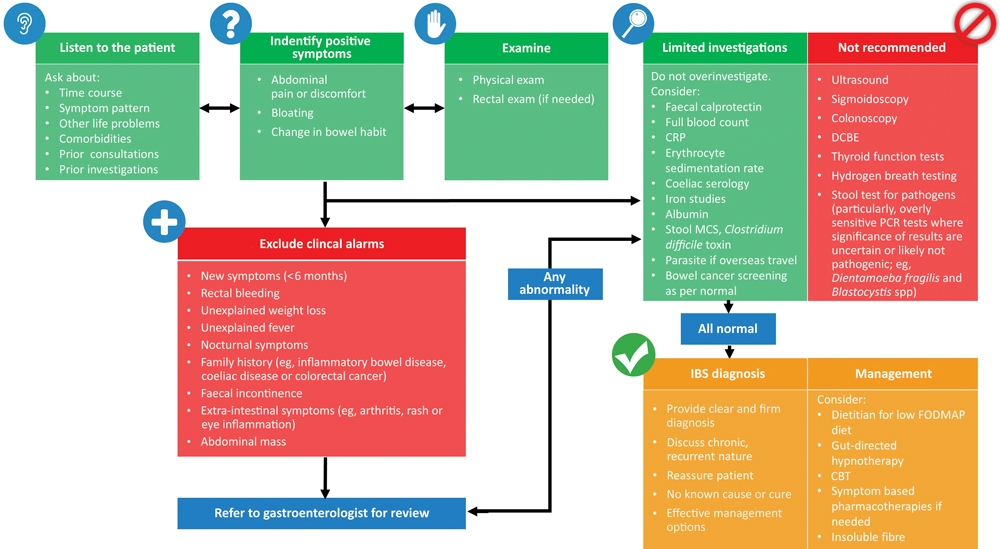
CBT = cognitive behavioural therapy. CRP = C-reactive protein. DCBE = double-contrast barium enema. FODMAP = fermentable oligosaccharides, disaccharides, monosaccharides and polyols. MCS = microscopy, culture and sensitivity. PCR = polymerase chain reaction. Figure adapted from Differentiating IBS and IBD, Clinical Insights Steering Committee,27 and Irritable bowel syndrome in adults, National Institute for Care and Excellence.17
Box 4 – Efficacy of treatments for functional gastrointestinal disorders: summary of recent systematic reviews
|
Treatments |
No. of trials (n) |
OR |
Relative risk* (CI) |
Gain† |
NNT (CI) |
Comments |
|||||||||
|
|
|||||||||||||||
|
Psychological therapies |
|||||||||||||||
|
Psychotherapy‡53 |
22 (n = 1314) |
2.60 (2.01–3.37) |
|
23% |
4–5 |
Global effect; similar effect between all psychotherapies; CBT most evidence |
|||||||||
|
CBT49 |
9 (n = 610) |
|
0.60 (0.44–0.83) |
22% |
3 (2–6) |
|
|||||||||
|
Relaxation and stress management49 |
6 (n = 255) |
|
0.77 (0.57–1.04) |
16% |
No benefit |
Significant variation |
|||||||||
|
Hypnotherapy49 |
5 (n = 278) |
|
0.74 (0.63–0.87) |
23% |
4 (3–8) |
Global symptom improvement, long term benefits |
|||||||||
|
Dietary therapies |
|||||||||||||||
|
Low FODMAP diet52 |
6 RCT |
1.81 (1.11–2.95) |
|
|
|
Improved global symptom severity and quality of life |
|||||||||
|
16 non-RCT |
0.80 (0.72–0.86) |
|
|
|
|||||||||||
|
Probiotics53 |
15 (n = 1838) |
2.24 (1.81–2.75) |
|
13.5% |
7–8 |
Variation with strain; long term effect not assessed |
|||||||||
|
Fibre51 |
14 (n = 906) |
|
0.86 (0.80–0.94) |
|
10 (6–33) |
Can increase abdominal pain |
|||||||||
|
Soluble fibre |
7 (n = 499) |
|
0.83 (0.73–0.94) |
|
7 (4–25) |
Evidence soluble fibre improves IBS-C |
|||||||||
|
Bran |
6 (n = 441) |
|
0.90 (0.79–1.03) |
|
No benefit |
|
|||||||||
|
Pharmacotherapies |
|||||||||||||||
|
Antispasmodics53 |
22 (n = 1718) |
1.97 (1.59–2.45) |
|
18% |
5–6 |
Targets pain only; low cost |
|||||||||
|
Motility agents53 |
31 (n > 18 000) |
|
|
4–16% |
6–28 |
Significant adverse effects |
|||||||||
|
Antidepressants49 |
|||||||||||||||
|
TCAs |
11 (n = 744) |
|
0.66 (0.56–0.79) |
20% |
4 (3–6) |
IBS-D only |
|||||||||
|
SSRIs |
7 (n = 356) |
|
0.68 (0.51–0.91) |
22% |
4 (2.5–20) |
Comorbid depression only |
|||||||||
|
CAMs |
|||||||||||||||
|
Peppermint oil53 |
4 (n = 392) |
4.11 (2.65–6.36) |
|
39% |
2–3 |
Targets pain only; reflux and other side effects |
|||||||||
|
1 (n = 208) |
|
RR,§ 1.9 (1.15–3.14) |
15–25% |
|
Global improvement |
||||||||||
|
|
|||||||||||||||
|
CAMs = complementary and alternative medicines. CBT = cognitive behavioural therapy. CI = confidence interval. FODMAP = fermentable oligosaccharides, disaccharides, monosaccharides and polyols. IBS = irritable bowel syndrome. IBS-C = constipation-predominant IBS. IBS-D = diarrhoea-predominant IBS. NNT = number needed to treat. OR = odds ratio. RCT = randomised controlled trial. RR = risk ratio. SSRI = selective serotonin reuptake inhibitor. TCA = tricyclic antidepressant.* Relative risk of symptoms not improving with intervention compared with control. † Gain of symptom improvement above control. ‡ Psychotherapy includes CBT, personal dynamic therapy, hypnotherapy and relaxation techniques.53 § Relative risk of symptom improvement with intervention compared with control. |
|||||||||||||||
Competing interests
Jane Andrews has worked as a speaker, consultant and advisory board member for Abbott, AbbVie, Allergan, Celgene, Ferring Pharmaceuticals, Takeda Pharmaceuticals, MSD, Shire, Janssen, Hospira and Pfizer; and has received research funding from Abbott, AbbVie, Ferring Pharmaceuticals, MSD, Shire and Janssen.
References
- Cremonini F, Talley NJ. Irritable bowel syndrome: epidemiology, natural history, health care seeking and emerging risk factors. Gastroenterol Clin North Am 2005; 34: 189-204.
- Halder SL, Locke GR, Schleck CD, et al. Natural history of functional gastrointestinal disorders: a 12-year longitudinal population-based study. Gastroenterology 2007; 133: 799-807.e1.
- Talley NJ. Functional gastrointestinal disorders as a public health problem. Neurogastroenterol Motil 2008; 20 Suppl 1: 121-129.
- Spiegel BM. The burden of IBS: looking at metrics. Curr Gastroenterol Rep 2009; 11: 265-269.
- Enck P, Dubois D, Marquis P. Quality of life in patients with upper gastrointestinal symptoms: results from the Domestic/International Gastroenterology Surveillance Study (DIGEST). Scand J Gastroenterol Suppl 1999; 231: 48-54.
- Fullerton S. Functional digestive disorders (FDD) in the year 2000—economic impact. Eur J Surg 1998; 164(S12): 62-64.
- Nellesen D, Yee K, Chawla A, et al. A systematic review of the economic and humanistic burden of illness in irritable bowel syndrome and chronic constipation. J Manag Care Pharm 2013; 19: 755-764.
- Longstreth GF, Wilson A, Knight K, et al. Irritable bowel syndrome, health care use, and costs: a US managed care perspective. Am J Gastroenterol 2003; 98: 600-607.
- Rome Foundation. Rome IV collection, 2016. Raleigh: Rome Foundation; 2016. http://theromefoundation.org/rome-iv (accessed July 2017).
- Locke GR, Zinsmeister AR, Fett SL, et al. Overlap of gastrointestinal symptom complexes in a US community. Neurogastroenterol Motil 2005; 17: 29-34.
- Chang JY, Locke GR, McNally MA, et al. Impact of functional gastrointestinal disorders on survival in the community. Am J Gastroenterol 2010; 105: 822-832.
- Knott VE, Holtmann G, Turnbull DA, et al. M1253 patients’ satisfaction with specialist gastroenterologist consultation for irritable bowel syndrome (IBS) and health care utilisation: exploring the role of patient expectations. Gastroenterology 2009; 136: A-382.
- Longstreth GF, Thompson WG, Chey WD, et al. Functional bowel disorders. Gastroenterology 2006; 130: 1480-1491.
- Cash BD, Schoenfeld P, Chey WD. The utility of diagnostic tests in irritable bowel syndrome patients: a systematic review. Am J Gastroenterol 2002; 97: 2812-2819.
- Spiegel BM, Farid M, Esrailian E, et al. Is irritable bowel syndrome a diagnosis of exclusion? A survey of primary care providers, gastroenterologists, and IBS experts. Am J Gastroenterol 2010; 105: 848-858.
- Hungin AP, Molloy-Bland M, Claes R, et al. Systematic review: the perceptions, diagnosis and management of irritable bowel syndrome in primary care — a Rome Foundation working team report. Aliment Pharmacol Ther 2014; 40: 1133-1145.
- National Institute for Care and Excellence. Irritable bowel syndrome in adults: quality standard [QS114]. 2016. London: NICE; 2016. https://www.nice.org.uk/guidance/qs114 (accessed Feb 2016).
- Talley NJ, Boyce PM, Jones M. Predictors of health care seeking for irritable bowel syndrome: a population based study. Gut 1997; 41: 394-398.
- Levy RL, Korff M, Whitehead WE, et al. Costs of care for irritable bowel syndrome patients in a health maintenance organization. Am J Gastroenterol 2001; 96: 3122-3129.
- Patel RP, Petitta A, Fogel R, et al. The economic impact of irritable bowel syndrome in a managed care setting. J Clin Gastroenterol 2002; 35: 14-20.
- Halpert A, Drossman D. Biopsychosocial issues in irritable bowel syndrome. J Clin Gastroenterol 2005; 39: 665.
- Manning AP, Thompson WG, Heaton KW, Morris AF. Towards positive diagnosis of the irritable bowel. Br Med J 1978; 2: 653-654.
- Mearin F, Lacy BE. Diagnostic criteria in IBS: useful or not? Neurogastroenterol Motil 2012; 24: 791-801.
- Spiller R, Camilleri M, Longstreth GF. Do the symptom-based, Rome criteria of irritable bowel syndrome lead to better diagnosis and treatment outcomes? Clin Gastroenterol Hepatol 2010; 8: 129-136.
- Mikocka-Walus A, Turnbull D, Moulding N, et al. Psychological comorbidity and complexity of gastrointestinal symptoms in clinically diagnosed irritable bowel syndrome patients. J Gastroenterol Hepatol 2008; 23(7 Pt 1): 1137-1143.
- Lacy BE, Mearin F, Chang L, et al. Bowel disorders. Gastroenterology 2016; 150: 1393-1407.e5.
- Clinical Insights Steering Committee. Differentiating IBS and IBD, 2013. Melbourne: Crohn’s and Colitis Australia; 2014. https://www.crohnsandcolitis.com.au/site/wp-content/uploads/Differentiating-Between-IBS-and-IBD.pdf (accessed May 2017).
- Choosing Wisely Australia [website]. Sydney: 2016. http://www.choosingwisely.org.au (accessed Dec 2016).
- Royal Australasian College of Physicians. Evolve: evaluating evidence, enhancing efficiencies. Sydney: RACP. http://www.evolve.edu.au (accessed May 2017).
- Turvill J. High negative predictive value of a normal faecal calprotectin in patients with symptomatic intestinal disease. Frontline Gastroenterol 2011; 3: 21-28.
- National Institute for Health and Care Excellence. Faecal calprotectin diagnostic tests for inflammatory diseases of the bowel. Diagnostics guidance [DG11]. London: NICE; 2013. https://www.nice.org.uk/guidance/dg11 (accessed Sept 2016).
- Zayyat R, Appleby RN, Logan RPH. Can we improve the negative predictive value of faecal calprotectin for the diagnosis of IBS in primary care? Gut 2011; 60(Suppl 1): A49-A50.
- Williamson KD, Steveling K, Holtmann G, et al. Clinical triage for colonoscopy is useful in young women. Intern Med J 2015; 45: 492-496.
- Lau MSY, Ford AC. Do lay people accept a positive diagnosis of irritable bowel syndrome? Gastroenterology 2015; 149: 252-253.
- Collins J, Farrall E, Turnbull DA, et al. Do we know what patients want? The doctor-patient communication gap in functional gastrointestinal disorders. Clin Gastroenterol Hepatol 2009; 7: 1252-1254, 4.e1-e2.
- Linedale EC, Chur-Hansen A, Mikocka-Walus A, et al. Uncertain diagnostic language affects further studies, endoscopies, and repeat consultations for patients with functional gastrointestinal disorders Clin Gastroenterol Hepatol 2016; 14: 1735-1741.
- Linedale EC, Shahzad M, Mikocka-Walus A, et al. Referrals to a tertiary hospital: a clinical snapshot of patients with functional gastrointestinal disorders and effectiveness of primary care management. United European Gastroenterol J 2016; 3(5 Suppl 1): 484.
- Harkness EF, Grant L, O’Brien SJ, et al. Using read codes to identify patients with irritable bowel syndrome in general practice: a database study. BMC Fam Pract 2013; 14: 183.
- Stone L. Blame, shame and hopelessness: medically unexplained symptoms and the ‘heartsink’ experience. Aust Fam Physician 2014; 43: 191-195.
- Dalrymple J, Bullock I. Diagnosis and management of irritable bowel syndrome in adults in primary care: summary of NICE guidance. BMJ 2008; 336: 556-558.
- Hu LY, Ku FC, Lu T, et al. Risk of cancer in patients with irritable bowel syndrome: a nationwide population-based study. Ann Epidemiol 2015; 25: 924-928.
- Hsiao CW, Huang WY, Ke TW, et al. Association between irritable bowel syndrome and colorectal cancer: a nationwide population-based study. Eur J Intern Med 2014; 25: 82-86.
- Adeniji OA, Barnett CB, Di Palma JA. Durability of the diagnosis of irritable bowel syndrome based on clinical criteria. Dig Dis Sci 2004; 49: 572-574.
- Owens DM, Nelson DK, Talley NJ. The irritable bowel syndrome: long-term prognosis and the physician-patient interaction. Ann Intern Med 1995; 122: 107.
- Youn YH, Kim HC, Lim HC, et al. Long-term clinical course of post-infectious irritable bowel syndrome after shigellosis: a 10-year follow-up study. Neurogastroenterol Motil 2016; 22: 490.
- Nørgaard M, Farkas DK, Pedersen L, et al. Irritable bowel syndrome and risk of colorectal cancer: a Danish nationwide cohort study. Br J Cancer 2011; 104: 1202.
- Olafsdottir LB, Gudjonsson H, Jonsdottir HH, et al. Stability of the irritable bowel syndrome and subgroups as measured by three diagnostic criteria – a 10-year follow-up study. Aliment Pharmacol Ther 2010; 32: 670-680.
- Madisch A, Holtmann G, Plein K, et al. Treatment of irritable bowel syndrome with herbal preparations: results of a double-blind, randomized, placebo-controlled, multi-centre trial. Aliment Pharmacol Ther 2004; 19: 271-279.
- Ford AC, Quigley EM, Lacy BE, et al. Effect of antidepressants and psychological therapies, including hypnotherapy, in irritable bowel syndrome: systematic review and meta-analysis. Am J Gastroenterol 2014; 109: 1350-1365; quiz 66.
- Liu JP, Yang M, Liu YX, et al. Herbal medicines for treatment of irritable bowel syndrome. Cochrane Database Syst Rev 2006; (1): CD004116.
- Moayyedi P, Quigley EM, Lacy BE, et al. The effect of fiber supplementation on irritable bowel syndrome: a systematic review and meta-analysis. Am J Gastroenterol 2014; 109: 1367-1374.
- Marsh A, Eslick EM, Eslick GD. Does a diet low in FODMAPs reduce symptoms associated with functional gastrointestinal disorders? A comprehensive systematic review and meta-analysis. Eur J Nutr 2016; 55: 897-906.
- Enck P, Junne F, Klosterhalfen S, et al. Therapy options in irritable bowel syndrome. Eur J Gastroenterol Hepatol 2010; 22: 1402-1411.
- Lackner JM, Mesmer C, Morley S, et al. Psychological treatments for irritable bowel syndrome: a systematic review and meta-analysis. J Consult Clin Psychol 2004; 72: 1100-1113.
- Ford AC, Talley NJ, Schoenfeld PS, et al. Efficacy of antidepressants and psychological therapies in irritable bowel syndrome: systematic review and meta-analysis. Gut 2009; 58: 367-378.
- Prior A, Colgan SM, Whorwell PJ. Changes in rectal sensitivity after hypnotherapy in patients with irritable bowel syndrome. Gut 1990; 31: 896-898.
- Whorwell PJ, Houghton LA, Taylor EE, et al. Physiological effects of emotion: assessment via hypnosis. Lancet 1992; 340: 69-72.
- Gonsalkorale WM, Houghton LA, Whorwell PJ. Hypnotherapy in irritable bowel syndrome: a large-scale audit of a clinical service with examination of factors influencing responsiveness. Am J Gastroenterol 2002; 97: 954-961.
- Whorwell PJ, Prior A, Faragher EB. Controlled trial of hypnotherapy in the treatment of severe refractory irritable-bowel syndrome. Lancet 1984; 2: 1232-1234.
- Vidakovic-Vukic M. Hypnotherapy in the treatment of irritable bowel syndrome: methods and results in Amsterdam. Scand J Gastroenterol Suppl 1999; 230: 49-51.
- Calvert EL, Houghton LA, Cooper P, et al. Long-term improvement in functional dyspepsia using hypnotherapy. Gastroenterology 2002; 123: 1778-1785.
- Gibson PR, Shepherd SJ. Evidence-based dietary management of functional gastrointestinal symptoms: The FODMAP approach. J Gastroenterol Hepatol 2010; 25: 252-258.
- Halmos EP, Power VA, Shepherd SJ, et al. A diet low in FODMAPs reduces symptoms of irritable bowel syndrome. Gastroenterology 2014; 146: 67-75.
- Shepherd SJ, Lomer MCE, Gibson PR. Short-chain carbohydrates and functional gastrointestinal disorders. Am J Gastroenterol 2013; 108: 707-717.
- Barrett JS, Gearry RB, Muir JG, et al. Dietary poorly absorbed, short-chain carbohydrates increase delivery of water and fermentable substrates to the proximal colon. Aliment Pharmacol Ther 2010; 31: 874-882.
- O’ Keeffe M, Lomer MC. Who should deliver the low FODMAP diet and what educational methods are optimal: a review. J Gastroenterol Hepatol 2017; 32 Suppl 1: 23-26.
- Barrett JS. How to institute the low-FODMAP diet. J Gastroenterol Hepatol 2017; 32 Suppl 1: 8-10.
- Tuck C, Barrett J. Re-challenging FODMAPs: the low FODMAP diet phase two. J Gastroenterol Hepatol 2017; 32 Suppl 1: 11-15.
- Ford AC, Lacy BE, Talley NJ. Irritable bowel syndrome. N Engl J Med 2017; 376: 2566-2578.
Linked content
-
MJA InSight: Ending diagnostic uncertainty about irritable bowel syndrome
-
MJA Podcast: Professor Jane Andrews
Provenance: Commissioned; externally peer reviewed.
Early-Onset Colorectal Cancer With Liver-Only Metastases: A Retrospective Cohort Study Integrating Prospectively Collected Real-World Clinical and Molecular Data From an Australian National Database (2009–2024) to Guide Treatment Planning
Savio G. Barreto, Christos S. Karapetis, Shahid Ullah, Matthew Burge, Susan Caird, Angus Campbell, Azim Jalali, Ross Jennens, Muhammad A. Khattak, Belinda Lee, Stephanie H. Lim, Shehara Mendis, Louise Nott, Timothy J. Price, Jeremy D. Shapiro, Jeanne Tie, Javier Torres, Colin Williams, Rachel Wong, Vanessa Wong, Peter Gibbs
Australian Pathways for Specialist Pain Management and Early Palliative Care for People With Pancreatic Cancer: Developed Using a Community Consensus Approach
Jennifer Philip, Melanie R. Lovell, Kylee Bellingham, Gail Garvey, Gregory B. Crawford, Nicole M. Rankin, Kara Burns, Isabel Young, Vivienne Milch, Dorothy Keefe, Katrina Anderson, James Lawson, Meinir Krishnasamy
Cause‐specific mortality among Queensland people with cirrhosis, by cirrhosis aetiology and decompensation status, 2007–22: a retrospective cohort study
Vikas Bhasker, Jessica R Fong, Paul J Clark, Gunter F Hartel, Richard Skoien, James O’Beirne, Elizabeth E Powell, Patricia C Valery
Clinical practice guidelines for hepatocellular carcinoma surveillance for people at high risk in Australia: summary of recommendations
Jacob George, Nicole L Allard, Stuart K Roberts, Leon A Adams, Jane Davies, Behzad Hajarizadeh, Jennifer H MacLachlan, Suzanne E Mahady, Rosalie Altus, Catherine Brown, David C Fry, Belinda Greenwood‐Smith, Natali Smud, Patricia C Valery, Nafisa Yussf, Kate Broun, Denise Campbell, Karen Canfell, Chelsea Carle Harrison, Victoria Freeman, Paul Grogan, Catherine Holliday, Suzanne Hughes, Anna Kelly, Cathelijne Kemenade, Claire Latumahina, Amanda McAtamney, Megan Varlow, Joachim Worthington, Susan Yuill, Eleonora Feletto
Assessment of metabolic dysfunction‐associated fatty liver disease in primary care: a consensus statement summary
Leon A Adams, William W Kemp, Kate R Muller, Elizabeth E Powell, Stuart K Roberts, Luis Calzadilla Bertot, Stephanie Best, Gary Deed, Jon D Emery, Samantha L Hocking, Graham R Jones, John S Lubel, Sinead Sheils, Stephen M Twigg, Gerald F Watts, Jacob George
Treatment outcomes for people with hepatitis C referred to tertiary care in Victoria, 2021–22: a retrospective observational study
Elly Layton, Nicole Matthews, Brendan Quinn, Nasra Higgins, Gabrielle Lindeman, Mielle Abbott, Jennifer MacLachlan, Elizabeth Birbilis, Margaret E Hellard, Joseph Doyle, Benjamin C Cowie, Mark Stoové