




Volume 207 - Issue 4
Comprehensive guide to biological agents
Author: Nicholas Farinola
Med J Aust 2017; 207 (4): 150. || doi: 10.5694/mja17.00009
Published online: 21 August 2017
Published online: 21 August 2017
Safety of biologics therapy
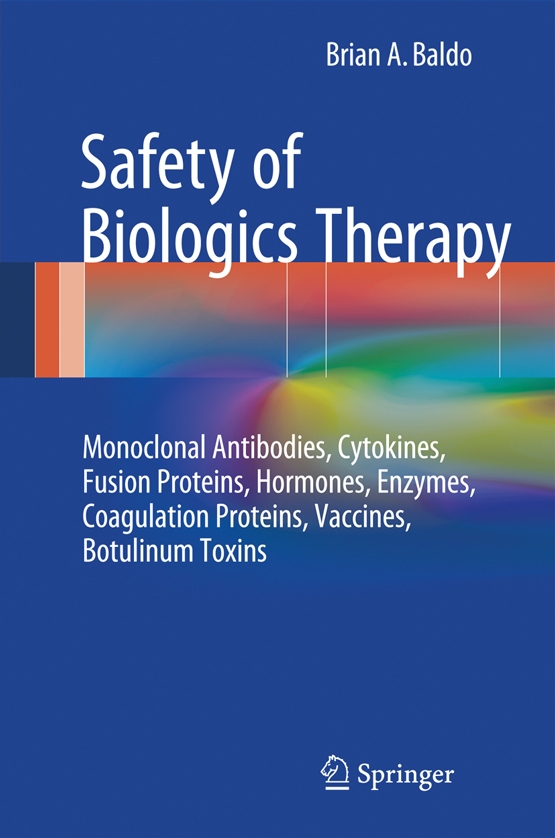
Safety of biologics therapy. Brian A Baldo. Springer, 2016 (€109.99; 610 pp). ISBN 9783319304700
The skyrocketing number of biological agents available is partly due to their specific targeting ability and also because new indications continue to be discovered, spanning multiple medical disciplines. Biological agents differ from small molecular drugs in the durations of action and adverse effects, particularly with hypersensitivity, infusion reactions, infections and immunogenicity. There are available resources detailing safety in specific diseases, but as more biological agents are marketed for a greater disease range, it is essential to have a single resource such as Safety of biologics therapy, which covers comprehensively all biologicals for all conditions for various health professionals, without becoming quickly outdated.
Formerly heading the Molecular Immunology Unit at the Kolling Institute in Sydney, Brian Baldo’s field knowledge is undoubted; yet publishing this 600-page book is still no mean feat. It is an up-to-date reference covering early biologicals, such as human insulin, to the recently approved monoclonal antibody atezolizumab. It details — sometimes excessively so — each drug’s indications, adverse effects and immunogenicity reported by clinical trials and international drug regulators. However, unfortunately for Australian readers, the Therapeutic Goods Administration indications and Pharmaceutical Benefits Scheme approval status are not explicitly included.
The text contains sequential lists, either of adverse effects with specific drugs or of drugs with specific adverse effects (eg, “human mouse chimeras abciximab, basiliximab, brentuximab, cetuximab, infliximab, rituximab, siltuximab, and dinutuximab”), which makes the text difficult to follow occasionally. The book excels in explaining the known mechanisms of action and toxicity of these drugs, but it may be improved by offering potential theories for unknown mechanisms of toxicity. Detailed tables contain useful information but overflow onto subsequent pages, leading to cumbersome flicking between pages for abbreviations and footnotes. The key message — use these drugs with appropriate caution — is lost in the main text’s detail; the text could be simplified in future editions to highlight this better.
The best feature of the book is the chapter summaries. These are succinct and very readable — ideal for clinicians needing a quick reference, students requiring clear and precise details about the drug’s safety, or academics wanting a taste of the complexities that lie within the chapter’s text. Even for just these summaries, investment in this book is worthwhile.
Competing interests
No relevant disclosures.
Intranasal Adrenaline Use for the Management of Insect Venom-Induced Anaphylaxis
Thomas J. Young, Wilhelmina R. F. Johnson, Braydon L. Pennington, Troy Wanandy, Wun Y. Lau, Thanh-Thao A. Le
Gabapentinoid Poisoning Presentations to Victorian Emergency Departments: A 15-Year Trend Analysis
Bishaal Tej Gurung, Amy McNeilage, Angus Skeen, Tina Lam, Joanna F. Dipnall, Jane Hayman, Suzanne Nielsen, Ting Xia
Still Treating Yesterday's Risk? Reconsidering Antiviral Use for Mild-to-Moderate COVID-19 Cases in a Broadly Immune Population
Hadar Mudrik-Zohar, Tim Cutfield, Susan Morpeth, Thomas Hills, Eamon Duffy, Laura J. Edwards, Allen C. Cheng, Steven Y. C. Tong
Birth prevalence, clinical sequelae, and management of congenital cytomegalovirus infections in Australia, 1999–2023: a national prospective study
Ece Egilmezer, Suzy M Teutsch, Carlos Nunez, Stuart T Hamilton, Adam W Bartlett, Pamela Palasanthiran, Elizabeth J Elliott, William D Rawlinson
Concurrent use of hormonal long‐acting reversible contraception by women of reproductive age dispensed teratogenic medications, Australia, 2013–2021
Aaron E Boyce, Tony Caccetta, Jo‐Ann See, Rosemary L Nixon AM
Concurrent use of hormonal long‐acting reversible contraception by women of reproductive age dispensed teratogenic medications, Australia, 2013–2021
Michelle KY Chen, Adrian Lim, Deshan F Sebaratnam