




Volume 216 - Issue 9
Uncontrolled blood pressure in Australia: a call to action
Authors: Jodie Bailie, Veronica Matthews and Ross S Bailie
Med J Aust 2022; 216 (9): 487-488. || doi: 10.5694/mja2.51503
Published online: 16 May 2022
Published online: 16 May 2022
To the Editor: We congratulate Schutte and colleagues1 for their call to action for improved management of blood pressure in Australia, highlighting that 68% of people have uncontrolled high blood pressure. The burden of high blood pressure is unevenly distributed, with Aboriginal and Torres Strait Islander (hereafter referred to respectfully as Indigenous) people reportedly having a higher rate of high blood pressure than non‐Indigenous Australians in every age group.2 Reducing the prevalence of high blood pressure is one of the most important means of reducing serious circulatory diseases, which are among the leading causes of death for Indigenous Australians.3 Hence, we want to extend the call to action and report on what is happening in primary health care settings with the control of blood pressure for Indigenous people.
During 2012–13, we analysed blood pressure screening and follow‐up for patients diagnosed with hypertension (n = 6523) from 123 primary health care centres across Australia using continuous quality improvement data from audits of adherence to best practice chronic illness care.4 Given there are no recently available data on follow‐up actions after an abnormal blood pressure reading at this geographic scale, and as blood pressure continues to be relatively uncontrolled, these data continue to provide unique insight.
The data, aggregated at primary health care centre level (Box), tells a story of clinical inertia. Regular blood pressure screening was done well — centres on average completed blood pressure screening for about 90% of patients within the past 6 and 12 months. In this cohort, about 65% of patients recorded abnormal blood pressure (n = 4240). Most primary health care centres had documentation of a follow‐up plan for more than 70% of patients, but there was wide variation (range, 0–100%; Box). Dealing with the low levels of medication reviews and adjustments (mean, ~15%; range, 0–100%) is a vital early step in limiting the contribution of uncontrolled blood pressure to adverse health outcomes for Indigenous people.
These data support the need for training on strategies to overcome clinical inertia, which was identified as a top priority by over 200 Indigenous primary health care practitioners, managers and policymakers.5 We add to the call for more attention on prevention of cardiovascular disease and suggest additional investment in evidence‐based interventions appropriate to Indigenous Australian culture and needs. The time for system‐wide action has come.
Box – Boxplots showing a record of scheduled services received by patients with hypertension and follow‐up of abnormal findings within the last 12 months of audit (unless otherwise indicated) at primary health centres during 2012–13
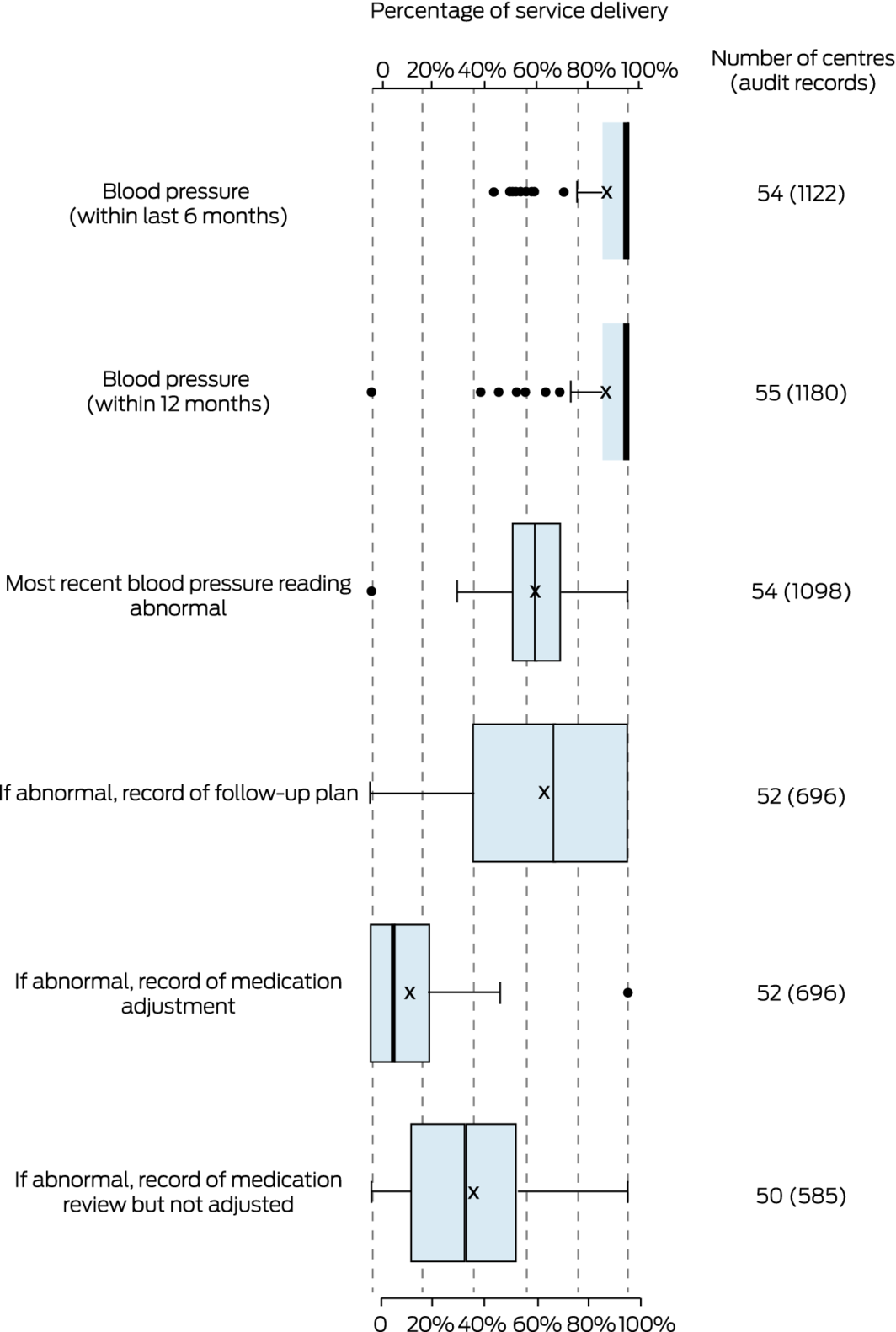
x = mean value. More information on how to interpret box plots is available in Matthews et al.4
Competing interests
No relevant disclosures.
Acknowledgements
The National Health and Medical Research Council funded the ABCD National Research Partnership Project (#545267) and the Centre for Research Excellence in Integrated Quality Improvement (#1078927) and the Centre for Research Excellence in Strengthening Systems for Indigenous Health Care Equity (#1170882). In‐kind and financial support was provided by the Lowitja Institute and a range of community‐controlled and government agencies. The funders had no role in the planning, writing or publication of the work, or for a research paper, any role in study design, data collection, analysis or interpretation, reporting or publication. The development of this manuscript would not have been possible without the active support, enthusiasm and commitment of staff in participating primary health care services, and members of the ABCD National Research Partnership, Centre for Research Excellence in Integrated Quality Improvement, and Centre for Research Excellence in Strengthening Systems for Indigenous Health Care Equity. Veronica Matthews is from the Quandamooka community, North Stradbroke Island, Queensland. Jodie Bailie and Ross Bailie are non‐Indigenous researchers. All authors have a long‐standing commitment to improving health outcomes for Aboriginal and Torres Strait Islander people.
References
- Schutte AE, Webster R, Jennings G, Schlaich MP. Uncontrolled blood pressure in Australia: a call to action. Med J Aust 2022; 216: 61‐63. https://www.mja.com.au/journal/2022/216/2/uncontrolled‐blood‐pressure‐australia‐call‐action
- Australian Institute of Health and Welfare. Aboriginal and Torres Strait Islander Health Performance Framework: 2020 summary report [Cat. No. IHPF 2]. https://www.indigenoushpf.gov.au/getattachment/65fbaaf3‐100c‐4df5‐941c‐a8455922693c/2020‐summary‐ihpf‐2.pdf (viewed Feb 2022).
- Walsh WF, Kangaharan N. Cardiac care for Indigenous Australians: practical considerations from a clinical perspective. Med J Aust 2017; 207: 40‐45. https://www.mja.com.au/journal/2017/207/1/cardiac‐care‐indigenous‐australians‐practical‐considerations‐clinical
- Matthews V, Connors C, Laycock A, et al. Chronic illness care for Aboriginal and Torres Strait Islander people: final report — ESP Project: priority evidence‐practice gaps and stakeholder views on barriers and strategies for improvement, April 2015. Menzies School of Health Research, 2015. https://apo.org.au/node/54395 (viewed Feb 2022).
- Bailie J, Laycock A, Matthews V, Bailie R. System‐level action required for wide‐scale improvement in quality of primary health care: synthesis of feedback from an interactive process to promote dissemination and use of aggregated quality of care data. Front Public Health 2016; 4: 86.
Linked content
-
MJA Perspective: Uncontrolled blood pressure in Australia: a call to action
-
MJA Letter: In reply
Fatty Liver Disease in Australia: A Narrative Review on the Epidemiology, Natural History, Prognostication and Management in People With Metabolic Dysfunction
Karl Vaz, Daniel Clayton-Chubb, William W. Kemp, Stuart K. Roberts, Ammar Majeed
Sex Differences in Management and Outcomes of People With ST-Elevation Myocardial Infarction, New South Wales, 2011–2020: A Retrospective Cohort Study
Adam C. Livori, Jedidiah I. Morton, Dianna J. Magliano, Jonathan E. Shaw
Rethinking Rheumatic Fever Diagnosis: Progress, Pitfalls and the Path Towards a Definitive Test
Anna P. Ralph, Rachel Webb, Tom Parks, Nicole J. Moreland, Asha C. Bowen, Benjamin Jones, Emma Ndagire, Andrea Z. Beaton
Sex Differences in Management and Outcomes of People With ST-Elevation Myocardial Infarction, New South Wales, 2011–2020: A Retrospective Cohort Study
Samia Kazi, Simone Marschner, Clara K. Chow
Distribution of Cardiovascular Disease Risk Based on the Updated 2023 Guideline-Recommended Australian Cardiovascular Disease Risk Algorithm and Comparison With the 2012 Algorithm: An Observational Study
Nina Lazarevic, Meghana Bhat, Grace Joshy, Danielle C. Butler, Mark Woodward, Anushka Patel, Rod T. Jackson, Garry Jennings, Rosemary Wyber, Ellie Paige, Emily Banks
They Brought the Hospital to Me
Hugh N. Burrill