




Volume 207 - Issue 10
Comprehensive guide to the diagnosis and management of occupational lung diseases
Author: Arthur (Bill) W Musk
Med J Aust 2017; 207 (10): 424. || doi: 10.5694/mja17.00572
Published online: 20 November 2017
Published online: 20 November 2017
Parkes’ occupational lung disorders, 4th edition
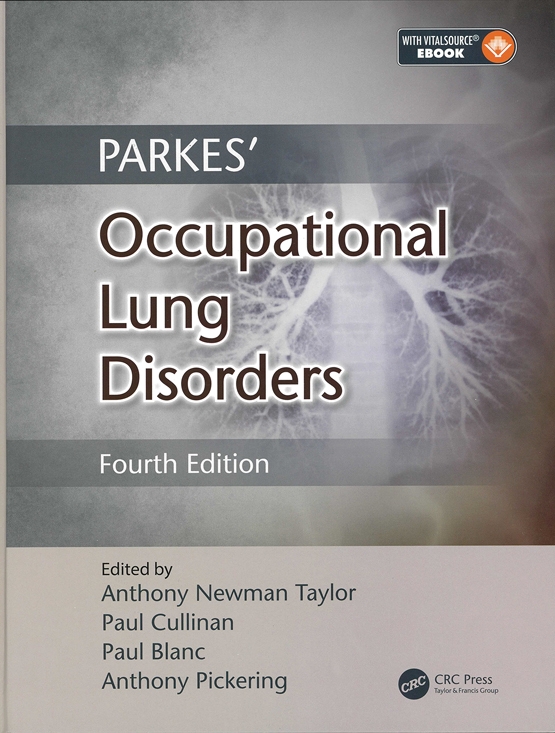
Parkes’ occupational lung disorders, 4th edition.
Newman Taylor A, Cullinan P, Blanc P, Pickering A, editors. CRC Press, 2017 (£127.00; 547 pp). ISBN 9781482240702
In the 20 years since the previous edition of this textbook, the spectrum of occupational lung diseases has evolved and has experienced considerable advances. The editors of Parke’s occupational lung disorders, 4th edition, have acknowledged these advances and have comprehensively addressed the new evidence and investigative changes.
This fourth edition includes work from 62 well qualified contributing authors internationally (from the United Kingdom, the United States, Canada, New Zealand, Australia, Sweden, the Netherlands, Belgium, Italy, France, Brazil and South Africa), reflecting the worldwide expansion of hazardous industries. Only one chapter (on geology and geochemistry) remains the same since the first edition in 1974. There has been a change in focus from pneumoconiosis to occupational cancers, occupational asthma, chronic obstructive pulmonary disease and extrinsic allergic alveolitis. The book has new chapters on interstitial lung disease, obliterative bronchiolitis and organising pneumonia. Operating in the different disease processes is also reasonably discussed.
The work is critical, authoritative and comprehensive. It is thoroughly referenced and updated to 2015, which, in addition to its focus on epidemiology, practical clinical issues, pertinent investigations and relevant scientific mechanisms, make it a valuable and reasonably contemporary resource.
The book emphasises the importance of taking a detailed occupational and environmental exposure history and interpretation of workplace visits — also including the patient’s smoking history — by the clinician faced with a patient who may have an occupational disease. Further, it is pointed out that the American Thoracic Society has estimated that a significant proportion of cases of common diseases (eg, asthma, chronic obstructive pulmonary disease and lung cancer) may be attributed to occupational exposures, which has important preventive as well as medicolegal implications. There is also practical advice on investigation and monitoring of possible occupational lung diseases, including the role of computed tomography studies. The chapters on the performance and interpretation of lung function tests and disability assessment are well written and may be most useful to the practising clinician. Moreover, the book correctly acknowledges and discusses the issues of attribution and compensation assessment and of parochial medicolegal administration.
The four editors are all well known internationally for their expertise in the area of occupational lung diseases, which is reflected in a high quality authoritative textbook.
Competing interests
No relevant disclosures.
Barriers and Facilitators to Timely Detection and Optimal Management of Chronic Wet Cough in Aboriginal Children Across Australia From the Perspectives of Carers of Aboriginal Children: A Qualitative Study
Gloria T. Y. Lau, Pam Laird, Robyn Aitken, Melanie Barwick, Liam Bedford, Emily R. Bowden, Jamie Everingham, Angela Fuery, Reece Griffin, Neha Jain, Mina Kinghorn, Renae Knapp, Gabrielle B. McCallum, Peter Morris, Richard Norman, Peter C. Richmond, Aarti Saiganesh, Slade Sibosado, Cameron Taylor, Maree Toombs, Roz Walker, Joan Wilson, Anne B. Chang, André Schultz
Barriers and Facilitators to Timely Detection and Optimal Management of Chronic Wet Cough in Aboriginal Children Across Australia From the Perspective of Health Care Providers: A Qualitative Study
Gloria T. Y. Lau, Pamela Laird, Robyn Aitken, Melanie Barwick, Liam Bedford, Emily R. Bowden, Corey Dalton, Jamie Everingham, Angela Fuery, Reece Griffin, Neha Jain, Mina Kinghorn, Renae Knapp, Gabrielle B. McCallum, Peter Morris, Richard Norman, Peter C. Richmond, Aarti Saiganesh, Slade Sibosado, Maree Toombs, Roz Walker, Joan Wilson, Anne B. Chang, André Schultz
Respiratory Syncytial Virus Disease Burden and Evidence Gaps in Australia Before Immunisation Introduction: A Retrospective Population-Based Study Using 2016–2019 Hospitalisation and 2023 Laboratory Surveillance Data
Chisato Imai-Boulter, Jean Li-Kim-Moy, Clayton Chiu, Sanjay Jayasinghe, Kristine Macartney
Not Gone but Often Forgotten: Action Needed to Address Tuberculosis in Aboriginal and Torres Strait Islander Communities
Nikkita Joshua, Emma L. Smith, Eunice (Cheeky) Love, Christopher P. Lowbridge, Nicole Tukana, Amy Bowden, Megan A. Campbell, Dawn Casey, James Ward
Uneven Ground: Survival Differences Among Victorian Lung Cancer Patients by Location of Residence (2011–2023): A Retrospective Cohort Study
Evangeline Samuel, Eldho Paul, Mike Lloyd, Sanuki Tissera, Craig Underhill, Sagun Parakh, Phillip Parente, Inger Olesen, Javier Torres, Katharine See, Gavin M. Wright, David Langton, Thomas John, Matthew Conron, James Bartlett, Nicola Atkin, Nikolajs Zeps, Susan V. Harden, Wasek Faisal, John R. Zalcberg, Rob G. Stirling
Treatment and Survival Outcomes for Indigenous and Non-Indigenous Australians Within the Victorian Lung Cancer Registry: A Retrospective Cross-Sectional Cohort Study
Melanie Wong, Mike Lloyd, Jessie Zeng, Sanuki Tissera, Kalinda E. Griffiths, Justine Clark, Jonathan Gillies, Lisa Briggs, Jacqueline Lesage, Tom Wood, Craig Underhill, Sagun Parakh, Louis B. Irving, Wasek Faisal, Rob Blum, Gary E. Richardson, Phillip Parente, Michelle Caldecott, Inger Olesen, Javier Torres, Evangeline Samuel, Christopher Lyne, Katharine See, David Langton, Thomas John, Gavin Wright, Matthew Conron, James Bartlett, Golsa Adabi, Maggie Moore, Susan Harden, Zoe K. McQuilten, John R. Zalcberg, Rob Stirling