




Volume 203 - Issue 5
Ciclesonide-induced bronchospasm: an important but preventable side effect
Authors: Payal H Mandaliya, Brendan Kennedy, Peter van Asperen and Paul D Robinson
Med J Aust 2015; 203 (5): 233. || doi: 10.5694/mja15.00014
Published online: 7 September 2015
Published online: 7 September 2015
Newer asthma preventer medication can cause bronchospasm
Despite recent advances in its management, asthma remains a significant ongoing cause of morbidity1 and mortality2 in Australia. Ciclesonide, a newer inhaled corticosteroid, offers exciting potential to improve both asthma control and longer-term outcomes. This is because of its improved safety profile relative to other asthma medications, and the potential for improved adherence to treatment, given its proven efficacy as a once-daily medication.3 It is administered as a prodrug, activated within the lungs, and has lower oral bioavailability and extensive first-pass metabolism which reduces its systemic side effect profile.4 In Australia, ciclesonide is now available on the Pharmaceutical Benefits Scheme for use in children from the age of 6 years. Despite increasing use of this drug, side effects are infrequently reported.
We highlight an important potential side effect of ciclesonide treatment, which occurred in three adolescent patients with asthma, who recently attended our tertiary paediatric hospital-based clinic with persistent asthma (ranging in severity from mild to moderately severe based on recommended classifications5). Ciclesonide therapy had been commenced in each patient in an attempt to improve both asthma control as well as compliance. All three patients experienced ciclesonide-induced bronchospasm after using ciclesonide, which was confirmed on formal challenge testing (with ciclesonide at the same dose that was being administered for asthma) in a specialised respiratory function laboratory. The bronchospasm was reversed by use of an inhaled bronchodilator (Box), and then prevented during ongoing treatment by use of a bronchodilator before dosing with ciclesonide. Ciclesonide treatment was subsequently shown to improve overall asthma control to within acceptable limits in two of the three patients. In the third, failure to achieve this reflected the severity of the underlying persistent asthma as shown by this patient’s need for daily oral corticosteroid therapy to achieve symptom control. The adverse reactions to ciclesonide in these patients were reported to the manufacturers of ciclesonide (Takeda Pharmaceuticals Australia), and ciclesonide-induced bronchoconstriction is now listed as a recognised side effect in the product information for this drug.
Ciclesonide is an attractive preventer medication for persistent asthma in children aged 6 years and over for several reasons. However, health professionals should be aware of this important potential side effect, which we speculate is currently underrecognised, but easily identified with careful questioning about wheeze and/or chest tightness after ciclesonide dosing. If suspected, we recommend that patients be referred for formal ciclesonide airway challenge testing (at the same ciclesonide dose being administered for treatment) in a specialised respiratory function laboratory. If the patient’s bronchoconstriction can be reversed by administering a bronchodilator, a subsequent trial of pretreatment with a bronchodilator before ciclesonide dosing should be performed before finally evaluating the role of ciclesonide therapy on asthma control.
1 Ciclesonide-induced bronchospasm during ciclesonide-based airway challenge testing
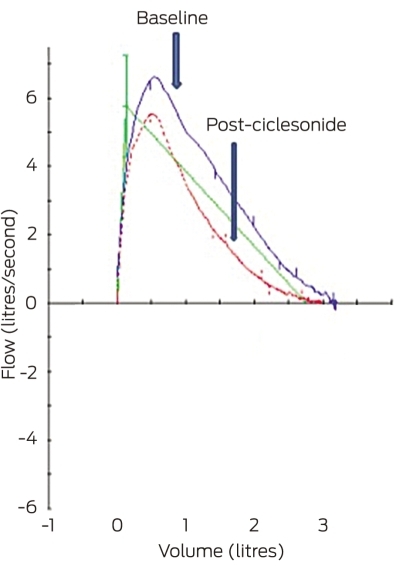
The green line indicates the reference data for a child of the same age, sex and height. Baseline and post-ciclesonide challenge flow-volume loops are shown by the purple and red lines, respectively. The fall in (forced expiratory volume in one second; FEV1) from 106% to 86% predicted represented a 19% fall in FEV1 with ciclesonide administration.
Competing interests
No relevant disclosures.
References
- Australian Centre for Asthma Monitoring. Asthma in Australia 2011: with a focus chapter on chronic obstructive pulmonary disease. Canberra: Australian Institute of Health and Welfare, 2011. (AIHW Asthma Series No. 4. AIHW Cat. No. ACM 22.) http://www.aihw.gov.au/WorkArea/DownloadAsset.aspx?id=60129544677 (accessed Jun 2015).
- Ombudsman New South Wales. NSW Child Death Review Team Annual Report 2013. Sydney: Ombudsman New South Wales, 2014. https://www.ombo.nsw.gov.au/__data/assets/pdf_file/0008/19628/CDRT-Annual-Report-2013.pdf (accessed Jun 2015).
- Gelfand EW, Georgitis JW, Noonan M, Ruff ME. Once-daily ciclesonide in children: efficacy and safety in asthma. J Pediatr 2006; 148: 377-383.
- Lipworth BJ, Kaliner MA, LaForce CF, et al. Effect of ciclesonide and fluticasone on hypothalamic–pituitary–adrenal axis function in adults with mild-to-moderate persistent asthma. Ann Allergy Asthma Immunol 2005; 94: 465-472.
- National Asthma Council Australia. Australian asthma handbook, Version 1.1. Melbourne: NAC Australia, 2014. http://www.asthmahandbook.org.au (accessed Jun 2015).
Barriers and Facilitators to Timely Detection and Optimal Management of Chronic Wet Cough in Aboriginal Children Across Australia From the Perspectives of Carers of Aboriginal Children: A Qualitative Study
Gloria T. Y. Lau, Pam Laird, Robyn Aitken, Melanie Barwick, Liam Bedford, Emily R. Bowden, Jamie Everingham, Angela Fuery, Reece Griffin, Neha Jain, Mina Kinghorn, Renae Knapp, Gabrielle B. McCallum, Peter Morris, Richard Norman, Peter C. Richmond, Aarti Saiganesh, Slade Sibosado, Cameron Taylor, Maree Toombs, Roz Walker, Joan Wilson, Anne B. Chang, André Schultz
Barriers and Facilitators to Timely Detection and Optimal Management of Chronic Wet Cough in Aboriginal Children Across Australia From the Perspective of Health Care Providers: A Qualitative Study
Gloria T. Y. Lau, Pamela Laird, Robyn Aitken, Melanie Barwick, Liam Bedford, Emily R. Bowden, Corey Dalton, Jamie Everingham, Angela Fuery, Reece Griffin, Neha Jain, Mina Kinghorn, Renae Knapp, Gabrielle B. McCallum, Peter Morris, Richard Norman, Peter C. Richmond, Aarti Saiganesh, Slade Sibosado, Maree Toombs, Roz Walker, Joan Wilson, Anne B. Chang, André Schultz
Respiratory Syncytial Virus Disease Burden and Evidence Gaps in Australia Before Immunisation Introduction: A Retrospective Population-Based Study Using 2016–2019 Hospitalisation and 2023 Laboratory Surveillance Data
Chisato Imai-Boulter, Jean Li-Kim-Moy, Clayton Chiu, Sanjay Jayasinghe, Kristine Macartney
Not Gone but Often Forgotten: Action Needed to Address Tuberculosis in Aboriginal and Torres Strait Islander Communities
Nikkita Joshua, Emma L. Smith, Eunice (Cheeky) Love, Christopher P. Lowbridge, Nicole Tukana, Amy Bowden, Megan A. Campbell, Dawn Casey, James Ward
Uneven Ground: Survival Differences Among Victorian Lung Cancer Patients by Location of Residence (2011–2023): A Retrospective Cohort Study
Evangeline Samuel, Eldho Paul, Mike Lloyd, Sanuki Tissera, Craig Underhill, Sagun Parakh, Phillip Parente, Inger Olesen, Javier Torres, Katharine See, Gavin M. Wright, David Langton, Thomas John, Matthew Conron, James Bartlett, Nicola Atkin, Nikolajs Zeps, Susan V. Harden, Wasek Faisal, John R. Zalcberg, Rob G. Stirling
Treatment and Survival Outcomes for Indigenous and Non-Indigenous Australians Within the Victorian Lung Cancer Registry: A Retrospective Cross-Sectional Cohort Study
Melanie Wong, Mike Lloyd, Jessie Zeng, Sanuki Tissera, Kalinda E. Griffiths, Justine Clark, Jonathan Gillies, Lisa Briggs, Jacqueline Lesage, Tom Wood, Craig Underhill, Sagun Parakh, Louis B. Irving, Wasek Faisal, Rob Blum, Gary E. Richardson, Phillip Parente, Michelle Caldecott, Inger Olesen, Javier Torres, Evangeline Samuel, Christopher Lyne, Katharine See, David Langton, Thomas John, Gavin Wright, Matthew Conron, James Bartlett, Golsa Adabi, Maggie Moore, Susan Harden, Zoe K. McQuilten, John R. Zalcberg, Rob Stirling