




Reflections
Book reviews
Volume 201 - Issue 9
Guns, bombs and stethoscopes
Author: Brendan J Nelson
Med J Aust 2014; 201 (9): 553. || doi: 10.5694/mja14.01122
Published online: 28 October 2014
Published online: 28 October 2014
It is tempting, human beings that we are, to settle for the broad brushstrokes of history. In neglectful ignorance we can easily forget individual sacrifices made in our name and allow the past to become a distant stranger. To do so in relation to our medical forebears who served, and of whom many were wounded and died in World War I, would demean them and ...
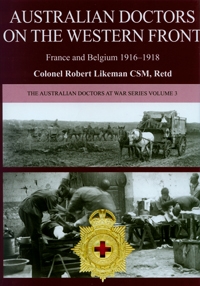
Australian doctors on the Western Front: France and Belgium 1916–1918. Blood, sweat and fears: medical practitioners and medical students of South Australia who served in World War I.
Australian doctors at war series; vol. 3. Robert Likeman. Sydney: Rosenberg Publishing, 2014 (496 pp, $69.95). ISBN 9781925078121. Christopher Verco, Annette Summers, Tony Swain, Michael Jelly. Army Health Services Historical Research Group, 2014 (228 pp,
It is tempting, human beings that we are, to settle for the broad brushstrokes of history. In neglectful ignorance we can easily forget individual sacrifices made in our name and allow the past to become a distant stranger. To do so in relation to our medical forebears who served, and of whom many were wounded and died in World War I, would demean them and diminish us.
Two publications make a stunning contribution to our understanding of the men and women who enlisted to serve in our name through the cataclysm that was the Great War. Each is an essential addition to what should be our own commitment to never forget. But both document not only service in war but also the origins, history and leadership of Australian medicine through much of the 20th century.
These books are a rollcall of extraordinary men and women who served overseas, and of an age of service — to others, to medicine and to Australia.
In Australian doctors on the Western Front, Likeman has painstakingly documented the lives of 700 Australian medical personnel — their place of birth, early education and contribution to family and community. He provides narrative descriptions of the battles that are easy to understand. The Western Front and its epic magnitude of suffering, endurance and courage are brought to life. So too are the training establishments and hospitals as essential elements of the larger medical effort.
The power as always is in the story. And the story of Algernon Lilford, MC is one of service, selflessness, devotion to duty and courage. A graduate of the University of Melbourne, Lilford enlisted immediately after graduation in 1916 and embarked for France. In August 1918, although he himself was suffering from trench fever, Lilford remained at his post in Rosières-en-Santerre when it was bombed and a truckload of German gas shells nearby caught fire. Wearing a respirator, he continued to care for the wounded even as he oversaw the evacuation of his casualty clearing station and the extinction of the fire. He later endured prolonged and multiple hospitalisations for “mania”, thought to be a consequence of post-traumatic stress. He never practised medicine again.
Another recipient of the Military Cross was Christopher Matheson, a Sydney graduate who served in the hell that was Passchendaele in late 1917. The citation for his MC, awarded at Mont St Quentin on 2 September 1918, reads:
… he pushed forward behind the first waves, attending the wounded under heavy artillery and machine-gun fire. Later he established a forward post, and through his gallantry and untiring exertion he saved many lives.
Matheson returned from the war to Australia in November 1919, entering general practice in Rockhampton, Queensland, where he gave his all to the community until his death in 1973.
Also documented is the life and war service of the Australian Medical Association's first president, Sir Henry Colville, who served a year in France and then in the 5th General Hospital as a captain in the Australian Army Medical Corps.
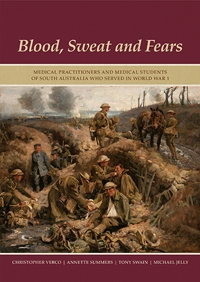
Blood, sweat and fears: medical practitioners and medical students of South Australia who served in World War I. Christopher Verco, Annette Summers, Tony Swain, Michael Jelly. Army Health Services Historical Research Group, 2014 (228 pp, $25.00).
To say Blood, sweat and fears documents the stories of the South Australian medical students and doctors who answered their nation's call in 1914 would be an understatement. It is much more. Verco and colleagues have given both the medical profession and the people of South Australia a great gift. It might be regarded as SA's contribution to Australia's World War I effort. The 12 Distinguished Service Orders and 20 Military Crosses or Military Medals awarded to South Australians still do not do justice to what the state gave to its then young nation.
Within the book's pages are commemorated stories of courage, dedication and loss beyond our understanding. But the book is also a celebration of the remarkable work done by that generation to build and lead the medical profession after the World War I. Having done that, many of them served again in World War II, both at home and overseas. They would then lead the learned colleges out of all proportion to their numbers.
* * *
Likeman reminds us of the words of Winston Churchill, in The story of Malakand Field Force written in 1898 when he was a subaltern in the Indian Army:
The profession of medicine and surgery must always rank as the most noble that men can adopt. The spectacle of a doctor in action among soldiers, in equal danger and with equal courage, saving life where all others are taking it, allaying pain where others are causing it, is one which must always seem glorious, whether to God or man.
As further testimony to the lives documented in these works, it is worth reflecting on two facts. The first is that there are only two individuals honoured with bronze sculptures at the Australian War Memorial — stretcher bearer John Simpson Kirkpatrick, and surgeon Weary Dunlop. The second is that the first Victoria Cross awarded to an Australian was to a doctor — Neville Howse at Vredefort in 1900.
Any medical student or medical practitioner in search of inspiration needs look no further than these two publications. Each is the story of a generation who made us who we are and gave us what we have.
Prisoner of war pathology in Changi, 1942–1945
Kate Ariotti, Elizabeth Roberts‐Pedersen
Should medical eponyms continue to be used in everyday practice?
Leya Nedumannil, Diana Lewis
100 years on: the first use of insulin in Australia
Sophie Templer
Reflections on the life and career of Professor Dame Valerie Beral AC DBE FRS FRCOG FMedSci (1943–2022)
Karen Canfell, Bette Liu, Emily Banks
The Honourable Dr Donald James Grimes AO
Michael Kirby, Patti Warn
From wipeout to drill out: a history of exostosis management and Australian surfing
Alon Taylor, Hannah North, Narinder P Singh, Paul A Fagan