




Perspectives
Rural health
Volume 201 - Issue 10
Rural patients travel for health care
Author: Linda J Samera
Med J Aust 2014; 201 (10): 566. || doi: 10.5694/mja14.01195
Published online: 17 November 2014
Published online: 17 November 2014
A country doctor confronts the devastating realities of needing specialist care in a distant city
A country doctor comes face to face with the devastating realities of needing specialist care in a distant city
Today, I entered the world of the chronically ill. I am forced to grapple with the shattering diagnosis of a life-threatening autoimmune disease. My medical career and life as I have known it are shelved for the foreseeable future. Hopes and dreams are buried under the rubble of severe illness. Suddenly, my husband is my carer, and his career hangs in the balance too. Roles within the family radically change in a moment, and nothing looks familiar. The devastation does not stop there, though. Being casually or self-employed means income ceases immediately for both of us. We have entered the unchartered waters of financial insecurity.
This is enough to swallow for one day. Tomorrow, I start the arduous task of planning and packing for the more than 1100 km round trip for treatment. Being sick, this is the last thing I feel like doing. The long drives are torture to stiff and painful joints, and severely challenge my ability to shut out the nausea. Why am I sentenced to travel for essential health care? I am guilty, like so many other Australians, of living in a regional area. This is the first of monthly journeys that are potentially a life sentence.
Initially, accommodation is provided by the hospital, charged at the state's Patient Assisted Travel Scheme (PATS) rebate rate, making it affordable. The shared cooking and dining facilities allow for the building of a support network away from home. We are all in the same boat, and the camaraderie of fellow patients in this setting proves invaluable. Six months later, this accommodation closes and, suddenly, we are out in the cold with our comrades with nowhere to stay. In New South Wales this is the trend: country patient accommodation is slowly being closed down. The state government has said it is not its responsibility. The hospitals say accommodation is not an essential part of treatment, and therefore not their responsibility. One state government official told me the responsibility lies with non-government organisations (NGOs). NGOs built country patient accommodation in the city years ago, but these are being demolished or sold off by state governments and hospitals.
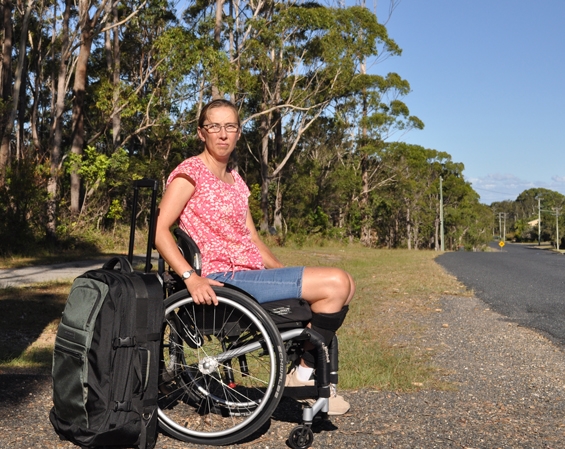
The situation for country patients is dire. The only accommodation that might be covered by the PATS rebate in NSW is a dorm bed in backpackers' accommodation. Not the place for the severely immunosuppressed, nor the healing and restful environment needed by sick patients. For anyone like myself in a wheelchair, accommodation options are further restricted. Try searching the internet for wheelchair-friendly accommodation for less than $100 per night near major hospitals. This is some of the discrimination that people with a disability face when trying to find affordable and accessible accommodation in Australia.
The severely limited facilities provided for regional patients are frequently unaffordable and unfriendly to the sick, limiting their ability to participate in treatment or recovery. Regional Australians are frequently blamed for their plight because they choose to live in the country. Those treating us demand: “Why don't you move to the city? It would be much simpler.” Simpler for who? Many regional Australians silently suffer every day, and have no voice on this issue because they are sick. They are the ones going into debt or giving up their homes to pay for travel, sleeping in their cars when there is nowhere affordable to stay, losing their jobs because they are away from home, suffering through family breakdown, foregoing treatment altogether, or even dying because no one will take responsibility for this problem.
Competing interests
No relevant disclosures.
Provenance: Not commissioned; not externally peer reviewed.
Shifting focus to adolescent wellbeing and inclusive participation in the digital age
Allyson R Todd, Elena Wang, Stephanie R Partridge
The clinical presentation, investigation, and management of women diagnosed with endometriosis in Australian general practices, 2011–2021: an open cohort study
Danielle Mazza, Kailash Thapaliya, Sharinne B Crawford, Alissia Hui, Maryam Moradi, Luke E Grzeskowiak
The impact of the Breast Screen NSW transition from film to digital mammography, 2002–2016: a linked population health data analysis
Rachel Farber, Nehmat Houssami, Katy J L Bell
Non‐technical errors associated with deaths in surgical care, Australia, 2012–2019, by surgical specialty (Australian and New Zealand Audit of Surgical Mortality): a retrospective cohort study
Jesse Ey, Victoria Kollias, Octavia Lee, Kelly Hou, Matheesha Herath, John B North, Ellie Treloar, Suzanne Edwards, Martin Bruening, Adam J Wells, Guy J Maddern
The CURE Asthma roadmap
Gary P Anderson, Anthony Flynn, Phil G Bardin, John D Blakey, Shyamali C Dharmage, Paul Foster, Peter G Gibson, Adam Jaffe, Alan James, Christine R Jenkins, Sundram Sivamalai, Peter D Sly, Guy B Marks, Vanessa M McDonald, Judy Wetttenhall
Evidence from Australian cohort studies about asthma trajectories and transitions across the life course: a narrative review
Caroline Lodge, Xin Dai, Ingrid A. Laing, Michael P Menden, Anthony Flynn, Gary P Anderson, Sarath Ranganathan, Shyamali C Dharmage