




Volume 198 - Issue 5
The pricing of statins and implications for Pharmaceutical Benefits Scheme expenditure
Author: Philip M Clarke
Med J Aust 2013; 198 (5): 260. || doi: 10.5694/mja12.11439
Published online: 18 March 2013
Published online: 18 March 2013
To the Editor: Following two articles in the Journal,1,2 I wish to provide an update on the pricing of statins in Australia and the implications for Pharmaceutical Benefits Scheme (PBS) expenditure. I was prompted to do so by a recent review by the Pharmaceutical Benefits Advisory Committee (PBAC), which was instigated by the Senate when it passed legislation enabling the current pharmaceutical pricing arrangements.3 The ...
To the Editor: Following two articles in the Journal,1,2 I wish to provide an update on the pricing of statins in Australia and the implications for Pharmaceutical Benefits Scheme (PBS) expenditure. I was prompted to do so by a recent review by the Pharmaceutical Benefits Advisory Committee (PBAC), which was instigated by the Senate when it passed legislation enabling the current pharmaceutical pricing arrangements.3 The purpose of the review was to determine if there was new evidence on whether rosuvastatin and atorvastatin should be included in the existing statins therapeutic group.
A summary of the PBAC review, which was released publicly in August 2012, reaffirmed previous recommendations that atorvastatin and rosuvastatin are more effective than simvastatin in lowering cholesterol levels.4 It also noted that the current evidence did not change the PBAC’s previous advice that only an average price differential of 12.5% between atorvastatin and simvastatin was acceptable.4 This has important implications, as the ex-manufacturer price of simvastatin has fallen significantly following the first round of price disclosure to between $9 (20 mg) and $19 (80 mg),5 thus increasing the price differential. Unfortunately, the recent 25% voluntary cut in the price of atorvastatin by the manufacturers is not sufficient to meet the PBAC recommendation. The ex-manufacturer price of the most commonly prescribed dose of atorvastatin (40 mg) fell from $51 to $38 on 1 December 2012, but the price for determining PBS subsidy that the PBAC would consider acceptable (assuming that it is set at the average recommended differential) would be around $21. Applying the PBAC recommendations in full would save taxpayers and consumers about an additional $260 million annually (calculated by applying PBAC recommended prices to the quantities of each dose of atorvastatin and rosuvastatin prescribed on the PBS in 2011–12).
But even if the PBAC recommendations for atorvastatin pricing were implemented, the cost in Australia would be many times higher than other comparable countries (eg, patients in New Zealand currently pay less than A$2 per month). Similar international price differentials now exist for several other therapies for which patents have recently expired (Box). This emphasises the need for substantial reform of the current pricing policies to ensure value for money when purchasing pharmaceuticals through the PBS.
International price comparison of ex-manufacturer prices of selected therapies*
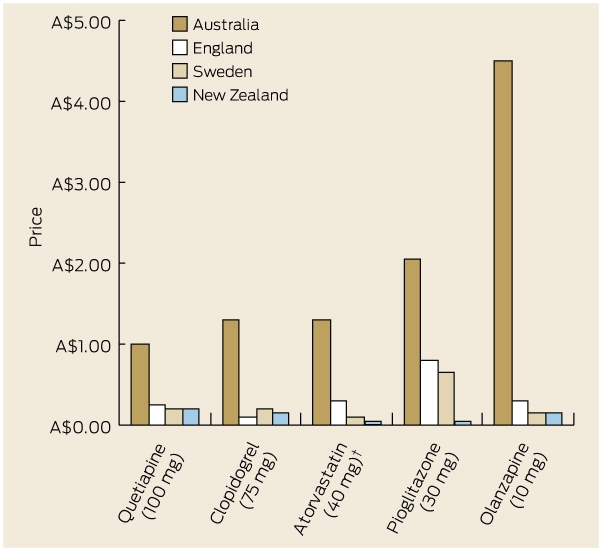
* Data were obtained from the Pharmaceutical Benefits Scheme (Australia), Pharmaceutical Services Negotiating Committee (Category M) (England), the Dental and Pharmaceutical Benefits Board (Sweden) and the Pharmaceutical Management Agency (PHARMAC) (New Zealand). Comparisons are based on average exchange rates between the 2010 and 2012 calendar years. † Price of atorvastatin in Australia takes into account the 25% price reduction that occurred on 1 December 2012.
Competing interests
No relevant disclosures.
References
- Clarke PM, Fitzgerald EM. Expiry of patent protection on statins: effects on pharmaceutical expenditure in Australia. Med J Aust 2010; 192: 633-636. 0_CHDGGAJC
- Clarke PM. Challenges and opportunities for the Pharmaceutical Benefits Scheme [editorial]. Med J Aust 2012; 196: 153-154. 0_CBBIDCJJ
- Commonwealth of Australia Parliamentary Debates. The Senate. National Health Amendment (Pharmaceutical Benefits Scheme) Bill 2010. Second Reading. Speech: Senator Nick Xenophon. Hansard 2010; 22 Nov: 1799. 0_i1142878
- Pharmaceutical Benefits Advisory Committee. July 2012 PBAC meeting outcomes — review. http://www.health.gov.au/internet/main/publishing.nsf/Content/pbacrec-july12-reviews (accessed Feb 2013).
- Department of Health and Ageing. National Health (weighted average disclosed price — main disclosure cycle) determination 2011. Instrument number PB 80 of 2011. http://www.comlaw.gov.au/Details/F2011L02702 (accessed Feb 2013).
Intranasal Adrenaline Use for the Management of Insect Venom-Induced Anaphylaxis
Thomas J. Young, Wilhelmina R. F. Johnson, Braydon L. Pennington, Troy Wanandy, Wun Y. Lau, Thanh-Thao A. Le
Gabapentinoid Poisoning Presentations to Victorian Emergency Departments: A 15-Year Trend Analysis
Bishaal Tej Gurung, Amy McNeilage, Angus Skeen, Tina Lam, Joanna F. Dipnall, Jane Hayman, Suzanne Nielsen, Ting Xia
Still Treating Yesterday's Risk? Reconsidering Antiviral Use for Mild-to-Moderate COVID-19 Cases in a Broadly Immune Population
Hadar Mudrik-Zohar, Tim Cutfield, Susan Morpeth, Thomas Hills, Eamon Duffy, Laura J. Edwards, Allen C. Cheng, Steven Y. C. Tong
Birth prevalence, clinical sequelae, and management of congenital cytomegalovirus infections in Australia, 1999–2023: a national prospective study
Ece Egilmezer, Suzy M Teutsch, Carlos Nunez, Stuart T Hamilton, Adam W Bartlett, Pamela Palasanthiran, Elizabeth J Elliott, William D Rawlinson
Medication delivery and dispensing interval preferences of people who use antihypertensive medications in Australia: a survey study
Carissa Bonner, Michael A Fajardo, Rachael M Keast, Emily Atkins, Niamh Chapman, Kristie R Weir, Anthony Rodgers, Aletta E Schutte
Concurrent use of hormonal long‐acting reversible contraception by women of reproductive age dispensed teratogenic medications, Australia, 2013–2021
Michelle KY Chen, Adrian Lim, Deshan F Sebaratnam