




Volume 197 - Issue 2
When a disaster strikes: two editors in war
Authors: Ana Marušić and Matko Marušić
Med J Aust 2012; 197 (2): 118-120. || doi: 10.5694/mja11.11630
Published online: 16 July 2012
Published online: 16 July 2012
When we watch reports of disasters that strike human populations, whether due to forces of nature or other human beings, we feel special compassion for our journal editor colleagues who face the catastrophe with their fellow citizens. They surely feel like we did in 1991 when the war started in Croatia and also a ...
Ana and Matko Marušić provide a personal view on editing in extreme situations
When we watch reports of disasters that strike human populations, whether due to forces of nature or other human beings, we feel special compassion for our journal editor colleagues who face the catastrophe with their fellow citizens. They surely feel like we did in 1991 when the war started in Croatia and also a year later when war broke out in neighbouring Bosnia and Herzegovina. As journal editors and researchers, we were removed from medical practice, but we could not simply stay isolated in the safety of science and teaching and close our eyes to the anguish of those around us.
The war caught all of us unprepared,1 probably like all disasters do. At first we did not believe that the war would start, and then we did not think it would take on the proportions it did, that the suffering would be so enormous, that recovery would take so long and, finally, that peace would bring other kinds of trials.
The year when the war began was special for us because it was the year our journal, the Croatian Medical Journal (CMJ), was born. Those were historic times of long-dreamed independence, when it finally was not politically dangerous to use the word “Croatian” in a title, as it was in the former Yugoslavia. Even more, we wanted to prove to our colleagues that it was possible to create a scientific journal in a country as small as Croatia, with its 4.4 million population — similar to that of Sydney’s greater metropolitan area. When the war began, we were working on the first issue of the journal, planned for 1992, filling it with handsome research reports and no mention of the political turmoil that had been brewing. Even after the first heavy casualties and the occupation of Croatian towns, the Editorial Board members had differing opinions on whether we should publish on war-related topics. “Science only!” maintained the majority, either to avoid problems in case of defeat or to preserve the political status quo. We compromised by publishing two supplements to the journal, one already in 1991 and the other in 1992. Matko said to the Editorial Board, “Some countries have malaria, some have AIDS — we have war and we should publish what we have learned about in war: trauma (physical and psychological); forensic medicine; refugee health; peace and human rights”. We started publishing on these topics in the regular issues later on, which helped us build up the CMJ into a respectable international journal dedicated to the health problems in small and developing communities.2
All our colleagues were delighted when we asked them to tell us about their work with war casualties and it was not difficult to solicit articles on the medical aspects of war. It was not as easy to get an actual manuscript. This was Matko’s task. Known as a devoted football player and cigarette and coffee fan, Matko would go to the battlefields to talk to his colleagues who were volunteers in the National Guard, as Croatia did not have an army at that time. They loved his visits since they shared his interests, and also because university professors were rather scarce on the battlefields. With the motto “Nothing makes better friendships than victories in football and defeats in war”, Matko lured dozens of colleagues into writing about their medical experiences in war, both for the CMJ and for other international journals. We soon learned that these excellent surgeons and physicians had important and exciting data, but no real skills in data presentation. This is how we developed our author-helpful policy of working with CMJ authors to produce good-quality manuscripts, both in language and in results reporting.2,3 In the beginning, this approach meant that Matko and the manuscript authors would make a rough outline with data tables and Ana would structure and polish the manuscript while the authors returned to places and activities they liked more, preferably field hospitals. At some point, the authors would come to our editorial office for coffee and would sign the submission letter for a journal, most often not the CMJ. With our help, Croatian physicians and surgeons who volunteered to go to field hospitals and remained in occupied territories published some 360 reports in international peer-reviewed medical journals.
The work with the authors during the war determined our future educational and research activities. From interventions to help authors we moved to “preventive” interventions for students, by introducing into the medical curriculum a mandatory course on research methodology and critical thinking and writing. In a small follow-up study of our authors, we showed that those we had instructed in manuscript writing and data presentation had, by 2003, more publications and more successful academic careers than their peers.3 Since 1996, when we introduced the course for students, we performed several studies which showed that the course had had a positive effect on students’ attitudes towards research in medicine.4 Without our war experience, we probably would not have embarked on such an exciting educational and research project, which led to the introduction of a fully vertically and horizontally integrated course on evidence-based medicine at the University of Split in 2010.
Working with authors and students was an enormously rewarding experience, but we felt that we had to do more as medical doctors and fellow citizens who were lucky enough to experience only a few air raids on the Croatian capital Zagreb. Just as it was with most of our activities during the war, ideas and actions came unexpectedly and suddenly. For example, we discussed with colleagues from neighbouring Bosnia and Herzegovina how to help the population and the hospital in the occupied Croat enclave in Bosnia. The next day, our colleague and great humanitarian, Dr Slobodan Lang, described the severity of human suffering in Bosnia on a TV show and called on people to send clothes, medication and other help. We were surprised to see Ana’s phone number listed as the contact information on the screen. The next day, the first call for Ana was from a Croat worker from Germany who asked how to send a truck with potatoes for Bosnia. The second call was from a humanitarian association of Croat workers in Germany that offered 200 hospital beds. The telephones kept on ringing, many people joined the action, and less than a month later we had sent more than a hundred trucks to Bosnia and Herzegovina. It was a difficult journey, and one of the drivers was killed and several were wounded, but the suffering of the people in the besieged area was alleviated.
For Ana, perhaps the most trying and personally painful experience was working with women refugees and their families, mostly from Bosnia and Herzegovina (at some point, the number of refugees in Croatia was about a quarter of its population, on top of internally displaced persons from occupied regions of Croatia). Ana worked with her psychiatrist colleagues to organise psychosocial support for refugee women and their families. Their fathers and brothers had been killed in the war, were prisoners in detention camps, or were missing persons. The women and their daughters often came from detention camps, where some had been raped. Recording their stories was painful, if only in witnessing the unimaginable agony of shame, guilt and desperation of these women survivors, as well as their strength to survive and keep on with their lives for their children. Their support for our work brought forward important medical documentation of the psychological aspects of surviving war-rape trauma.5
Witnessing so much human suffering led us to try to contribute to peace-building and reconciliation. We became active in peace-building non-governmental organisations of doctors, we organised peace-building activities for our students, and we published many articles to increase public engagement in peace and reconciliation. In fact, we were the first medical journal in the region to publish an article from colleagues in Serbia. Matko also wrote a collection of stories about children and their parents in war, dedicated to our son Stjepan Ljudevit, who was 5 years old at the beginning of the war.1
Twenty years later, the war is long over but the excitement of creating a medical journal and providing assistance to those in need is as strong as it was then. The war taught us to work hard and never give up the struggle for truth, respect, justice and peace. We have continued to publish on topics that have remained important even so long after the war: the impact of war on social health of people, especially post-traumatic stress disorder and mourning of lost family members; identification of missing persons in war (more than a thousand people from Croatia are still missing); and the recovery of health care infrastructure and resources. Whatever we have lost of our medical and research careers and private life in the war was made up to us by the people of Croatia and Bosnia and Herzegovina who survived the wars and never lost hope. So this is our message to fellow editors if they ever experience war or other large-scale disaster: work with people and share your knowledge with the world.
Front-cover images from the first issue of the Croatian Medical Journal
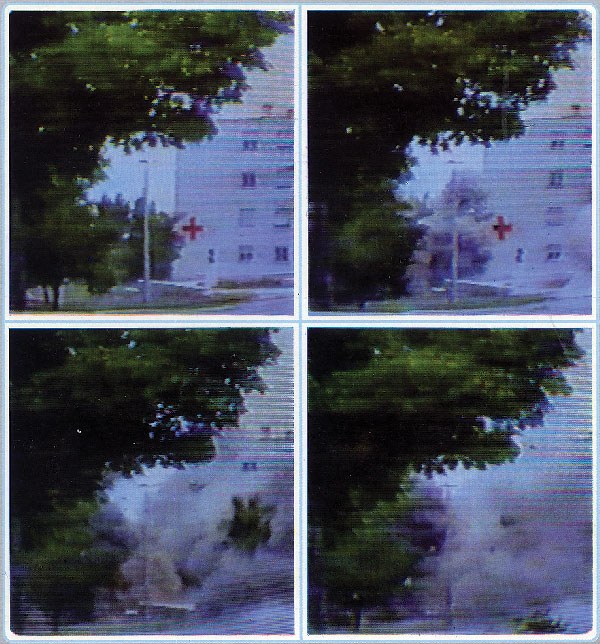
This series of photographs documents an air raid on a medical centre despite the Red Cross mark. This issue of the journal was prepared and printed during air raids on Zagreb — the cover was almost printed with the cross in green as it was too dark for the printers to mix the right colours!
Ana and Matko’s son Stjepan Ljudevit, playing football in the backyard of their house in Zagreb in the summer of 1991
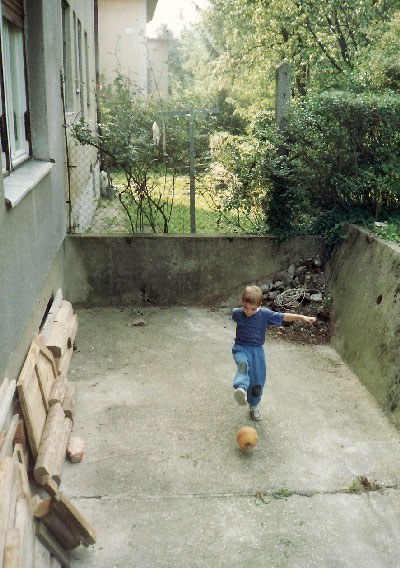
Cannons from the battlefields some 40 km away could be heard in the quiet of a Sunday afternoon. The basement windows had to be protected by sandbags and wooden boards as the family had to spend a few nights in the basement during air raids on a TV tower at the top of the nearby mountain.
References
- Marušić M. Do angels cry? Tales of the war. Portland: Ooligan Press, 2008. 0_i1115626
- Sambunjak D, Ivaniš A. Survive, help, learn: experience of a medical journal in war and post-war times. J Public Health Policy 2006; 27: 124-135. 0_i1115628
- Marušić M, Markulin H, Lukić IK, Marušić A. Academic advancement of authors receiving tutoring from a medical journal. Teach Learn Med 2006; 18: 126-129. 0_i1115630
- Vujaklija A, Hren D, Sambunjak D, et al. Can teaching research methodology influence students’ attitude toward science? Cohort study and nonrandomized trial in a single medical school. J Investig Med 2010; 58: 282-286. 0_i1115632
- Kozarić-Kovaićić D, Folnegović-Šmalc V, Škrinjarić J, et al. Rape, torture, and traumatization of Bosnian and Croatian women: psychological sequelae. Am J Orthopsychiatry 1995; 65: 428-433. 0_i1115634
Using generative artificial intelligence in clinical practice: a narrative review and proposed agenda for implementation
Ian A Scott, Sandeep Reddy, Tanya Kelly, Tim Miller, Anton Vegt
The CURE Asthma roadmap
Gary P Anderson, Anthony Flynn, Phil G Bardin, John D Blakey, Shyamali C Dharmage, Paul Foster, Peter G Gibson, Adam Jaffe, Alan James, Christine R Jenkins, Sundram Sivamalai, Peter D Sly, Guy B Marks, Vanessa M McDonald, Judy Wetttenhall
CURE Asthma: a unique opportunity for Australia
Anthony Flynn, Wendy Edmondson, Alan James, Caroline Lodge, Vanessa M McDonald, Christine R Jenkins, John Blakey, Gary P Anderson
Evidence from Australian cohort studies about asthma trajectories and transitions across the life course: a narrative review
Caroline Lodge, Xin Dai, Ingrid A. Laing, Michael P Menden, Anthony Flynn, Gary P Anderson, Sarath Ranganathan, Shyamali C Dharmage
Technological advances in the search for a CURE for asthma
Sara Quon, Timothy M Johanson, Ridhima Wadhwa, Alen Faiz, Anthony Flynn, Gary P Anderson, Amanda J Cox, Nicholas P West, Michael P Menden, Rhys S Allan
Protecting public interest journalism as a public health good
Bronwyn Fredericks, Neha Lalchandani, Melissa A Sweet, Alex Cramb, Carmel Williams