




Volume 195 - Issue 9
DIY psychiatry
Author: Philip L P Morris
Med J Aust 2011; 195 (9): 549.
Published online: 7 November 2011
Published online: 7 November 2011
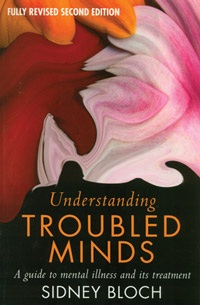
Understanding troubled minds. A guide to mental illness and its treatment
. Sidney Bloch. Melbourne: Melbourne University Press, 2011 (371 pp, $39.99). ISBN 9780522857542.
This is a new version of a similar volume published over 10 years ago (The foundations of clinical psychiatry), co-edited by Bruce Singh and Sidney Bloch. The influence of the original work can be seen in the coverage of standard psychiatric topics — the history of psychiatry, perspectives of understanding mental illness, the work and role of psychiatrists, stress and coping, clinical syndromes, special clinical populations, drugs and physical treatments, psychotherapies, mental health promotion and ethics — and, perhaps, in the practitioner-centric view of the field.
Since that first edition, much has happened in the field of mental health. This progress (and, in some instances, backsliding) has been included in the current volume, which has Bloch as sole author. Bloch is emeritus professor of psychiatry at the University of Melbourne and an honorary consultant psychiatrist at St Vincent’s Hospital, Melbourne. He is a respected academic with a wealth of clinical experience in adult psychiatry and psychotherapy, and in the role of ethics in psychiatric practice. It would be difficult to find a colleague with better qualifications to author a book of this nature.
But this is not a textbook. It is a guide to mental illness for the general public, and for patients, their families and friends. The single authorship has allowed Bloch the opportunity to add valuable personal insights and experiences to the text. Indeed, this is one of the most enjoyable aspects of the book. He uses literature and art to illustrate ideas and clinical phenomena without overwhelming the basic narrative of describing mental illness and its treatment.
The level of language used requires a relatively sophisticated readership; probably one with at least secondary-level education. The book will fill a gap in providing authoritative information about mental illness for patients and concerned individuals, as well as for non-clinical workers and government and non-government agencies in the mental health area. I can see it being used in general practices, and in the libraries of community service providers and advocacy agencies. The price is modest and should not be a barrier to access.
Understanding troubled minds is a valuable addition to the literature on mental illness, aimed at the educated layperson.
Reorienting Allied Health Into Community-Based Care for People Experiencing Trauma and Social Disadvantage
Simon Rosenbaum, Grace McKeon, Gulsah Kurt, Oscar Lederman, Kemi Wright, Sabuj Kanti Mistry, Jackie E. Curtis, Philip B. Ward, Zachary Steel, Hamish Fibbins, Rachel Morell, Melissa C. Eaton, Andrew Watkins, Ben Harris-Roxas, Brendan Goodger, Eleanor Beck, Megan Teychenne, Joseph Firth, Davy Vancampfort, David Burns, Russell Roberts, Tristan Favaloro, Danielle Weber, Rosanna Barbero, Vasili Maroulis, Melissa Holmes, Stefan Mackenzie, Chiara Mastrogiovanni, Afsana Anwar, Uzma Choudhry, Catherine Sherrington, Jane Currie, Thomas Gadsden, Scott Teasdale
Stigmatising Attitudes Towards People With Depression, Bipolar Disorder, Borderline Personality, ADHD and Early and Long-Term/Untreated Schizophrenia: Representative Survey of Australian Adults
Amy J. Morgan, Anna M. Ross, Gayle McNaught, Rachel Green, Nicola J. Reavley
Psychosocial Hazards for Healthcare Workers: Supporting the Second Victim Also Helps the Primary Victims
Sarah Michael
Supporting Population Mental Health in the Wake of Mass Tragedies
Susan J. Rees, Derrick M. Silove
In the Wake of the National Suicide Prevention Strategy 2025–2035: Suicide Prevention in Type 1 Diabetes
Rigel Paciente, Keely Bebbington, Alix Woolard, Helen Milroy