




Volume 195 - Issue 2
Why are women referred for female genital cosmetic surgery?
Authors: Rebecca Deans, Lih-Mei Liao, Naomi S Crouch and Sarah M Creighton
Med J Aust 2011; 195 (2): 99. || doi: 10.5694/j.1326-5377.2011.tb03223.x
Published online: 18 July 2011
Published online: 18 July 2011
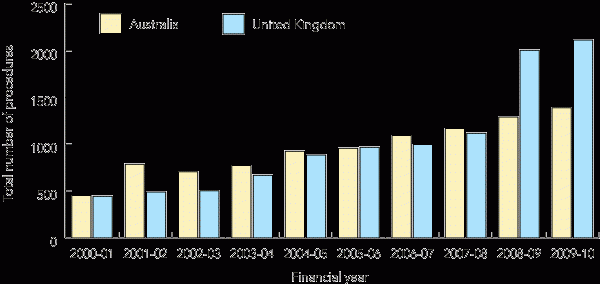
To the Editor: The number of vulvoplasty or labioplasty procedures rebated by Medicare Australia has more than doubled over the past 10 years;1 in the United Kingdom, a similar trend was observed in the National Health Service (NHS) (Box).2 Recent media debate in Australia highlights this as a concerning problem.3
The community assumes that surgical operations are clinically effective treatments performed for identifiable pathological features. In the context of female genital cosmetic surgery (FGCS), there is a blurring between disease and dissatisfaction, the latter being at least partly informed by cultural pressure about physical appearances. In addition, there is an absence of evidence on clinical effectiveness,4 and an apparent lack of commitment to monitor adverse events.
This raises the question of how clinicians justify referring women for FGCS. A recent audit of referral letters for labioplasty in an NHS gynaecology clinic in the UK (University College London Hospitals project no. 03/0173) offers interesting insights.
Of the 48 letters reviewed, the mean age of the women referred was 25 years (range, 9–50 years). Complaints about genital appearance were identified in 34/48 (71%) of letters (eg, embarrassment about undressing in public changing rooms). Physical discomfort was mentioned in 23/48 (48%) letters (eg, difficulty with activities such as cycling). Sexual problems were mentioned in 21/48 (44%) letters (eg, a reluctance to engage in sexual relationships). In two of the letters, the referrers mentioned disparaging comments by previous sexual partners, and one mentioned harassment by other girls at school. Alarmingly, a further seven letters (15%) alluded to concerns being flagged by the girls’ mothers.
Only 77% of referrers reported examining the patient. A third of referrers judged the labia to be “normal”, yet nevertheless requested surgery for their patients. Pejorative language such as “leathery in appearance” or “pendulous and elongated” was used in 12 (25%) of the letters.
Medical training may cover basic vulval anatomy, but detailed study of morphology is not included. This knowledge gap would have been less problematic in the past. However, in recent years, where intense marketing of FGCS5 is contributing to soaring demand, medical practitioners may not be sufficiently informed about female genital anatomy to assess and advise women about their concerns.
Reasons for the increasing prevalence of female distress about genital appearance are likely to be complex and rooted in social and cultural changes. In the absence of identifiable diseases, referral for operations may not be the most appropriate way of managing women’s body insecurities.
Labioplasty and vulvoplasty operations rebated by Medicare Australia1 and covered by the United Kingdom National Health Service2 over the past 10 years*
 | |||||||||||||||
|
INR = international normalised ratio. * Graph shows abbreviated, not daily, data. Intervals are weekly up to Week 9, then vary according to when INR was measured. | |||||||||||||||
Acknowledgements
We thank Associate Professor Jason Abbott for his contribution to this letter.
References
- Australian Government. Medicare Australia. Pharmaceutical Benefits Schedule item reports. Item 35533. 1999–2009. https://www.medicareaustralia.gov.au/statistics/mbs_item.shtml (accessed May 2011).
- United Kingdom National Health Service. Hospital episode statistics 2000–2010. http://www.hesonline.nhs.uk (accessed May 2011).
- Robotham J. More women opt for genital plastic surgery. Sydney Morning Herald 2010; 8 Nov. http://www.smh.com.au/lifestyle/wellbeing/more-women-opt-for-genital-plastic-surgery-20101107-17j1f.html (accessed May 2011).
- Liao LM, Michala L, Creighton S. Labial surgery for well women: a review of the literature. BJOG 2010; 117: 20-25. 0_i1095866
- Tiefer L. Female genital cosmetic surgery: freakish or inevitable? Analysis from medical marketing, bioethics, and feminist theory. Feminism Psychol 2008; 18: 466-479. 0_i1095869
Shifting focus to adolescent wellbeing and inclusive participation in the digital age
Allyson R Todd, Elena Wang, Stephanie R Partridge
The clinical presentation, investigation, and management of women diagnosed with endometriosis in Australian general practices, 2011–2021: an open cohort study
Danielle Mazza, Kailash Thapaliya, Sharinne B Crawford, Alissia Hui, Maryam Moradi, Luke E Grzeskowiak
The impact of the Breast Screen NSW transition from film to digital mammography, 2002–2016: a linked population health data analysis
Rachel Farber, Nehmat Houssami, Katy J L Bell
Non‐technical errors associated with deaths in surgical care, Australia, 2012–2019, by surgical specialty (Australian and New Zealand Audit of Surgical Mortality): a retrospective cohort study
Jesse Ey, Victoria Kollias, Octavia Lee, Kelly Hou, Matheesha Herath, John B North, Ellie Treloar, Suzanne Edwards, Martin Bruening, Adam J Wells, Guy J Maddern
The CURE Asthma roadmap
Gary P Anderson, Anthony Flynn, Phil G Bardin, John D Blakey, Shyamali C Dharmage, Paul Foster, Peter G Gibson, Adam Jaffe, Alan James, Christine R Jenkins, Sundram Sivamalai, Peter D Sly, Guy B Marks, Vanessa M McDonald, Judy Wetttenhall
Evidence from Australian cohort studies about asthma trajectories and transitions across the life course: a narrative review
Caroline Lodge, Xin Dai, Ingrid A. Laing, Michael P Menden, Anthony Flynn, Gary P Anderson, Sarath Ranganathan, Shyamali C Dharmage