




Volume 195 - Issue 2
A vaccine to prevent exacerbations in COPD
Authors: Robert L Clancy and Margaret Dunkley
Med J Aust 2011; 195 (2): 99-100. || doi: 10.5694/j.1326-5377.2011.tb03224.x
Published online: 18 July 2011
Published online: 18 July 2011
To the Editor: Animal and human studies confirm the view that colonisation by non-typeable Haemophilus influenzae (NTHi) of airways already damaged by inhaled toxins initiates a second major pathway of damage in chronic obstructive pulmonary disease (COPD). This provides a framework for novel and effective management strategies for this condition, which has previously been considered to be a self-induced disease of elderly people for which nothing can be done.1
Acute exacerbations of COPD are recognised as critical determinants of acute and long-term outcomes. They represent a shift within the bronchus of the balance between two pressures — colonising NTHi and protective recruitment of phagocytic cells — that favours the bacteria and results in an inappropriate and excessive inflammatory response. A novel oral vaccine that reduces acute exacerbations in COPD is currently undergoing an advanced clinical trial in 21 centres across Australia.
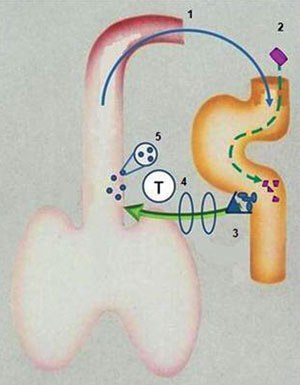
Oral immunotherapy with enteric-coated inactivated NTHi enhances the efficiency of mucosal immune protection (Box). In a rodent model, specific T cells, derived from stimulation of Peyer’s patches by orally administered NTHi, enhanced clearance of bacteria from the bronchus by recruiting and activating phagocytes.2 In mice co-infected with NTHi and influenza virus, oral administration of NTHi abrogated the increase in levels of both bacteria and virus, suggesting NTHi is a final common pathway for both viral and bacterial infections.2 In humans who smoke, seasonal increase in circulating specific T cells was significantly augmented after oral immunotherapy with NTHi, blocking access of inhaled NTHi into peripheral airways.3
These data support a mechanism whereby NTHi increases physiological protection based on aspiration of bronchus content into the gut. Qualitative2-4 and quantitative2,3 sputum analysis showed that protection was correlated with a reduction of all pathogens and a significant 3-log fall in NTHi, as expected from specific activation of a non-specific clearance mechanism (phagocytosis). In COPD, T cell-recruited neutrophils within sputum undergo a phenotypic change characterised by longevity and enhanced phagocytosis, maintained by autocrine loops.2
Early clinical trials4 of oral immunotherapy showed reductions in the frequency and severity of exacerbations, with consistent decreases in antibiotic usage of more than 50%.
A potent and well characterised NTHi isolate with broad cross-protection in screening assays has now been developed for use as the vaccine HI-164OV (unpublished data). Phase II clinical studies of the vaccine have shown it is safe and effective3 and resulted in significant reductions in exacerbations treated with systemic corticosteroids (63%) and hospital admissions (90%)5 among patients with severe COPD taking best-practice treatment. Phase IIb trials are now underway.
Evidence of IgE antibody to NTHi in both COPD and treatment-resistant asthma predicts broader clinical value for oral therapy with HI-164OV, through its capacity to prevent inhaled bacteria (allergens) penetrating into small airways.3
Enhancement of mucosal immune protection by oral immunotherapy with enteric-coated inactivated non-typeable Haemophilus influenzae1
Competing interests
Both authors are employed by the company working on the vaccine technology described in this letter and hold stock or stock options in the company.
References
- Beyond the lungs: a new view of COPD [Editorial]. Lancet 2007; 370: 713. 0_CHDCDAGD
- Clancy RL, Dunkley ML. Acute exacerbations in COPD and their control with oral immunisation with nontypeable Haemophilus influenzae. Front Immunol 2011; 2: 7. Doi: 10.3389/fimmu. 2011.00007. 0_i1095883
- Clancy RL, Dunkley ML. Oral non-typeable Haemophilus influenzae enhances physiological mechanism of airways protection. Clin Exp Immunol 2010; 161: 127-133. 0_i1095885
- Foxwell AR, Cripps AW, Dear KBG. Haemophilus influenzae oral whole cell vaccination for preventing acute exacerbations of chronic bronchitis. Cochrane Database Syst Rev 2006; (4): CD001958. 0_i1095887
- Tandon MK, Phillips M, Waterer G, et al. Oral immunotherapy with inactivated nontypeable Haemophilus influenzae reduces severity of acute exacerbations in severe COPD. Chest 2010; 137: 805-811. 0_i1095889
Rhabdomyolysis After COVID-19
Navya Kataria, Abel Devadass, Lana Sundac, Laura De Souza, Nabeel Sheikh, Samantha Ng, Scott Campbell, Yishen Wang, Ross S. Francis
Technological advances in the search for a CURE for asthma
Sara Quon, Timothy M Johanson, Ridhima Wadhwa, Alen Faiz, Anthony Flynn, Gary P Anderson, Amanda J Cox, Nicholas P West, Michael P Menden, Rhys S Allan
The CURE Asthma roadmap
Gary P Anderson, Anthony Flynn, Phil G Bardin, John D Blakey, Shyamali C Dharmage, Paul Foster, Peter G Gibson, Adam Jaffe, Alan James, Christine R Jenkins, Sundram Sivamalai, Peter D Sly, Guy B Marks, Vanessa M McDonald, Judy Wetttenhall
The first live term birth following uterus transplantation in Australia
Rebecca Deans, Brigitte Gerstl, Antonia W Shand, Sarah Lyons, Aaron Budden, Helen L Barrett, Grant Luxton, Mangalee Fernando, Kenneth Yong, Karen Keung, Kaushalya Arulpragasam, Henry Pleass, King Man Wan, Eva Kehag, Jana‐Emily Pittman, Mianna Lotz, Maria Fenn, Erin Nesbitt‐Hawes, Lily Byun, Katrina Tang, Mats Brannstrom, Jason Abbott
The public health impacts of mining in Australia
Javier Cortes‐Ramirez, Ruby N Michael, Leisa‐Maree Toms, Melissa Haswell
Lingual Raynaud phenomenon
Michael Taggart, Mina John