




Volume 195 - Issue 11
Reducing farm injury deaths through regulation
Author: Tony G Lower
Med J Aust 2011; 195 (11): 645. || doi: 10.5694/mja11.11452
Published online: 12 December 2011
Published online: 12 December 2011
Manufacturers will need to improve quad bike design to meet safety requirements
Agriculture is internationally recognised as a hazardous industry. Despite a 44% reduction in non-intentional farm injury deaths in Australia over the past 15 years (of which machinery-related incidents are the predominant cause), considerable opportunities for prevention remain.1
Quad bikes and tractors are leading agents in these incidents. To date in 2011, there have been 16 farm-based and five off-farm quad bike deaths, plus eight tractor fatalities. These do not include the considerable number of injuries, which sometimes result in lifelong debilitating conditions.
In tractors, rollover fatalities have decreased by 60% after the introduction of regulations requiring compulsory rollover protection structures.2 In agriculture, with its diverse hazards and working environments, good design is vital to improving health and safety. Regrettably, this has not been the case with quad bikes.
Over the past 10 years in Australia, on average there have been 14 quad bike fatalities each year. About half of all fatalities have involved rollovers, which frequently cause death by asphyxiation and/or crush syndrome.3 Annual fatality figures of 600–800 in the same 10-year period in the United States illustrate the scope of this issue.4
Currently, there are about 220 000 operating quad bikes, each typically weighing 250–350 kg, in Australia, with annual sales exceeding 20 000 units. Given their use will grow, one would think that improving design to reduce rollover risks would be high on the agenda of the quad bike manufacturers. Think again!
Independent engineers have seriously questioned the validity of quad bike industry simulation research, which disputes the benefits of protective devices. The results of industry modelling are at odds with published research on head and trunk injury, and provides little support for installing crush protection devices to protect riders.
Even so, the industry data still indicate a net protective benefit of up to 29% for the one commercial crush protection device in Australia.3 Yet an industry representative has categorically stated that he does not “see any circumstance in which we would decide to fit such a device”.5
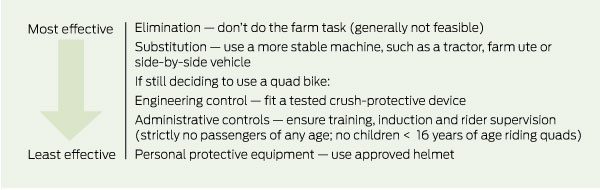
From 1 January 2012, the new national Model Work Health and Safety Regulations 2011 (http://safeworkaustralia.gov.au/AboutSafeWorkAustralia/WhatWeDo/Publications/Pages/Model-WHS-Regulations.aspx) will require that all “powered mobile plant” (including tractors, field machinery and quad bikes) must manage risk in accordance with the hierarchy of controls (Box), including risks of overturning. The quad bike industry continues to rely on training and helmets — low-order solutions in the hierarchy of controls — to minimise risks. Given the new regulations require these risks to be managed “so far as is reasonably practicable”,6 this is unlikely to be adequate.
The potential for these regulations to have international ramifications in itself may be a factor contributing to the industry’s intransigence in fitting crush protection, particularly with the potential prospect of litigation. Inevitably, regulators who set an international precedent will face strident opposition from a multinational industry. The self-regulation tactics adopted by the industry in the US will also need to be circumvented, where the industry has influenced quad bike state laws by developing model state all-terrain vehicle safety legislation, which, unsurprisingly, does not feature crush protection.7
Without genuine solutions from manufacturers, regulators will have to drag an unwilling industry forward. History has shown that enforced regulation can kick-start design improvements that benefit both users and companies. Indeed, given the new regulations, it is questionable whether these vehicles meet safety requirements for use in an Australian workplace where overturns must be managed.
Although mandating design improvements for safety in rollover incidents is critical, it is not a panacea. Clinicians have an important role in encouraging practices to reduce quad bike-related injuries (Box).
The new regulations will allow a line in the sand to be drawn on how this situation is handled. While this is unlikely to be an easy process, the alternative of the continuing high burden that quad bike casualties place on communities is simply unacceptable.
Competing interests
No relevant disclosures.
References
- Lower T, Fragar L, Herde E. Potential for prevention of farm injury fatalities in Australia. J Health Safety Environ 2011; 27: 125-137. 0_CHDHCDHE
- Lower T, Herde E. Non-intentional farm injury fatalities in Australia 2003–2006. N S W Public Health Bull 2012. In press. 0_i1115631
- Munoz S, Van Auken R, Zellner J. An assessment of the effects of the Roberston V-bar ROPS on the risk of rider injury due to overturns resulting from ATV misuse. DRI-TR-07-14. Torrance, Calif: Dynamic Research, Inc, 2007. 0_i1115633
- Garland S. 2009 annual report of ATV-related deaths and injuries. Bethesda, Md: US Consumer Product Safety Commission, 2010. 0_i1115635
- Bowden T. How safe are quad bikes [TV report]? 7.30 2011; Sep 13. Australian Broadcasting Corporation. http://www.abc.net.au/7.30/content/2011/s3317049.htm (accessed Nov 2011).
- Safe Work Australia. Guide to the Model Work Health and Safety Regulations. Canberra: SWA, 2011. http://safeworkaustralia.gov.au/AboutSafeWork Australia/WhatWeDo/Publications/Documents/621/Guide_Model_WHS_Regulations.pdf (accessed Nov 2011).
- Speciality Vehicle Institute of America. Model state ATV legislation. http://www.svia.org/Relations/Legislation.aspx (accessed Nov 2011).
Provenance: Commissioned; not externally peer reviewed.