




Volume 194 - Issue 7
Patient safety and quality of care
Author: Stephen J Duckett
Med J Aust 2011; 194 (7): 352. || doi: 10.5694/j.1326-5377.2011.tb03005.x
Published online: 4 April 2011
Published online: 4 April 2011
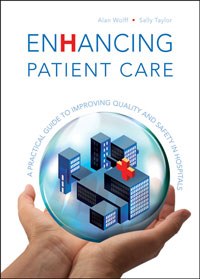
Enhancing patient care. A practical guide to improving quality and safety in hospitals.
Alan Wolff, Sally Taylor. Sydney: MJA Books, 2009 (234 pp, $49.95). ISBN 9780977578665.
Wimmera Hospital, in Horsham, western Victoria, has a well deserved reputation for promoting quality and safety. Here, Alan Wolff, Wimmera’s medical director, and Sally Taylor, its clinical risk manager, outline the steps they followed in developing a rigorous quality management process at the hospital.
This is indeed, as claimed, a practical guide and is recommended for all those interested in clinical governance. The Wimmera model appropriately distinguishes between safety and quality, and outlines steps to promote quality and assure safety.
In terms of how the book might have been strengthened, I think a chapter outlining what a board safety and quality committee might do would have been useful.
Further, the book has its provenance in a regional hospital and there is a question in my mind about whether all the elements of the Wimmera model are scalable.
The book also de-emphasises the role of routine data for tracking safety in hospitals. Although hospitals can track their own trends over time using routine data, this sort of monitoring is much more powerful when it involves comparison with other like facilities.
The model’s approach to management of adverse events focuses too much on the visible, the “event”, and tends to de-emphasise the myriad small things (eg, the incidence of pneumonia) which might together contribute to a poorer experience of hospitalisation.
The book could also have been strengthened by incorporating guidance on how to structure investigations, when they are called for. The Queensland approach (“pyramid model”) of looking at data, casemix, resources, processes of care and professional issues is a valuable one.1
The book rightly identifies the health professional involved in an adverse event as the “second victim”. The medical director might also be seen as the “third victim”. The role of the medical director is a hard one, especially in a small hospital. It means holding to account local colleagues, often people with whom one has worked for many years. It is an isolated role and one deserving of more support. The authors are to be commended for making this hard journey an easier one.
References
- Duckett SJ, Coory M, Sketcher-Baker K. Identifying variations in quality of care in Queensland hospitals. Med J Aust 2007; 187: 571-575. 1
Medical Colleges Have an Obligation to Ensure Full Participation in Clinical Quality Registries
Thomas J. Hugh
Getting on the Same Page: Why Australia Needs a National Maternity Early Warning System (MEWS) Chart
Briony A. Cutts, Lucy Bowyer, Nisha Khot, Sandra Lowe, Stefan C. Kane
Data for Equity: Can Linked Administrative Data Inform Pathways to More Equitable Child Health?
Sarah Gray, Shuaijun Guo, Meredith O'Connor, Elodie O'Connor, Katrina Williams, Hannah Badland, Susan Woolfenden, Josie Dickerson, Gerry Redmond, Marnie Downes, Sharon R. Goldfeld
Specialty College Selection: Why Change is Critical to Support a Future Rural Workforce
Matthew R. McGrail, Jenny May AM, Katherine Logan
Differentiated and simplified oral HIV pre‐exposure prophylaxis (PrEP) models hold the key to virtually eliminating HIV transmission in Australia by 2030
Tyson Arapali, Sarah Warzywoda, Anthony K J Smith, Curtis Chan, Timothy R Broady, Erin Sullivan, Catherine MacPhail, Mohamed A Hammoud, Alexander Dowell‐Day, Benjamin R Bavinton
The number of cancer‐related deaths that could be attributable to spatial disparities in survival in Australia, 2010–2019: a retrospective population‐based cohort study
Charlotte K Bainomugisa, Jessica Cameron, Paramita Dasgupta, Peter Baade