




Volume 194 - Issue 11
High-dose intravenous flucloxacillin may affect warfarin therapy
Authors: Philip Y-I Choi, Katherine L Phillips and Ian Rae
Med J Aust 2011; 194 (11): 613. || doi: 10.5694/j.1326-5377.2011.tb03122.x
Published online: 6 June 2011
Published online: 6 June 2011
To the Editor: Warfarin is an orally administered vitamin K antagonist and has many well described interactions with commonly prescribed medications.1 However, only a handful of case reports worldwide have shown that flucloxacillin, a widely used antibiotic, may affect warfarin therapy by reducing its anticoagulant effect — in one instance contributing to the development of ischaemic stroke.2,3 There are several reports describing potential mech-anisms of interaction for flucloxacillin with warfarin.4,5
We describe the case of a 64-year-old man who was diagnosed with infective endocarditis on the basis of mitral valve vegetations and blood cultures that were positive for methicillin-sensitive Staphylococcus aureus. The patient underwent mitral valve replacement with a prosthetic valve and received prolonged antibiotic therapy with intravenous flucloxacillin for 8 weeks.
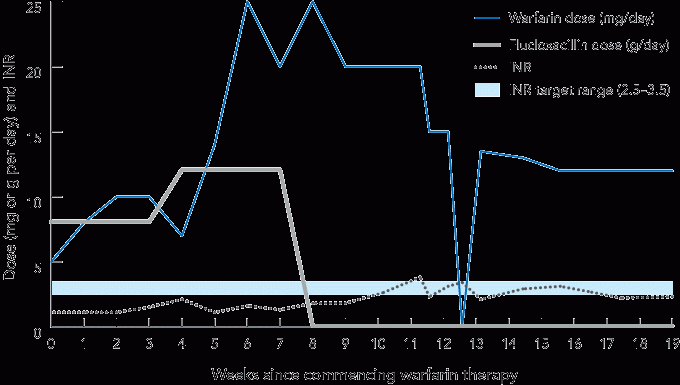
Initially, for nearly 4 weeks, therapeutic anticoagulation with warfarin was difficult to achieve with warfarin doses ranging between 5 and 10 mg per day (target international normalised ratio [INR], 2.5–3.5). During this time, the patient was receiving intravenous flucloxacillin at a total daily dose of 8 g (2 g every 6 h). Flucloxacillin was increased to 12 g per day (2 g every 4 h) and there was a subsequent fall in the patient’s INR, which was sustained despite increasing the dose of warfarin to 25 mg per day (Box). Completion of flucloxacillin therapy was associated with a rise in the patient’s INR and a reduction in his warfarin dose requirement.
No other relevant medications were commenced during this period of observation.
This case highlights the potential for a dose-related effect of intravenous high-dose flucloxacillin (up to 12 g per day) on warfarin metabolism and the need for vigilance when prescribing antibiotics in conjunction with oral vitamin K antagonists. Other penicillins such as amoxicillin can, conversely, enhance the anticoagulant effects of warfarin, so the warfarin–flucloxacillin interaction may not be intuitive for many clinicians.
Doses* for oral warfarin and intravenous flucloxacillin administered to a 64-year-old man with infective endocarditis, and corresponding INR
 |
|
INR = international normalised ratio. |
References
- Juurlink DN. Drug interactions with warfarin: what clinicians need to know. CMAJ 2007; 177: 369-371.
- Merwick A, Hannon N, Kelly PJ, O’Rourke K. Warfarin-flucloxacillin interaction presenting as cardioembolic ischemic stroke. Eur J Clin Pharmacol 2010; 66: 643-644. 0_CBBIAFDG
- Garg A, Mohammed M. Decreased INR response secondary to warfarin-flucloxacillin interaction. Ann Pharmacother 2009; 43: 1374-1375. 0_CBBEIFDI
- Huwyler J, Wright MB, Gutmann H, Drewe J. Induction of cytochrome P450 3A4 and P-glycoprotein by the isoxazolyl-penicillin antibiotic flucloxacillin. Curr Drug Metab 2006; 7: 119-126. 0_i1095857
- Tang W, Stearns RA. Heterotropic cooperativity of cytochrome P450 3A4 and potential drug-drug interactions. Curr Drug Metab 2001; 2: 185-198. ref5
Splenic injury in severe cases of the zoonoses Q fever and rickettsial infection: diagnostic challenges
Ashleigh Drury, Philippa Harrison, Aiveen Bannan
Health and economic benefits of improving pre‐hospital identification of stroke in Australian women: a modelling study
Thomas Gadsden, Lei Si, Emily R Atkins, Cheryl Carcel, Xia Wang, Stephen Jan, Mark Woodward, Laura E Downey
Updating the diagnosis and management of elevated serum ferritin levels in the era of routine ferritin testing of blood donors by Australian Red Cross Lifeblood
Gary D Zhang, James Chen, Daniel M Johnstone, Martin B Delatycki, Katie Allen, John K Olynyk
Early cardiovascular collapse after envenoming by snakes in Australia, 2005–2020: an observational study (ASP‐31)
Geoffrey K Isbister, Katherine Z Isoardi, Angela L Chiew, Shane Jenkins, Nicholas A Buckley
Updated recommendations for warfarin reversal in the setting of four‐factor prothrombin complex concentrate
Danielle Robinson, James McFadyen, Eileen Merriman, Chee Wee Tan, Ross Baker, Huyen Tran
Updating the diagnosis and management of iron deficiency in the era of routine ferritin testing of blood donors by Australian Red Cross Lifeblood
Gary D Zhang, Daniel Johnstone, Michael F Leahy, John K Olynyk