




Volume 191 - Issue 11
More than a patient’s story
Author: Ruth M Armstrong
Med J Aust 2009; 191 (11): 658. || doi: 10.5694/j.1326-5377.2009.tb03369.x
Published online: 7 December 2009
Published online: 7 December 2009
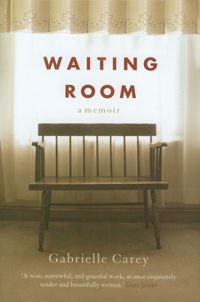
Waiting room. A memoir.
Gabrielle Carey. Melbourne: Scribe, 2009 (217 pp). ISBN 9781921372629.
I’ve got mixed feelings about memoirs. Having cringed my way through the insipid or vitriolic ramblings of a number of previously admired politicians, actors and journalists, I’ve come to the conclusion that some people’s inner worlds are best kept that way. Nonetheless, I had high hopes as I read the blurb for well known Australian writer Gabrielle Carey’s Waiting room, and plucked it from the review pile to read over a long weekend.
All doctors should read patient stories and Carey is an accomplished Australian writer of my generation — surely there would be much in the book to learn from and relate to. I was not disappointed.
Waiting room details the diagnosis and management of Carey’s elderly mother’s meningioma. As a medical story, it appears accurate and straightforward and its portrayal of the clinical encounters, surgery and hospital stay is surprisingly undramatic. Without labouring the point, and with a very Australian sense of acceptance and ultimate trust in the medical system’s competence, Carey documents long hours spent waiting for life-changing medical appointments and the all-too-common experience of having planned surgery delayed by a lack of hospital beds. The medical characters are in the book for their functionality rather than their personalities.
In fact, the medical story is really a backdrop to the main business of the book; Carey’s relationship with her enigmatic mother.
When you reach a certain age, you realise that life is filled with unanswered questions, incomplete understandings, ambiguous meanings and relational loose ends. The beauty of a memoir is that it can unapologetically reflect this chaos without the need for momentous conversations, dramatic revelations and eventual resolution.
As a doctor, writer, daughter, wife and mother, I found much to learn from and relate to in Carey’s Waiting room. Sometimes the truth may be stranger than fiction, but generally it is just much more real.
Shifting focus to adolescent wellbeing and inclusive participation in the digital age
Allyson R Todd, Elena Wang, Stephanie R Partridge
The clinical presentation, investigation, and management of women diagnosed with endometriosis in Australian general practices, 2011–2021: an open cohort study
Danielle Mazza, Kailash Thapaliya, Sharinne B Crawford, Alissia Hui, Maryam Moradi, Luke E Grzeskowiak
The impact of the Breast Screen NSW transition from film to digital mammography, 2002–2016: a linked population health data analysis
Rachel Farber, Nehmat Houssami, Katy J L Bell
Non‐technical errors associated with deaths in surgical care, Australia, 2012–2019, by surgical specialty (Australian and New Zealand Audit of Surgical Mortality): a retrospective cohort study
Jesse Ey, Victoria Kollias, Octavia Lee, Kelly Hou, Matheesha Herath, John B North, Ellie Treloar, Suzanne Edwards, Martin Bruening, Adam J Wells, Guy J Maddern
The CURE Asthma roadmap
Gary P Anderson, Anthony Flynn, Phil G Bardin, John D Blakey, Shyamali C Dharmage, Paul Foster, Peter G Gibson, Adam Jaffe, Alan James, Christine R Jenkins, Sundram Sivamalai, Peter D Sly, Guy B Marks, Vanessa M McDonald, Judy Wetttenhall
Evidence from Australian cohort studies about asthma trajectories and transitions across the life course: a narrative review
Caroline Lodge, Xin Dai, Ingrid A. Laing, Michael P Menden, Anthony Flynn, Gary P Anderson, Sarath Ranganathan, Shyamali C Dharmage