




Volume 189 - Issue 5
Bicycle handlebar injuries in Western Australia: from imprints to abdominal wall hernias
Authors: Parshotam K Gera, Andrew P Barker, Ian Gollow, Jillian Orford, Sue Wicks and Liz Whan
Med J Aust 2008; 189 (5): 295. || doi: 10.5694/j.1326-5377.2008.tb02037.x
Published online: 1 September 2008
Published online: 1 September 2008
To the Editor: In bicycle accidents, direct impact with the bicycle handlebar can cause serious abdominal injuries. These injuries occur not only in high-speed collisions, where the rider is thrown from the bicycle, but also in low-speed crashes, where the bicycle handlebar strikes the rider in the abdomen or pelvic region.1
We retrospectively reviewed all children who presented to Princess Margaret Hospital for Children with abdominal bicycle handlebar injuries from January 2002 to July 2007. The patients were identified from the emergency department trauma database; 60 boys and 10 girls were identified, aged 5–15 years.
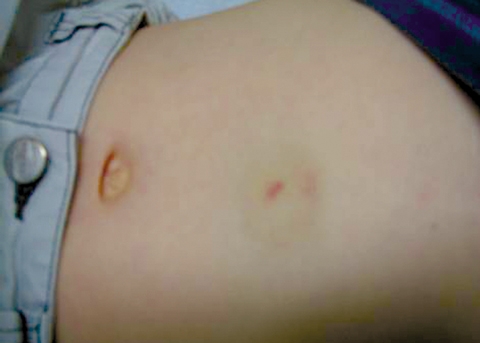
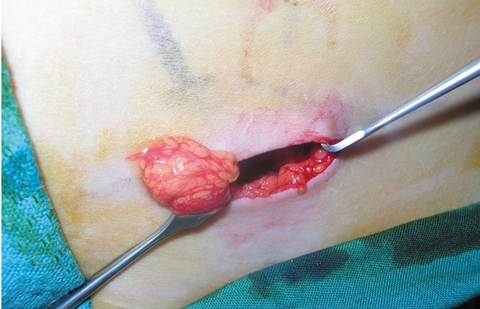
Significant injuries (defined as injuries to the liver, spleen, kidney, pancreas, small bowel, stomach or urinary bladder) were noted in 25 of the 70 patients (36%), and 15 of the 70 patients (21%) required surgery. Twenty-one patients (30%) had handlebar imprints on the abdomen (Box, A), and 17 of them (81%) had significant injuries. Traumatic abdominal wall hernia (TAWH) was present in three patients (Box, B).
The odds of a significant injury were 21.8 times higher (95% CI, 5.8–82.1) for patients with handlebar imprints than for those with no handlebar imprints. Computed tomography (CT) was the main method of diagnosis of significant injury, and there was a statistically significant association between handlebar imprints and a positive CT scan result, defined as evidence of a solid or hollow viscus injury (2-sided Fisher’s exact test, P = 0.01). Of those patients who underwent CT scanning, 89% of those with handlebar imprints (16/18) had a positive CT scan, compared with 36% of those with no handlebar imprints (4/11). The odds of a positive CT scan were 14 times higher (95% CI, 2.1–95.1) for patients with handlebar imprints than for those with no handlebar imprints.
Similar rates of significant injury resulting from impact with handlebars have been reported previously.2 TAWH was first described in 1906,3 and 31 cases of handlebar-related TAWH in children have been reported to date, excluding our cases.4,5 TAWH is produced by sudden application of blunt force to the abdomen that does not penetrate the skin, but is strong enough to disrupt muscle and fascia. Surgical repair is usually required to prevent complications.5
Children with handlebar imprints should be observed closely, and assessed by CT scan and treated surgically as indicated. They should be encouraged to use protective gear, such as handlebar padding, helmets and protective clothing, when riding bicycles.
References
- Nadler EP, Potoka DA, Shultz BL, et al. The high morbidity associated with handlebar injuries in children. J Trauma 2005; 58: 1171-1174. 0_CBBEFIGC
- Clarnette TD, Beasley SW. Handlebar injuries in children: patterns and prevention. Aust N Z J Surg 1997; 67: 338-339. 0_CBBBJICE
- Selby CD. Direct abdominal hernia of traumatic origin. JAMA 1906; 47: 1485-1486. 0_CBBHADIB
- Iinuma Y, Yamazaki Y, Hirose Y, et al. A case of traumatic abdominal wall hernia that could not be identified until exploratory laparoscopy was performed. Pediatr Surg Int 2005; 21: 54-57. 0_CBBGIFBD
- Haimovici L, Papafragkou S, Keesler E, et al. Handlebar hernia: traumatic abdominal wall hernia with multiple enterotomies. A case report and review of literature. J Pediatr Surg 2007; 42: 567-569. 0_i1091864
‘Once Bitten’: A Case of Tetanus Following Snakebite in Australia
Adrian A. S. Doherty, Naomi N. E. Clarke, Sarah Fletcher, Sarah Huffam, Camille V. Awburn, Eugene Athan
Epidemiology and Quality of Care for Aboriginal and Torres Strait Islander Peoples Treated by Emergency Medical Services for Stroke in Victoria, Australia: Retrospective Analysis of Linked Data
Candice Menezes, Ziad Nehme, Luke J. Burchill, Tegwyn McManamny, Angela Dos Santos, Michelle Crilly, Luke P. Dawson, Benjamin Clissold, David Anderson, Emily Nehme
Intranasal Adrenaline Use for the Management of Insect Venom-Induced Anaphylaxis
Thomas J. Young, Wilhelmina R. F. Johnson, Braydon L. Pennington, Troy Wanandy, Wun Y. Lau, Thanh-Thao A. Le
Gabapentinoid Poisoning Presentations to Victorian Emergency Departments: A 15-Year Trend Analysis
Bishaal Tej Gurung, Amy McNeilage, Angus Skeen, Tina Lam, Joanna F. Dipnall, Jane Hayman, Suzanne Nielsen, Ting Xia
They Brought the Hospital to Me
Hugh N. Burrill
Predictors of Ambulance Transport to Hospital for Older People Living in Tasmanian Aged Care Facilities: A Retrospective Cohort Study
Sharon Andrews, Pieter F. Fouche, Belinda Flanagan, Michael McDermott, Melanie Greenwood