




Volume 188 - Issue 9
Social marketing can promote good health
Author: Catriona M F Bonfiglioli
Med J Aust 2008; 188 (9): 541. || doi: 10.5694/j.1326-5377.2008.tb01772.x
Published online: 5 May 2008
Published online: 5 May 2008
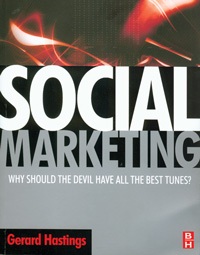
Social marketing. Why should the devil have all the best tunes?
Gerard Hastings. Oxford: Butterworth-Heinemann, 2007 (xvii + 367 pp). ISBN 978 0 7506 83500.
Not so long ago, it seemed businesses couldn’t swap their products for our money fast enough before disappearing. Now we can’t even have a haircut without surrendering our name, address, phone number and date of birth. Welcome to relationship marketing.
Today’s companies really do care about our satisfaction because customer satisfaction underpins repeat business, explains Gerard Hastings in Social marketing. Why should the devil have all the best tunes?
Hastings, the United Kingdom’s first professor of social marketing, argues that public health needs to expand the use of these successful marketing strategies to make health promotion more powerful. By examining commercial practices and dissecting case studies of public health interventions, he demonstrates how health promotion is moving beyond fear campaigns and short-term interventions to building relationships with people and providing practical, ongoing assistance to encourage risk reduction and healthier living.
Hastings clearly and succinctly explains the theories underlying social marketing: stages of change, social cognitive theory and exchange theory. He argues that social marketing requires strategic analysis of the problem, of the competing forces and of the target population to underpin solutions that work.
Hastings and his colleagues at the University of Stirling, Scotland, recently demonstrated the power of analysing a problem by systematically reviewing the impact of junk food advertising and finding there are adverse effects on children’s food preferences, purchases and consumption.
Understanding competing forces is crucial, he argues, because one of the reasons we have binge-drinkers, smokers and people who eat and drink unhealthily is that companies have been better at marketing than have health professionals.
Hastings’ well structured and clearly written book equips readers with a valuable tool of public health that can be used to counteract the “hazard merchants”, who market death and disease through products (such as tobacco), and to promote healthier living.
Designing Housing to Reduce Overcrowding-Related Harms: Rheumatic Heart Disease as the Canary in the Coal Mine
Simon Quilty, Veronica Matthews, Angus Baumann, James Marangou, Bo Remenyi, Gavin Wheaton, Serena Morton Nabanunga, Norman Frank Jupurrurla, Simon Robinson, Steve Mintern, Cary Duffield, Joshua R. Francis, Paul C. Memmott
Australian Climate Leadership in 2026: COP-Out or Step-Up for Health?
Catherine G. A. Pendrey, Angie Bone, Aletha Ward, Francis Nona, Michelle Isles, Paul M. Kelly, Nicholas J. Talley
The impact of the Breast Screen NSW transition from film to digital mammography, 2002–2016: a linked population health data analysis
Rachel Farber, Nehmat Houssami, Katy J L Bell
Shifting focus to adolescent wellbeing and inclusive participation in the digital age
Allyson R Todd, Elena Wang, Stephanie R Partridge
The CURE Asthma roadmap
Gary P Anderson, Anthony Flynn, Phil G Bardin, John D Blakey, Shyamali C Dharmage, Paul Foster, Peter G Gibson, Adam Jaffe, Alan James, Christine R Jenkins, Sundram Sivamalai, Peter D Sly, Guy B Marks, Vanessa M McDonald, Judy Wetttenhall
Protecting public interest journalism as a public health good
Bronwyn Fredericks, Neha Lalchandani, Melissa A Sweet, Alex Cramb, Carmel Williams