




Volume 188 - Issue 8
Tissue plasminogen activator for acute ischaemic stroke
Author: James C Hurley
Med J Aust 2008; 188 (8): 488. || doi: 10.5694/j.1326-5377.2008.tb01729.x
Published online: 21 April 2008
Published online: 21 April 2008
To the Editor: The recent report on the use of a stroke thrombolysis protocol by Batmanian and colleagues1 raises many issues. The most recent guidelines regarding thrombolytic therapy for ischaemic stroke recommend that “If thrombolytic therapy is to be used . . . consultation with a neurologist or stroke physician is essential before instigating therapy. Strict adherence to the inclusion and exclusion criteria is important . . .”2 Hence, I find the integral role of a neurologist in Batmanian and colleagues’ protocol reassuring.
However, consent to therapy in this setting is not simple. In the protocol, they informed the patient and/or next of kin about the risks and benefits of thrombolysis, but did they seek informed consent? The benefits of thrombolytic therapy are controversial, and equipoise exists.
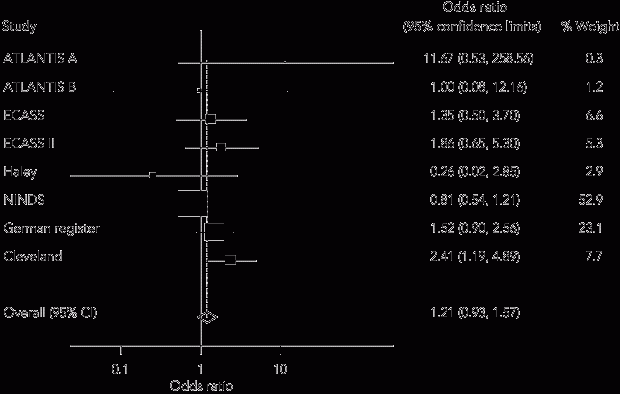
Reflecting this, a multicentre trial3 is underway that includes patients who meet the eligibility criteria of Batmanian et al’s protocol. The evidence cited by Batmanian and colleagues in support of thrombolysis was based on small randomised trials published more than a decade ago.4 Further, the summary results of the meta-analysis they cited are associated with significant heterogeneity and lose statistical significance with the inclusion of additional results from observational studies5 (Box).
Moreover, the more recently published audits and the analysis that led to the number-needed-to-treat estimate cited by Batmanian et al were based on comparisons with a reference group dominated by the placebo group of the NINDS (National Institute of Neurological Disorders and Stroke) trial.6 This trial has been criticised for likely faulty randomisation resulting in baseline disparities unfavourable to the placebo recipients. These projections of benefit based on comparisons with a small and non-representative placebo group from a trial published over a decade ago are misleading. A calculation of numbers needed to treat based on such limited evidence, particularly for a soft endpoint such as assessment of disability, is hazardous and potentially misleading.7
There are other important issues associated with this therapy that need to be resolved. For example: Are mortality rates increased in groups receiving tissue plasminogen activator therapy in non-teaching hospitals?;8 Is this therapy safe in older people?; and finally, does this therapy not have the proven mortality risk associated with streptokinase in randomised trials in patients with stroke?4
Thrombolysis for stroke requires more evidence from randomised trials, not more protocols. Trials including older people are especially needed, given the age-dependent mortality risk associated with this therapy.
Odds ratios for fatal outcome from published cohorts of patients receiving tissue plasminogen activator therapy within 3 hours of onset of acute ischaemic stroke
 |
|
The addition of two recent observational cohorts, the German Stroke Register and the Cleveland experience, to the meta-analysis of six controlled trials as reported in Wardlaw et al4 increases the summary odds ratio from 0.97 (95% CI, 0.69–1.36) to 1.21 (95% CI, 0.93–1.57). (Figure reproduced from Hurley5 with permission from Wiley-Blackwell Publishing Ltd.) ATLANTIS = Alteplase Thrombolysis for Acute Noninterventional Therapy in Ischemic Stroke. ECASS = European–Australasian Cooperative Acute Stroke Study. NINDS = National Institute of Neurological Disorders and Stroke. |
References
- Batmanian JJ, Lam M, Matthews C, et al. A protocol-driven model for the rapid initiation of stroke thrombolysis in the emergency department. Med J Aust 2007; 187: 567-570. 0_i1091855
- Neurology Expert Group. Therapeutic guidelines: neurology, version 3. Melbourne: Therapeutic Guidelines Limited, 2007. 0_BABJACIG
- Whiteley W, Lindley R, Wardlaw J, Sandercock P, on behalf of the IST-3 Collaborative Group. Third International Stroke Trial. Int J Stroke 2006; 1: 172-176. http://www.blackwell-synergy.com/doi/full/10.1111/j.1747-4949.2006.00043.x (accessed Mar 2008).
- Wardlaw JM, del Zoppo G, Yamaguchi T, Berge E. Thrombolysis for acute ischaemic stroke. Cochrane Database Syst Rev 2003; (3): CD000213. 0_i1091861
- Hurley JC. Hazards of thrombolytic therapy for stroke: the real-world experience [letter]. Intern Med J 2007; 37: 348-349. 0_i1091863
- Tissue plasminogen activator for acute ischemic stroke. The National Institute of Neurological Disorders and Stroke rt-PA Stroke Study Group. N Engl J Med 1995; 333: 1581-1587. 0_i1091865
- Koziol JA, Feng AC. On the analysis and interpretation of outcome measures in stroke clinical trials: lessons from the SAINT I study of NXY-059 for acute ischemic stroke. Stroke 2006; 37: 2644-2647. 0_i1091867
- Reed SD, Cramer SC, Blough DK, et al. Treatment with tissue plasminogen activator and inpatient mortality rates for patients with ischemic stroke treated in community hospitals. Stroke 2001; 32: 1832-1840. 0_i1091871
Motor Neuron Disease Mortality Trends in Australia From 1986 to 2023: A Population-Based Study
Carol M. Y. Lee, Rupendra N. Shrestha, Julian Gold, Mark Stevenson, Kelly L. Williams, Lyndal Henden, Sandrine K. K. Chan Moi Fat, Zoe Zussa, Amanda Wright, Martin Jude, Mark A. S. Laidlaw, Willem J. R. Fokkink, Dominic B. Rowe
Mild traumatic brain injury and concussion and persisting post‐concussion symptoms: new guidelines to support evidence‐based assessment and management in Australia and Aotearoa New Zealand
Karen M Barlow, Jennie L Ponsford, Alice Theodom, Gill Cowen, Gavin A Davis, Vicki Anderson, Franz E Babl, David Cole, Jennifer Cullen, Stuart R Dalziel, Melinda Fitzgerald, Howard Flavell, Caroline Yates, Rebecca Kimble, John H Olver, Rhonda Orr, Mark Ralfe, Michael Rose, Nick Rushworth, Julia Treleaven, Gary Browne, Nathan Delang, Sarah Harris, Gary Mitchell, Sean Tweedy
The prevalence of and variation in indicators of the quality and safety of long term aged care in Australia, 2019: a cross‐sectional population‐based study
Tesfahun C Eshetie, Gillian E Caughey, Catherine Lang, Olivia Ryan, Renuka Visvanathan, Craig Whitehead, Keith Evans, Janet K Sluggett, Jyoti Khadka, Carolyn Dawkins, Helena Williams, Miranda Starke, Sara Blunt, Anne Liddell, Megan Corlis, Anna Sheppeard, Penelope Lello, Marilyn Thien, Steven L Wesselingh, Maria C Inacio
Health and economic benefits of improving pre‐hospital identification of stroke in Australian women: a modelling study
Thomas Gadsden, Lei Si, Emily R Atkins, Cheryl Carcel, Xia Wang, Stephen Jan, Mark Woodward, Laura E Downey
Symptom burden, quality of life, and diagnostic journey of people with postural orthostatic tachycardia syndrome, Australia, 2021–24: a descriptive patient registry data study
Marie‐Claire Seeley, Gemma Wilson, Eric Ong, Amy Langdon, Jonathan Chieng, Danielle Bailey, Kristina Comacchio, Amanda Page, Dennis H Lau, Celine Gallagher
The intersection of rurality and dementia prevalence in Australia for Aboriginal and Torres Strait Islander and non‐Indigenous peoples
Antonia J Clarke, Marwan Ahmed, Judith M Katzenellenbogen, John Towney (Wiradjuri), Anna H Balabanski, Adrienne Withall (Dharawal Yuin), Kylie Radford, Amy Brodtmann