




Volume 188 - Issue 4
Psychiatric foundations
Author: Christopher J Pollock
Med J Aust 2008; 188 (4): 250. || doi: 10.5694/j.1326-5377.2008.tb01599.x
Published online: 18 February 2008
Published online: 18 February 2008
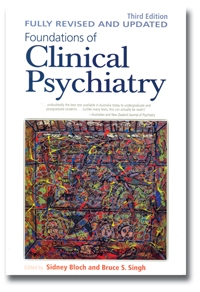
Foundations of clinical psychiatry. 3rd ed.
Sidney Bloch, Bruce S Singh, editors. Melbourne: Melbourne University Press, 2007 (xii + 642 pp). ISBN 978 0 522 85320 9.
A good textbook of psychiatry is hard to find. Not only does such a book have to be well written, but its editors need to think carefully about what information is of relevance and vital to today’s trainee.
Mindful of these issues, the editors of the latest edition of Foundations of clinical psychiatry have worked to bring the material up to date and have broadened the text, adding a chapter on intellectual and developmental disability. At the same time, they have retained the previous edition’s clinical focus and kept the book to a realistic length.
The text is divided into four sections. The first presents a unifying biopsychosocial approach that trainees need to adopt when dealing with psychiatric patients. Important interviewing, synthesising and framework skills for formulating psychological problems are discussed. The second section deals with the range of basic psychiatric disorders such as trauma, anxiety, mood disorders and schizophrenia, while the third concerns special clinical areas such as children, older people, Indigenous peoples, and suicide. The final section deals with mental health service provision, including biological and psychological treatments.
Importantly, Bloch and Singh recognise the calls that both science and the science of understanding people make on clinical practice by including a chapter on understanding and explaining psychiatric illness. To the best of my knowledge, this is unique in psychiatric textbooks and the key to successfully traversing a complex field. So much so that I would recommend all students read this chapter both at the beginning and again at the end of their training, to assist them in making sense of what they have learned.
The second edition of Foundations was good; the third, however, is better. It is a readable, comprehensive textbook of psychiatry that easily meets its key task of educating medical students and interested health professionals.
Co-Designed Best Practice Principles for the Care of Fathers and Non-Birthing Parents Exposed to Perinatal Trauma: A Participatory Action Research Study
Alka Kothari, Dale Trevor, Glen Quinn, Jane Geltch, Joel Dulhunty, Helen Skouteris, Leonie K. Callaway
Reorienting Allied Health Into Community-Based Care for People Experiencing Trauma and Social Disadvantage
Simon Rosenbaum, Grace McKeon, Gulsah Kurt, Oscar Lederman, Kemi Wright, Sabuj Kanti Mistry, Jackie E. Curtis, Philip B. Ward, Zachary Steel, Hamish Fibbins, Rachel Morell, Melissa C. Eaton, Andrew Watkins, Ben Harris-Roxas, Brendan Goodger, Eleanor Beck, Megan Teychenne, Joseph Firth, Davy Vancampfort, David Burns, Russell Roberts, Tristan Favaloro, Danielle Weber, Rosanna Barbero, Vasili Maroulis, Melissa Holmes, Stefan Mackenzie, Chiara Mastrogiovanni, Afsana Anwar, Uzma Choudhry, Catherine Sherrington, Jane Currie, Thomas Gadsden, Scott Teasdale
Stigmatising Attitudes Towards People With Depression, Bipolar Disorder, Borderline Personality, ADHD and Early and Long-Term/Untreated Schizophrenia: Representative Survey of Australian Adults
Amy J. Morgan, Anna M. Ross, Gayle McNaught, Rachel Green, Nicola J. Reavley
Psychosocial Hazards for Healthcare Workers: Supporting the Second Victim Also Helps the Primary Victims
Sarah Michael
Supporting Population Mental Health in the Wake of Mass Tragedies
Susan J. Rees, Derrick M. Silove