




Volume 185 - Issue 7
Investing in sound mental health
Author: Stephen J Duckett
Med J Aust 2006 || doi: 10.5694/j.1326-5377.2006.tb00601.x
Published online: 8 December 2005
Published online: 8 December 2005
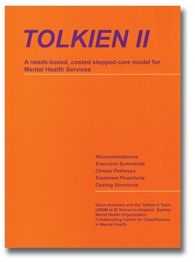
Tolkien II a needs-based, costed stepped-care model for mental health services.
Gavin Andrews and the Tolkien II Team, University of New South Wales at St Vincents Hospital. Sydney: World Health Organization Collaborating Centre for Classification in Mental Health, 2006 (vi + 376 pp). ISBN 0 9578073 4 1
Rarely does a book grab you by the shirt front and shake you in the way that this one does. It is an in-your-face call for reform in the way mental health services are configured and delivered, claiming a plan in which a 30% increase in budget could treat 50% more people and produce a 90% increase in health gain.
Mental illness is one of the key contributors to burden of disease. Burden of disease studies, though, dont give any indication of marginal benefits that would accrue from additional investment and so do not per se provide useful information for an investment strategy. This book does. It starts with an analysis of the cost-effectiveness of the contemporary allocation of resources for the various classes of mental illness, suggesting, for example, that the cost-effectiveness ratio for affective disorders is $20 for each year of disability averted, compared with schizophrenia at $196 for each year of disability averted. It proposes a new configuration of investments, with greater reliance on community-based accommodation, for instance, and estimates that its proposals would lead to improved cost-effectiveness across all of the major illness subgroups.
In format, it has a very brief introduction followed by proposed treatment recommendations or intervention models for each of the main classes of psychiatric illness. The stepped-care model in the title is reflected throughout the book in investments in front-end primary care and community interventions, designed to filter patients so that the use of the high-cost inpatient end of the treatment continuum is minimised. These plans are designed from a societal point of view, with implementation impacting on both Commonwealth and state responsibilities.
I am not a psychiatrist, so I cannot make any assessment of the validity of the proposed treatment plans, but an impressive range of expert consultants has been used in the development of the plans. The weakness of an expert-panel approach is acknowledged, and the lack of approaches based on higher levels of evidence is claimed to be because of the lack of such evidence.
There are nine people in Australia who, without a doubt, must read this book, or at least the first few pages: the Directors-General/Secretaries of the state, territory and Commonwealth Health Departments. They should then request their Directors of Mental Health to evaluate the book and the recommendations therein, and to advise on why this should not be the approach adopted for future investments in mental health funding.
Stephen J DuckettExecutive Director, Reform and Development Division, Queensland Health, Brisbane, QLD
Designing Housing to Reduce Overcrowding-Related Harms: Rheumatic Heart Disease as the Canary in the Coal Mine
Simon Quilty, Veronica Matthews, Angus Baumann, James Marangou, Bo Remenyi, Gavin Wheaton, Serena Morton Nabanunga, Norman Frank Jupurrurla, Simon Robinson, Steve Mintern, Cary Duffield, Joshua R. Francis, Paul C. Memmott
Australian Climate Leadership in 2026: COP-Out or Step-Up for Health?
Catherine G. A. Pendrey, Angie Bone, Aletha Ward, Francis Nona, Michelle Isles, Paul M. Kelly, Nicholas J. Talley
The impact of the Breast Screen NSW transition from film to digital mammography, 2002–2016: a linked population health data analysis
Rachel Farber, Nehmat Houssami, Katy J L Bell
Shifting focus to adolescent wellbeing and inclusive participation in the digital age
Allyson R Todd, Elena Wang, Stephanie R Partridge
The CURE Asthma roadmap
Gary P Anderson, Anthony Flynn, Phil G Bardin, John D Blakey, Shyamali C Dharmage, Paul Foster, Peter G Gibson, Adam Jaffe, Alan James, Christine R Jenkins, Sundram Sivamalai, Peter D Sly, Guy B Marks, Vanessa M McDonald, Judy Wetttenhall
Protecting public interest journalism as a public health good
Bronwyn Fredericks, Neha Lalchandani, Melissa A Sweet, Alex Cramb, Carmel Williams