




Volume 184 - Issue 11
Oesophageal rupture arising as a complication of acute appendicitis in a child
Authors: Kenneth Wong and Gerard Roy
Med J Aust 2006; 184 (11): 588. || doi: 10.5694/j.1326-5377.2006.tb00391.x
Published online: 5 June 2006
Published online: 5 June 2006
To the Editor: Boerhaave’s syndrome is a rare condition in which increased intra-oesophageal pressure associated with forceful vomiting leads to spontaneous oesophageal rupture. Although the condition mostly affects middle-aged men,1 we present here a case arising as a complication of appendicitis in a child.
A 10-year-old boy presented with a 4-day history of abdominal pain, diarrhoea and bloodstained vomiting. He was febrile and tachycardic, with a mildly distended abdomen but no peritonism. Chest and abdominal x-rays were normal.
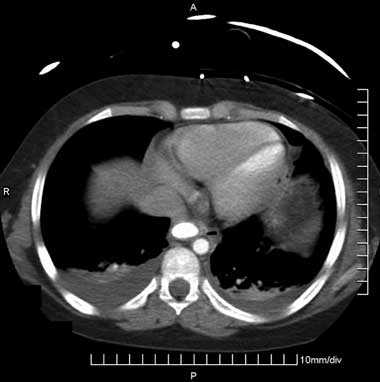
Over the next 6 hours, despite being given 4 litres of normal saline intravenously, the patient became hypotensive, oliguric and hypoxic, with increased abdominal guarding. A perforated appendix was suspected and an urgent laparotomy was planned. A preoperative chest x-ray revealed a large left-sided hydropneumothorax causing tracheal deviation. Insertion of an intercostal catheter immediately returned 600 mL of haemoserous fluid. At laparotomy, amid gross purulent contamination, a perforated appendix was removed. A subsequent computed tomography (CT) scan of the thorax showed contained mediastinal contrast extravasation with an associated air/fluid level from the lower oesophagus on the left side (Box), suggesting oesophageal rupture and establishing Boerhaave’s syndrome.
Intravenous antibiotics and nasogastric and pleural drainage were instituted. A repeat CT scan of the thorax 3 days later showed no further mediastinal contrast extravasation. The child improved clinically until spiking high temperatures on the seventh day postoperatively. A chest x-ray showed a left-sided pleural effusion. Thoracoscopy revealed a loculated empyema. This was managed by a formal decortication via a left lateral thoracotomy. The patient was discharged after 2 weeks.
Vomiting is a common presenting symptom in acute appendicitis. Yet there is only one previously reported case of Boerhaave’s syndrome secondary to acute appendicitis.1 Therefore, this unusual complication of acute appendicitis may be missed. Without treatment, 100% mortality is expected.2
In retrospect, it was evident that our patient showed the classical clinical symptoms of Boerhaave’s syndrome: a history of prolonged haematemesis, systemic compromise and a left-sided tension hydropneumothorax.2,3 As an initial chest x-ray may be normal, a repeat x-ray is worthwhile in any patient with prolonged vomiting. If clinical suspicion persists, a CT scan of the thorax, which is a more sensitive and specific test for detecting oesophageal rupture, is advisable.2,3
The management of Boerhaave’s syndrome involves initial resuscitation with broad-spectrum antibiotics, nasogastric intubation and pleural drainage.2-5 In recent literature, urgent operative intervention has been recommended to control communication between the oesophagus and mediastinum.2,3,5 In our case, we pursued non-operative management based on radiological evidence of a small, contained mediastinal collection and clinical improvement after pleural drainage. The present case highlights a rare complication of a common surgical condition and suggests that careful non-operative management may be successful.
References
- Inculet R, Clark C, Girvan D. Boerhaave’s syndrome and children: a rare and unexpected combination. J Pediatr Surg 1996; 31: 1300-1301.
- Jamieson GG. Oesophageal trauma. In: Clunie GJ, Tjandra JJ, Francis DM, editors. Textbook of surgery. Melbourne: Blackwell Science, 1997. 0_i1091798
- Hill AG, Tiu AT, Martin IG. Boerhaave’s syndrome: 10 years experience and review of the literature. ANZ J Surg 2003; 73: 1008-1010. 0_i1091800
- Cameron JL, Kieffer RF, Hendrix TR, et al. Selective nonoperative management of contained intrathoracic esophageal disruptions. Ann Thorac Surg 1979; 27: 404-408. 0_i1091802
- Zwischenberger JB, Savage C, Bhutani MS. Esophagus. In: Townsend CM, Beauchamp RD, Evers BM, Mattox KL, editors. Sabiston textbook of surgery: the biological basis of modern surgical practice. 17th ed. Pennsylvania: Elsevier Saunders, 2004. 0_i1091804
Non-Technical Errors Associated With Deaths in Surgical Care, Australia, 2012–2019, by Surgical Specialty (Australian and New Zealand Audit of Surgical Mortality)
Jesse Ey, Guy J. Maddern
Localised Herpes Simplex Following Midline Laparotomy
Jessica S. Bulluss, Paul Chee, Matthew J. Verheyden
Non‐technical errors associated with deaths in surgical care, Australia, 2012–2019, by surgical specialty (Australian and New Zealand Audit of Surgical Mortality): a retrospective cohort study
Jesse Ey, Victoria Kollias, Octavia Lee, Kelly Hou, Matheesha Herath, John B North, Ellie Treloar, Suzanne Edwards, Martin Bruening, Adam J Wells, Guy J Maddern
Changes in patient management after preoperative MRI for newly diagnosed breast cancer: a multicentre prospective observational study
Michael L Marinovich, Nehmat Houssami, Andrew Spillane, Gregory B Mann, Donna Taylor, Michelle Reintals, Nadine Phillips, Max K Bulsara, Patsy Siok Hwa Soon, Tracey Dickens, Christobel M Saunders
The first Australian evidence‐based guidelines on male infertility
Darren J Katz, Liza O’Donnell, Robert I McLachlan, Tim J Moss, Clare V Boothroyd, Veena Jayadev, Sarah R Catford
The first live term birth following uterus transplantation in Australia
Rebecca Deans, Brigitte Gerstl, Antonia W Shand, Sarah Lyons, Aaron Budden, Helen L Barrett, Grant Luxton, Mangalee Fernando, Kenneth Yong, Karen Keung, Kaushalya Arulpragasam, Henry Pleass, King Man Wan, Eva Kehag, Jana‐Emily Pittman, Mianna Lotz, Maria Fenn, Erin Nesbitt‐Hawes, Lily Byun, Katrina Tang, Mats Brannstrom, Jason Abbott