




Volume 184 - Issue 11
How trade harms Third World health
Author: David Wilkinson
Med J Aust 2006 || doi: 10.5694/j.1326-5377.2006.tb00369.x
Published online: 8 May 2006
Published online: 8 May 2006
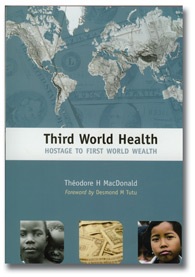
Third World health. Hostage to First World wealth.
Théodore H MacDonald. Oxford: Radcliffe Publishing, 2005 (xi + 297 pp). ISBN 1 85775 769 6.
Any book that starts with a glowing endorsement from Archbishop Emeritus Desmond Tutu deserves serious attention. What really works about this book is the mixture of personalised case studies, with a serious, rational and evidence-based exploration of data on such macro issues as trade deficits, World Bank loans and multinational companies trade practices. The link between Sath, a 27-year-old Cambodian woman who we meet on the first page, and who dies in complicated childbirth, and structural adjustment, the International Monetary Fund, the Group of Eight and (dare I utter it) globalisation, is made explicit.
While there may be little in this book that is new to the serious student of these issues, what is provided is a thoroughly comprehensive review and explication of the issues. The writing is clear and accessible, although I rapidly tired of the use of etc.
From personal experience through travelling and talking to colleagues working in the Third World, there seems to be little positive progress in terms of turning back the tide of poverty, illness and economic stagnation. In many ways governments have failed, as have United Nations agencies.
Now it seems to be the turn of the mega-philanthropists; witness the work of the Gates Foundation and the Ellison Institute. Only time will tell whether they make any difference. At a time when the world is richer than ever before, there are more acutely poor people than ever before, and this is clearly a deep tragedy. At least we can continue to try to understand the multiple, complex and interrelated reasons for it, and try to do something about it.
David WilkinsonDeputy Head of School, Professor of Primary Care, University of Queensland, QLD
Dousing the burning inequity of global warming for people experiencing homelessness
Timothy English, Alejandro Vásquez Hernández, Glenn Miller, Nuala Fogarty, Charles Cosgrove, Paul Rosenthal, Matthew Larkin, Jon Swain, Danielle Austin, Jo River
The contribution of evidence‐based practice and the practice‐based evidence approaches to contemporary Australian psychology: implications for culturally safe practice
Paul Gray (Wiradjuri), Dawn Darlaston‐Jones, Pat Dudgeon AM (Bardi), Kate Derry, Joanna Alexi, William Smith (Wiradjuri and Wemba Wemba), Tanja Hirvonen (Jaru and Bunuba), David Badcock, Shraddha Kashyap, Belle Selkirk (Noongar)
Explaining risk in chronic conditions: the Yolŋu science of signs
Emma Haynes, Alison Mitchell, Minitja Marawili (Yolŋu), Dawn C Bessarab (Bardi)
Is it time to retire the label “CALD” in public health research and practice?
Sabine Allida, Della Maneze
What do Aboriginal people in the Northern Territory value during the operation journey? A qualitative study
Edith B Waugh, Marita Hefler, Sophie Pascoe, Mark Mayo, Matthew JL Hare, David A Story, Neil Wilkshire, Peter Henwood, David Croker, Jampijinpa Ross
Fulfilling First Nations health, cultural safety and equity accreditation standards in primary medical education: reflections from a First Nations desktop review team
Paul Saunders, Nicole Mercer, Maria Mackay, Ian Lee, Madelyne Hudson‐Buhagiar, Miriam Cavanagh, Emma Milliss, Melody Muscat, Kathleen Martin, Adam Shipp, Melissa Johnson, Belinda Gibb