




Volume 183 - Issue 5
Doctors in Western literature
Author: Marcia D Childress
Med J Aust 2005 || doi: 10.5694/j.1326-5377.2005.tb07020.x
Published online: 5 September 2005
Published online: 5 September 2005
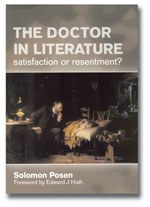
The doctor in literature: satisfaction or resentment?
Solomon Posen. Oxford: Radcliffe Publishing, 2005 (ix + 298 pp). ISBN 1 85775 609 6.
Described as a reference guide highlighting 1500 passages from over 600 texts (virtually all available in English), this volume is compiled from Posens lifetime of reading with an eye toward literary portraits of physicians. He has identified eleven facets of the physicianpatientsociety encounter and organised the book around these, with chapters addressing, for example, physician fees, the doctors time, bedside manner, emotional distance between doctor and patient, and litigation, as played out by medical characters in literature across the ages.
This is not an anthology, for excerpts from literature frequently run but a sentence or two and serve Posens points rather than those of cited texts authors. Nor is it an annotated bibliography of literature depicting doctors, or even the index that the author suggests medical scholars need, for references are embedded in Posens assertions and one must go to endnotes for full information.
While documenting astonishing constancy in physicianpatient relations over two and a half millennia (eg, patients like doctors who are willing to help, society resents doctors fees), Posens conclusions may be over-engineered. Having excluded texts that employ allegory or symbolism or that portray doctors who traffic in metaphor (psychiatrists, he says) or dark arts or who misbehave as criminals or clowns, he chiefly cites works in which doctors exhibit what he terms recognizable medical behavior. His readings of fictional doctors who meet his criteria are straightforward but sometimes sufficiently colored by his own lenses as to miss authors satire or social criticism.
As a result, Posens composite view of medical practice is inherently conservative, and his typical doctor even more than societys is white, male, paternalistic and active rather than contemplative, irreligious, devoted more to profession than family, socially powerful, and resentful of political or institutional control. More historically and culturally nuanced aspects and ethical tensions of the doctorpatientsociety triad tend to go unaddressed here, even though many of the cited literary works do take them on.
Marcia D ChildressDirector, Program of Humanities in Medicine University of Virginia School of Medicine Charlottesville, VA, USA
Using generative artificial intelligence in clinical practice: a narrative review and proposed agenda for implementation
Ian A Scott, Sandeep Reddy, Tanya Kelly, Tim Miller, Anton Vegt
The CURE Asthma roadmap
Gary P Anderson, Anthony Flynn, Phil G Bardin, John D Blakey, Shyamali C Dharmage, Paul Foster, Peter G Gibson, Adam Jaffe, Alan James, Christine R Jenkins, Sundram Sivamalai, Peter D Sly, Guy B Marks, Vanessa M McDonald, Judy Wetttenhall
CURE Asthma: a unique opportunity for Australia
Anthony Flynn, Wendy Edmondson, Alan James, Caroline Lodge, Vanessa M McDonald, Christine R Jenkins, John Blakey, Gary P Anderson
Evidence from Australian cohort studies about asthma trajectories and transitions across the life course: a narrative review
Caroline Lodge, Xin Dai, Ingrid A. Laing, Michael P Menden, Anthony Flynn, Gary P Anderson, Sarath Ranganathan, Shyamali C Dharmage
Technological advances in the search for a CURE for asthma
Sara Quon, Timothy M Johanson, Ridhima Wadhwa, Alen Faiz, Anthony Flynn, Gary P Anderson, Amanda J Cox, Nicholas P West, Michael P Menden, Rhys S Allan
Protecting public interest journalism as a public health good
Bronwyn Fredericks, Neha Lalchandani, Melissa A Sweet, Alex Cramb, Carmel Williams