




Volume 183 - Issue 11
The ups and downs of men's sexual health
Author: Denis J Cherry
Med J Aust 2005 || doi: 10.5694/j.1326-5377.2005.tb00030.x
Published online: 25 November 2005
Published online: 25 November 2005
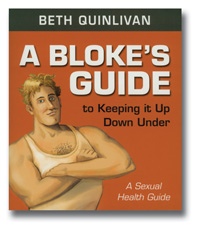
A blokes guide to keeping it up down under. A sexual health guide.
Beth Quinlivan. Melbourne: Ibis Publishing, 2005 (175 pp). ISBN 1 920923 96 9.
Hmm, I thought, Hmm, I thought, when I received A blokes guide to keeping it up down under to review. What is a woman doing writing on this topic and, whats more, a woman about whom I know nothing?
A quick search of the Internet revealed that my not knowing about Beth Quinlivan reveals more about me (and my rather provincial life) than her presumed anonymity. As a medical journalist for the BRW and the Financial Review, Quinlivan has ample justification for writing on mens issues. Add the cooperation of psychologist, Michael Young, and you have both writing skills and a genuine knowledge of mens sexual health issues.
At the outset they reveal a conundrum despite the available plethora of (at times quite candid) information on sexual issues, mens sexual health is not improving. The authors propose that information alone does not equate to an education the real key to improving mens health.
With that I agree, and although this almost pocket-sized book cannot result in an education, it goes a long way towards providing a succinct and relevant body of information for the average Aussie bloke.
As an educational tool for men and their partners it succeeds. Although small in size it is big in content and, more importantly, has a certain degree of street savvy in terms of content and layout. It is well organised in a series of chapters starting with basic male sexual anatomy and physiology and then progressing through the four major pelvic issues of sexual dysfunction, male cancers, STDs, and fertility. It is perhaps not surprising that erectile dysfunction gets its own chapter, since Viagra has ensured its status as the male disorder of the last decade; but its disappointing that BPE/BPH (Benign Prostatic Enlargement; Benign Prostatic Hypertrophy) doesnt get a guernsey.
It is noteworthy that dotted throughout the book are competent warnings on issues rarely mentioned elsewhere. For example, the need for urgent action when a priapism occurs, the need for care in the controversial issue of hormone therapy in the older male, and the brave new world problem of clinics that advertise (and dupe men into believing that only they have the answers). Although the book has a good array of diagrams, I felt there could be more, especially in the early chapter on anatomy. As well, there is no index, an essential element of any book.
In the discussion on circumcision, there is no mention of the possible scarring and deformity of the glans penis and shaft. As well, it would have been helpful if the relative incidence of the pros and cons of circumcision were added, an important element for discerning real risks and benefits.
A lot of thought and effort has created a quality book that I hope will become a companion for a lot of men. Beth Quinlivan (with Michael Young) deserves much praise.
Denis J CherryMedical Director Perth Human Sexuality Centre, WA