




Volume 182 - Issue 1
Are current playground safety standards adequate for preventing arm fractures?
Authors: Shauna Sherker and Joan Ozanne-Smith
Med J Aust 2005; 182 (1): 46-47. || doi: 10.5694/j.1326-5377.2005.tb06565.x
Published online: 3 January 2005
Published online: 3 January 2005
Shauna Sherker,* Joan Ozanne-Smith†
* Postdoctoral Research Fellow, NSW Injury Risk Management Research Centre, University of New South Wales, Sydney, NSW; † Chair of Injury Prevention, Accident Research Centre, Monash University, Melbourne, VIC. Shauna.SherkerATunsw.edu.au
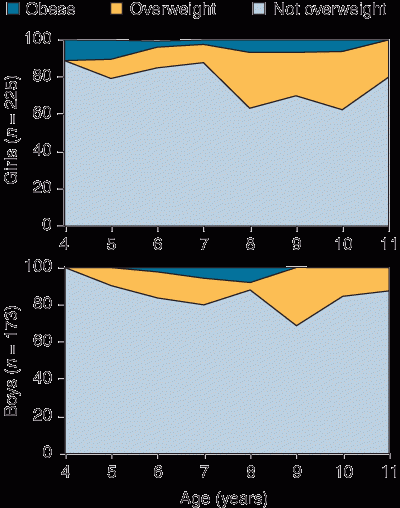
In reply: The prevalence of obesity has increased dramatically among Australian children, particularly over the past 2 decades.1 However, the role of obesity as a risk factor for fall-related arm fracture remains unclear. Using standard definitions for child overweight and obesity,2 our study population3 (Box) did not demonstrate quite as high a prevalence of obesity as had been previously reported for Victorian schoolchildren.1
This case series was part of a larger, yet to be published case–control study, the results of which indicate no significant difference in body mass index between children who fell from playground equipment and fractured their arm (cases) and those who fell and landed on their arm with no significant injury (controls).
The negative public health effects of increasing prevalence of obesity among Australian children highlight the need to promote safe and enjoyable physical activity. Playground equipment provides a very popular means of physical activity for children. Improving playground safety standards to minimise the risk of arm fracture — a traumatic, costly and preventable childhood injury — has never been more urgent.
Children with arm fracture caused by falls from playground equipment, showing proportion of children who were normal weight, overweight or obese.*
* Based on unpublished data from Sherker and Ozanne-Smith.3
References
- Booth M, Chey T, Wake M, et al. Change in the prevalence of overweight and obesity among young Australians, 1969–1997. Am J Clin Nutr 2003; 77: 29-36. CBBDHFAH
- Cole T, Bellizzi M, Flegal K, Dietz W. Establishing a standard definition for child overweight and obesity worldwide: international survey. BMJ 2000; 320: 1240-1243. CBBBBDGE
- Sherker S, Ozanne-Smith J. Are current playground safety standards adequate for preventing arm fractures? Med J Aust 2004; 180: 562-565. CBBCGIIC
Barriers and Facilitators to Timely Detection and Optimal Management of Chronic Wet Cough in Aboriginal Children Across Australia From the Perspectives of Carers of Aboriginal Children: A Qualitative Study
Gloria T. Y. Lau, Pam Laird, Robyn Aitken, Melanie Barwick, Liam Bedford, Emily R. Bowden, Jamie Everingham, Angela Fuery, Reece Griffin, Neha Jain, Mina Kinghorn, Renae Knapp, Gabrielle B. McCallum, Peter Morris, Richard Norman, Peter C. Richmond, Aarti Saiganesh, Slade Sibosado, Cameron Taylor, Maree Toombs, Roz Walker, Joan Wilson, Anne B. Chang, André Schultz
Barriers and Facilitators to Timely Detection and Optimal Management of Chronic Wet Cough in Aboriginal Children Across Australia From the Perspective of Health Care Providers: A Qualitative Study
Gloria T. Y. Lau, Pamela Laird, Robyn Aitken, Melanie Barwick, Liam Bedford, Emily R. Bowden, Corey Dalton, Jamie Everingham, Angela Fuery, Reece Griffin, Neha Jain, Mina Kinghorn, Renae Knapp, Gabrielle B. McCallum, Peter Morris, Richard Norman, Peter C. Richmond, Aarti Saiganesh, Slade Sibosado, Maree Toombs, Roz Walker, Joan Wilson, Anne B. Chang, André Schultz
Short-Term Safety of Concomitant Meningococcal B and National Immunisation Program Vaccines in Infants Aged < 15 Months: A Survey-Based Surveillance Study
Thuy Nguyen, Evelyn C. S. Tay, Michael Dymock, Thomas L. Snelling, Lucy Dawes, Julie Marsh, Yue Wu, Alan Leeb, Nicholas Wood, Lucy Deng
The GenV Biobank: Enabling Biological Research in a Large Longitudinal Population-Representative Cohort of Australian Newborns and Their Parents
Katherine Lange, Kim L. Powell, Yeukai Mangwiro, Tony Frugier, Donna T. Geddes, Melissa Wake, Richard Saffery
Watchful Waiting Compared With Immediate Antibiotics for Urban Aboriginal and Torres Strait Islander Children With Uncomplicated Acute Otitis Media (WATCH): A Non-Inferiority Randomised Controlled Trial
Jennifer S. Reath, Hasantha Gunasekera, Sanja Lujic, Amanda J. Leach, Letitia Campbell, Robyn Walsh, Tim Usherwood, Geoffrey K. Spurling, Claudette A. Tyson, Deborah A. Askew, Kelvin Kong, Chelsea J. Watego, Peter Morris, Wendy Hu, Penelope A. Abbott
A Rare Case of Storage Mite Anaphylaxis in Infancy
Eliza Kluckow, Katie Frith