




Volume 181 - Issue 11
Reactive arthritis and vasculitis in a child due to Ross River virus infection
Authors: Kynan T Feeney, Kevin J Murray, Amanda J Whittle and Gary K Dowse
Med J Aust 2004; 181 (11): 710. || doi: 10.5694/j.1326-5377.2004.tb06532.x
Published online: 6 December 2004
Published online: 6 December 2004
To the Editor: We report an unusual case of Ross River virus (RRV) disease in a 7-year-old child. The patient presented to her general practitioner with fever, rash and pain in the lower limbs. Swelling of the joints of the hands and left knee was found, with a widespread rash that covered the trunk, limbs and face. The rash comprised lesions of varying types, including maculopapular, vesicular and petechial lesions (Box).
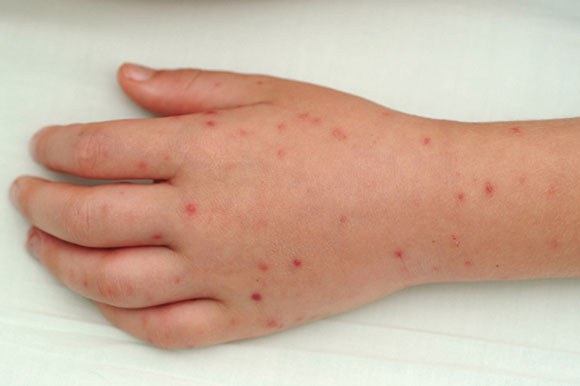
The general practitioner transferred the patient to the state tertiary paediatric service. No antibiotics were given before transfer. On arrival at Princess Margaret Hospital for Children, Perth, the patient was unwell, with a fever of 38°C. A provisional diagnosis was made of septicaemia (probably meningococcal), and treatment was begun with intravenous ceftriaxone. Extensive investigations were performed, but results of all initial serological, polymerase chain reaction and culture investigations were negative.
Rheumatology review was requested because of the prominent arthritic component of the illness. This revealed widespread polyarthritis, and the illness was felt to be a reactive or post-infectious process.
The child’s family raised the possibility of RRV disease, as her grandmother had had this disease several years previously, and the child had stayed overnight at her grandmother’s home in a coastal lake area 2 weeks before disease onset. The area had abundant mosquitoes, as well as kangaroos, which are vertebrate amplifiers for RRV.1
Serological tests for RRV were performed 3 days after admission, and were negative for IgG and positive for IgM. Repeat serological testing during convalescence showed a fourfold rise in IgG titre (from 80 to 320), confirming the diagnosis of RRV disease.
The patient’s rash decreased over several days. She had persistent synovitis in the left knee at review 3 weeks after admission. At review at 8 weeks all symptoms and signs had resolved, and she had full function.
This case highlights the fact that, while RRV disease with severe symptoms and arthritic manifestations is uncommon in children, it nevertheless should still be considered in the differential diagnosis of children with a febrile and arthritic disease.1,2 This child’s illness appears to have been a reactive vasculitis and polyarthritis, which, while well recognised with other infections, is not well described in association with RRV disease in children. RRV arthritis is caused by joint infection, and treatment is currently based on empirical anti-inflammatory regimens.
During the recent RRV disease epidemic in Western Australia, 1174 notifications for RRV disease were received between 1 October 2003 and 31 March 2004. Of these, 21 patients were aged 15 years or younger. Thus, while RRV disease is an infrequent illness in children, it does occur, and should be considered in the differential diagnosis of a child who presents with a febrile illness, rash and joint symptoms from an area with known autochthonous transmission of RRV.
References
- Harley D, Sleigh A, Ritchie S. Ross River virus transmission, infection and disease: a cross-disciplinary review. Clin Microbiol Rev 2001; 14: 909-932.
- Flexman JP, Smith DW, Mackenzie JS, et al. A comparison of the diseases caused by Ross River virus and Barmah Forest virus. Med J Aust 1998; 169: 159-163. i1085673
Costs of Delivering the Hep B PAST Model of Care in Remote Australia: A Retrospective Pre–Post Study
Hoa Nguyen, Anh Le Tuan Nguyen, Paula Binks, Melita McKinnon, Emily Vintour-Cesar, Karen Wills, Nicola Stephens, Benjamin Cowie, Joshua S. Davis, Yuejen Zhao, Peter Nihill, Julie A. Campbell, Andrew J. Palmer, Jane Davies, Barbara de Graaff
Buruli Ulcer Acquired From Ringtail Possum Rescue
Daniel P. O'Brien, Naomi Clarke, Sara Bonnici, Mohammad A. Hussain
Q Fever Visceral Abscesses After Contact With Native Australian Marsupials
Samantha J. Laws, Enzo Binotto, James Stewart, Jennifer Ho, Trent Yarwood, Josh Hanson, Simon Smith
Hospital-Admitted Injection-Related Infections Among Incarcerated People Who Inject Drugs in Australia: A Retrospective Cohort Study
Andrew Palmer, Matthew Carter, Jeremy Yeo, Cecilia Shim, Jason Connor, Jeremy Hayllar, Gerald Holtmann, Naomi Moy, Elliott G. Playford, Naomi Runnegar, Paul J. Clark
The Live Attenuated Influenza Vaccine in Australia: An Additional Tool for Influenza Prevention
Cyra Patel, Alexis Pillsbury, Tran Nguyen, Xia Wang, Helen E. Quinn, Clayton K. Chiu, Allen C. Cheng, Katie L. Flanagan, Zhicheng Wang
Reflex Testing for Hepatitis D Infection: A Unique Opportunity to Reduce Hepatitis D-Related Chronic Liver Disease Deaths in Australia
Jessica Howell, Lauren Andersson, Miriam T. Levy, James O'Beirne, Leon Adams, Katharine Irvine, Avik Majumdar, Golo Ahlenstiel, Kathy Jackson, Krispin Hajkowicz, Joseph Doyle, Jane Davies, Sarah Cherian, Wayne Dimech, Alexander J. Thompson