




Volume 180 - Issue 5
Sideline tool for sports medicine
Author: Peter A Fricker
Med J Aust 2004 || doi: 10.5694/j.1326-5377.2004.tb05881.x
Published online: 5 December 2003
Published online: 5 December 2003
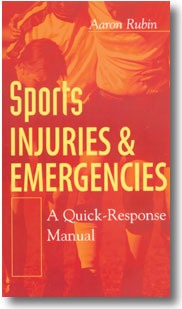
Sports injuries and emergencies. A quick-response manual.
Aaron Rubin. New York: McGraw-Hill, 2003 (xvii + 470 pp). ISBN 0 07 139610 1.
It should be recognised that in the US training to practise sports medicine is one of the many elective professional development programs a doctor can undertake. These "fellowships" generally take about 1 year and are added to an intern/residency program. This book is pitched at the resident undertaking some first-hand training in sports medicine and, no doubt, caring for athletes at College level undertaking various sporting activities.
The book covers all the usual topics in orthopaedic and musculoskeletal injuries, cardiovascular and respiratory emergencies, as well as medical conditions such as asthma, exercise-induced bronchospasm, and the treatment of cardiac arrest.
There are chapters on subjects such as the psychology of injury, and a number of appendices which describe the team physicians bag, the athletic trainers kit, emergency medical supplies etc.
The book does focus on specific sports- related injury and gives very useful guidelines for management for each of these diagnoses. It would certainly serve as a useful tool for the doctor sitting on the sidelines at a competition. The book is well illustrated, and each chapter contains a few useful current references.
The authors were not all well known to me. However, some of the names were familiar as experts in their respective areas within the domain of sports medicine. As a clinician interested in sports medicine, I found it an easy read, notwithstanding its very American focus.
The book does fill a gap in the market in that it is directed at a more sophisticated "first-aid for sport" niche. I did not find anything in the book with which I would strongly disagree, and the book is topical.
I note the retail price inscribed on my reviewers copy was $119.95 (presumably Australian dollars) and I would say this is expensive for a handbook. It would be valuable, though, among its target readership.
Peter A FrickerChair of Sports Medicine University of Canberra, ACT
Mild traumatic brain injury and concussion and persisting post‐concussion symptoms: new guidelines to support evidence‐based assessment and management in Australia and Aotearoa New Zealand
Karen M Barlow, Jennie L Ponsford, Alice Theodom, Gill Cowen, Gavin A Davis, Vicki Anderson, Franz E Babl, David Cole, Jennifer Cullen, Stuart R Dalziel, Melinda Fitzgerald, Howard Flavell, Caroline Yates, Rebecca Kimble, John H Olver, Rhonda Orr, Mark Ralfe, Michael Rose, Nick Rushworth, Julia Treleaven, Gary Browne, Nathan Delang, Sarah Harris, Gary Mitchell, Sean Tweedy
Physical activity interventions to prevent and manage type 2 diabetes in Aboriginal and Torres Strait Islander people: a systematic review
Raymond J Kelly, Rona Macniven, Leonid Churilov, Margaret J Morris, David O'Neal, Elif I Ekinci
The economics of a national anterior cruciate ligament injury prevention program for amateur football players: a Markov model analysis
Andrew Ross, Joosup Kim, Marnee McKay, Evangelos Pappas, Natalie Hardaker, Matt Whalan, Kerry Peek
Concussion in Aboriginal and Torres Strait Islander peoples: what is the true epidemiology?
Jonathan Bullen, Trish Hill‐Wall, Elizabeth Thomas, Richard Norman, Gill Cowen
Chronic traumatic encephalopathy in Australia: the first three years of the Australian Sports Brain Bank
Catherine M Suter, Andrew J Affleck, Maggie Lee, Alan J Pearce, Linda E Iles, Michael E Buckland