




Volume 180 - Issue 11
What explains falling asthma mortality?
Author: Elizabeth J Comino
Med J Aust 2004; 180 (11): 595. || doi: 10.5694/j.1326-5377.2004.tb06104.x
Published online: 7 June 2004
Published online: 7 June 2004
Elizabeth J Comino
Senior Research Fellow, School of Public Health and Community Medicine, University of New South Wales, Liverpool Hospital, Liverpool, NSW.
E.CominoATunsw.edu.au
To the Editor: The Australian Bureau of Statistics recently released details of asthma mortality for 2002. These figures indicate that asthma mortality has continued to decline in 2002 and that deaths in young people aged 5–34 years are at their lowest level since the early 1950s (Box). In this age group, the number of deaths fell from 43 in 2001 to 33 in 2002 (a 23.3% drop), and for all ages the number of deaths fell from 422 in 2001 to 397 in 2002 (a 5.9% drop). This suggests that the various asthma awareness activities, spearheaded by the National Asthma Council and other interest groups, have been successful in raising awareness of asthma and its management. Or does it?
Emerging evidence suggests other changes in the epidemiology of asthma in Australia. Robertson recently reported a 26% decrease in the prevalence of asthma in Melbourne school children between 1993 and 2002, but increased reporting of rhinitis and eczema over the same period.1 The significance of these findings is difficult to interpret without measures of airway function. A second study supported these results and also observed a small decline in the prevalence of parent-reported asthma, but found little change in atopy or airway hyperresponsiveness.2 Age-adjusted hospital separation rates for asthma decreased by 31.1% in young people and 31.4% in all ages between 1989–90 and 1999–00.3
There is little evidence of improved management of asthma in the general practice setting. Data published from the BEACH (Bettering the Evaluation and Care of Health) survey of general practice activity indicates a significant reduction in rates of presentation for asthma among children but not adults, with no changes in indicators of severity over time.4 Our recent research in south-western Sydney, examining uptake of the “asthma 3+ visit plan”5,6 by general practitioners and their patients, is disappointing. It suggests reluctance on the part of both GPs and patients to participate in the plan.
Clearly, there remains much that we do not understand about the natural history of asthma.7 We need to continue to monitor asthma through regular surveys and routine data collection in order to understand more about fluctuations in asthma prevalence, the relationship to changing child-rearing practices (such as use of childcare facilities) and the impact of management practices.
Asthma mortality in Australians aged 5–34 years, 1920–2002*
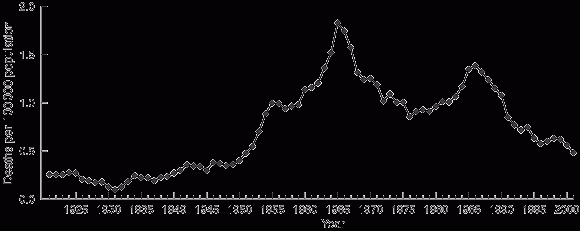
* Points on the graph represent 3-year “moving” averages — for example, the 2001 value is the average of 2000, 2001 and 2002 data; the 2000 value is the average of 1999, 2000 and 2001 data, etc. This technique is used to smooth annual fluctuations that occur in data of this kind.
References
- Robertson CR, Roberts MF, Kappers JH. Asthma prevalence in Melbourne schoolchildren: have we reached a peak? Med J Aust 2004; 180: 273-276. CACDGIHE
- Toelle BG, Ng K, Belousova E, et al. Prevalence of asthma and allergy in schoolchildren in Belmont, Australia: three cross-sectional surveys over 20 years. BMJ 2004; 328: 386-387. i1083067
- The health of the people of New South Wales. Report of the Chief Health Officer, 2002. Sydney: Public Health Division, NSW Department of Health, 2002. i1083069
- Henderson J, Knox S, Britt H. Changes in asthma management in Australian general practice. Paper presented at the 2nd World Conference of the International Primary Care Respiratory Group; 2004 Feb 19–22; Melbourne, Australia. i1083071
- National Asthma Council Australia. The asthma 3+ visit plan. 2002. Available at: www.nationalasthma.org.au/publications/3plusplan/3plus_rev.html (accessed Apr 2004).
- Zwar N, Harris M, Comino E, et al. Barriers and facilitators to implementation of the asthma 3+ visit plan. General Practice and Primary Health Care Research Conference; 2003 Jun 18–20; Canberra, Australia. i1083075
- Crane J. Asthma prevalence: mysterious enigmatic riddle or time-expired illusion? Med J Aust 2004; 180: 263-264. i1083077
Interpreting Australian Stillbirth Rate Trends: Implications for Surveillance and Continuous Quality Improvement
Aleena M. Wojcieszek, Kirstine Sketcher-Baker, Christine Andrews, Michael Coory, Imogen Kettle, Melissa Malivoire, David Ellwood, Vicki Flenady
Paracetamol in Pregnancy: Uncertain Evidence, Certain Consequences
David J. Tunnicliffe, Miranda Cumpston, Debra Kennedy, Margie Danchin, Armando Teixeira-Pinto
Fatty Liver Disease in Australia: A Narrative Review on the Epidemiology, Natural History, Prognostication and Management in People With Metabolic Dysfunction
Karl Vaz, Daniel Clayton-Chubb, William W. Kemp, Stuart K. Roberts, Ammar Majeed
Birth prevalence, clinical sequelae, and management of congenital cytomegalovirus infections in Australia, 1999–2023: a national prospective study
Ece Egilmezer, Suzy M Teutsch, Carlos Nunez, Stuart T Hamilton, Adam W Bartlett, Pamela Palasanthiran, Elizabeth J Elliott, William D Rawlinson
The number of cancer‐related deaths that could be attributable to spatial disparities in survival in Australia, 2010–2019: a retrospective population‐based cohort study
Charlotte K Bainomugisa, Jessica Cameron, Paramita Dasgupta, Peter Baade
Mandatory research projects during medical specialist training in Australia and New Zealand
Paulina Stehlik, Caitlin Brandenburg, David A Henry