




Volume 180 - Issue 11
Q fever in children: an emerging public health issue in Queensland
Authors: Jennifer H Barralet and Neil R Parker
Med J Aust 2004; 180 (11): 596-597. || doi: 10.5694/j.1326-5377.2004.tb06106.x
Published online: 7 June 2004
Published online: 7 June 2004
Jennifer H Barralet,* Neil R Parker†
* Epidemiologist, Communicable Diseases Unit, † Public Health Physician, Darling Downs Public Health Unit, Queensland Health, GPO Box 48, Brisbane, QLD 4001. Neil_ParkerAThealth.qld.gov.au
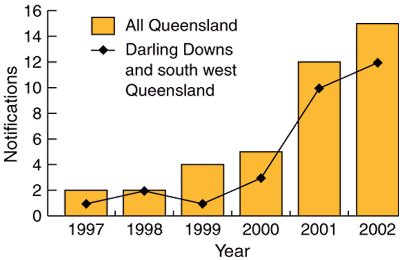
To the Editor: Queensland has a small but increasing number of Q fever notifications in children. This is of concern to public health services in the Darling Downs and south-west Queensland where most Q fever notifications originate (Box). Little is known about Q fever in children, especially in Australia, as the disease is primarily diagnosed in adults following occupational exposure to Coxiella burnetii. Here we report a case series examining clinical presentation, exposure to risk factors and disease outcomes in children.
Twenty-one children aged 3–14 years notified with Q fever from the Darling Downs and south-west Queensland in 2001 and 2002 were followed up. In acute cases the febrile illness was similar to that in adults from the same region. The one child with chronic Q fever had no known acute illness and presented with osteomyelitis of the wrist. All the children recovered, although relapsing symptoms were reported in two children and three reported persisting fatigue for 3 months or more after diagnosis.
All but one patient reported contact with cattle, sheep or goats (13 lived on a farm and 7 had visited a farm). The single exception reported contact with kangaroos and feral pigs through hunting. Prolonged exposure to animals or the farm environment was not necessary for infection. Twelve of the children had high risk exposure to C. burnetii (contact with animal births, newborn animals, or animal carcasses).
With increasing age, exposure of children from rural properties approaches that of their parents as they participate in the same activities. An effective vaccine is available,1 but use in people younger than 15 years is not recommended because of the lack of safety and efficacy data. Although avoidance of high risk situations such as shearing, animal births or on-farm butchering will decrease the chance of infection, these measures may be impractical for rural children. Realising this, some practitioners choose to vaccinate younger children who assist with animal births and butchering.
Increasing notifications in children may reflect increased awareness that Q fever is not confined to adults with occupational exposures. Increased awareness leading to recognition of infection would give children access to effective treatment and may contribute to prevention of chronic disease. However, much remains unknown about Q fever in children, including how often the infection is asymptomatic, the spectrum and outcome of disease, and if there are effective preventive strategies.
As many rural children cannot avoid potential exposure to Q fever, our study highlights the need for a safe and effective vaccine for children.
References
- Ackland JR, Worswick DA, Marmion BP. Vaccine prophylaxis of Q fever. A follow-up study of the efficacy of Q-Vax (CSL) 1985–1990. Med J Aust 1994; 160: 704-708. BEIGDADC
Costs of Delivering the Hep B PAST Model of Care in Remote Australia: A Retrospective Pre–Post Study
Hoa Nguyen, Anh Le Tuan Nguyen, Paula Binks, Melita McKinnon, Emily Vintour-Cesar, Karen Wills, Nicola Stephens, Benjamin Cowie, Joshua S. Davis, Yuejen Zhao, Peter Nihill, Julie A. Campbell, Andrew J. Palmer, Jane Davies, Barbara de Graaff
Buruli Ulcer Acquired From Ringtail Possum Rescue
Daniel P. O'Brien, Naomi Clarke, Sara Bonnici, Mohammad A. Hussain
Q Fever Visceral Abscesses After Contact With Native Australian Marsupials
Samantha J. Laws, Enzo Binotto, James Stewart, Jennifer Ho, Trent Yarwood, Josh Hanson, Simon Smith
Hospital-Admitted Injection-Related Infections Among Incarcerated People Who Inject Drugs in Australia: A Retrospective Cohort Study
Andrew Palmer, Matthew Carter, Jeremy Yeo, Cecilia Shim, Jason Connor, Jeremy Hayllar, Gerald Holtmann, Naomi Moy, Elliott G. Playford, Naomi Runnegar, Paul J. Clark
The Live Attenuated Influenza Vaccine in Australia: An Additional Tool for Influenza Prevention
Cyra Patel, Alexis Pillsbury, Tran Nguyen, Xia Wang, Helen E. Quinn, Clayton K. Chiu, Allen C. Cheng, Katie L. Flanagan, Zhicheng Wang
Reflex Testing for Hepatitis D Infection: A Unique Opportunity to Reduce Hepatitis D-Related Chronic Liver Disease Deaths in Australia
Jessica Howell, Lauren Andersson, Miriam T. Levy, James O'Beirne, Leon Adams, Katharine Irvine, Avik Majumdar, Golo Ahlenstiel, Kathy Jackson, Krispin Hajkowicz, Joseph Doyle, Jane Davies, Sarah Cherian, Wayne Dimech, Alexander J. Thompson