




Volume 180 - Issue 11
Bulk-billing GP clinics did not significantly reduce emergency department caseload in Mackay, Queensland
Authors: Dale W Hanson, Herbert R Sadlier and Reinhold Muller
Med J Aust 2004; 180 (11): 594-595. || doi: 10.5694/j.1326-5377.2004.tb06102.x
Published online: 7 June 2004
Published online: 7 June 2004
Dale W Hanson,* Herbert R Sadlier,† Reinhold Muller‡
* Tom and Dorothy Cook Research Fellow, James Cook University; † Director, Emergency Department, Mackay Base Hospital, PO Box 5580, Mackay Mail Centre, Mackay, QLD 4741; ‡ Associate Professor, School of Public Health and Tropical Medicine, James Cook University, Townsville, QLD. dwhansonATmackay.matilda.net.au
To the Editor: It has been argued that reduced levels of bulk billing have resulted in emergency department (ED) overcrowding due to an increase in non-emergency, primary care ED presentations.1 In the 2001–02 financial year, Queensland EDs experienced a 7.1% growth in caseload compared with 2000–01 (Mr D Searle, Surgical Access Team, Queensland Health, personal communication, Nov 2002). During the same period, there was a 1.5% decline in the proportion of general practice services bulk billed in Queensland.
Before December 2000, no dedicated general practice bulk-billing clinics existed in Mackay. The opening of two bulk-billing clinics, one within 1 km of Mackay Base Hospital, provided an opportunity to assess the effect of the increased availability of bulk-billing services on ED presentations.
The Mackay region had a full-time-equivalent GP : patient ratio of 1 : 1648 in 2002, compared with a Queensland average of 1 : 1143.2 In the September quarter of 2000, 58.4% of GP consultations were bulk billed in Mackay, compared with 85.7% in Brisbane (Ms D-A Kelly, Federal Member for Dawson, personal communication, Jun 2003).
The Mackay Base Hospital ED provides 24-hour, 365-day emergency medical services to the Mackay region, and managed 34 558 presentations in the 1999–00 financial year, admitting 15% of its caseload. On the Australasian Triage Score (ATS) classification, 0.2% of presentations were category 1, 4% category 2, 20% category 3, 54% category 4, and 21% category 5.
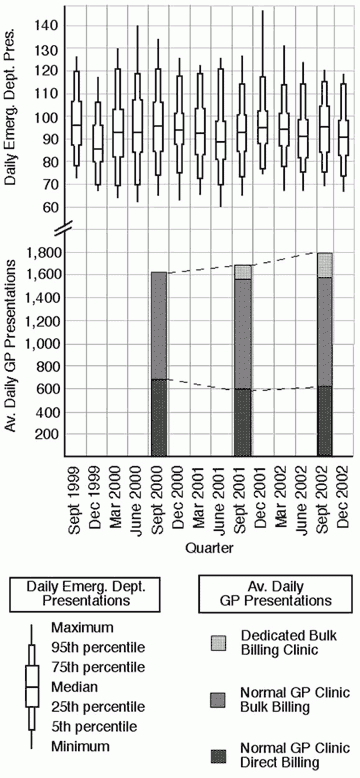
Since the bulk-billing clinics were established, there has been an average of 237 extra bulk-billing consultations per day, with a resultant 7.3% increase in the proportion of GP consultations bulk billed in the federal electorate of Dawson (Ms D-A Kelly, Federal Member for Dawson, personal communication, Jun 2003) (91% of the electorate lives in the Mackay region). However, ED presentations have remained stable, with a median 93 presentations per day (Box). Changes in the proportion of ATS 3, 4 and 5 presentations were observed (25%, 55% and 14%, respectively), but were associated with internal organisational changes (shifting surgical and orthopaedic dressing clinics out of the ED and into the outpatient department, and a review of triage policy), and cannot be reliably attributed to the influence of the bulk-billing clinics.
In Mackay, the implementation of two bulk-billing GP clinics did not result in a measurable reduction in the absolute number of ED presentations. These results are consistent with previous studies that suggest that non-emergency, primary care ED presentations are not a major determinant of ED overcrowding.3
Acknowledgements
Acknowledgement: This study was funded under the Priority Driven Research Program of the Australian Health Ministers Advisory Council.
References
- Gray D. Ministers push for action on emergency wards. The Age (Melbourne) 2002; Aug 15. Available at: www.theage.com.au/articles/2002/08/14/1029113955652.html (accessed May 2004).
- Tropical medicine training. GP/Population data. Townsville: North Queensland General Practice and Rural Medicine Training Consortium Ltd, 2002. i1083057
- Baggoley C. Primary care patients — what’s the problem? Emerg Med 1998; 10: 95-100. i1083059
Medical Colleges Have an Obligation to Ensure Full Participation in Clinical Quality Registries
Thomas J. Hugh
Getting on the Same Page: Why Australia Needs a National Maternity Early Warning System (MEWS) Chart
Briony A. Cutts, Lucy Bowyer, Nisha Khot, Sandra Lowe, Stefan C. Kane
Data for Equity: Can Linked Administrative Data Inform Pathways to More Equitable Child Health?
Sarah Gray, Shuaijun Guo, Meredith O'Connor, Elodie O'Connor, Katrina Williams, Hannah Badland, Susan Woolfenden, Josie Dickerson, Gerry Redmond, Marnie Downes, Sharon R. Goldfeld
Specialty College Selection: Why Change is Critical to Support a Future Rural Workforce
Matthew R. McGrail, Jenny May AM, Katherine Logan
Differentiated and simplified oral HIV pre‐exposure prophylaxis (PrEP) models hold the key to virtually eliminating HIV transmission in Australia by 2030
Tyson Arapali, Sarah Warzywoda, Anthony K J Smith, Curtis Chan, Timothy R Broady, Erin Sullivan, Catherine MacPhail, Mohamed A Hammoud, Alexander Dowell‐Day, Benjamin R Bavinton
The number of cancer‐related deaths that could be attributable to spatial disparities in survival in Australia, 2010–2019: a retrospective population‐based cohort study
Charlotte K Bainomugisa, Jessica Cameron, Paramita Dasgupta, Peter Baade