




Volume 179 - Issue 7
The Bali bombing: the Royal Darwin Hospital response
Authors: Didier J Palmer, Dianne Stephens, Dale A Fisher, Brian Spain, David J Read and Len Notaras
Med J Aust 2003; 179 (7): 358-361. || doi: 10.5694/j.1326-5377.2003.tb05593.x
Published online: 6 October 2003
Published online: 6 October 2003
After the Bali bombing on 12 October 2002, injured Australians were evacuated to Darwin. The first patients arrived at the Royal Darwin Hospital (RDH) 26 hours after the blasts. RDH assessed and resuscitated 61 patients (including 20 intensive care patients, with 15 requiring ventilation, 19 surgery and more than 20 escharotomies). RDH evacuated 48 patients to burns centres around Australia within 36 hours of the first patient arrivals at the hospital and 62 hours after the bomb blasts. The response was successful, but improvements are needed in coordination between the different groups involved in such operations.
At 07:45 CST on Sunday, 13 October 2002, a patient was seen in the emergency department (ED) of RDH with minor lacerations and a remarkable story. The patient described being in a nightclub in Kuta Beach, Bali, about 10 metres from the primary blast. He escaped by climbing through a collapsed roof, past dismembered bodies, and then ran to the airport, where he caught the next flight out of Bali.
External Disaster Plan activation
At 09:30, the Director of Emergency Medicine notified the General Manager and Medical Superintendent of RDH, and Level 1 of the External Disaster Plan was activated.
Over the next few hours, the only news came from television reports and Australian doctors in Bali using mobile telephones to ask for assistance. On the Sunday morning, like many organisations in Australia, RDH offered to send retrieval teams to Bali. The main impediments to this were that aviation companies were not willing to fly into an uninsured environment and ground clearance for landing was difficult to obtain — the first RAAF Hercules C-130 aircraft only obtained landing clearance as it approached Denpasar.
During the morning, key clinicians and administrators considered the capacity of RDH to respond. This information was conveyed to the Northern Territory’s Chief Minister, who contacted senior officers of the Commonwealth Department of Foreign Affairs and Trade. The decision was made to use Darwin as the first Australian retrieval port for seriously injured victims.
Darwin is geographically uniquely placed to act as a forward general hospital for disasters in our region. Located 1765 km from Denpasar, a little more than two hours by air, Royal Darwin Hospital (RDH) was the closest tertiary referral facility in Australia for victims of the Bali bombing. RDH is 10 minutes by ambulance from the international airport. In sustained air evacuations, pilot hours are often a rate-limiting step; small increases in cycle time (length of flight and turnaround time) can have major effects on pilot availability.
At 14:00, the first RDH control-room meeting occurred, and Level 2 of the External Disaster Plan was initiated (ie, fully prepare RDH to receive the injured). Control-room meetings occurred every few hours over the next 24 hours. At this stage, little was known; we planned for between 50 and 200 patients, with 50% being “walking wounded”.
At 15:00, RDH was informed that it would be the sole initial receiving hospital for the Bali victims. We did not receive information on patient numbers or injury severity until the first wave of patients arrived.
Preparing to receive bomb victims
Between 14:00 and 18:00, 24 RDH inpatients were transferred to the collocated Darwin Private Hospital. Specialist-led discharge rounds cleared a further 20 beds. This enabled the establishment of a 48-bed receiving ward. All outpatient clinics and operating lists for the following five days were cancelled, with affected patients contacted. The local media broadcast announcements informing the community of the events about to unfold and asking potential patients with non-urgent conditions to make alternative arrangements. Despite this, there was no decrease in the number of usual attendances, probably because RDH has the only ED in the region.
Additional linen, stores and pharmacy supplies were distributed to the ED, intensive care unit (ICU), theatres, and receiving ward. Additional equipment was borrowed from Darwin Private Hospital. Nearly 600 RDH staff were recalled by telephone cascades and deployed over the next few hours.
The ED mobilised its disaster stores and augmented supplies of consumables (particularly cling wrap for temporary burns dressings, morphine, ketamine, rocuronium, tetanus toxoid, antibiotics and O Rh-negative blood). A fibreoptic intubating scope was added to the usual “difficult airway” boxes. All suxamethonium was removed from the ED to prevent a depolarising relaxant being used in error. Before the arrival of the first patients, group tutorials were held covering burns dressings, escharotomies, and fluid and airway management. The lines of command were made explicit.
The ICU occupancy could, fortuitously, be reduced to one patient before the Bali patients’ arrival. The ICU is designed for eight patients, but can accommodate 12 ventilated patients. Four additional beds were created in the adjacent coronary care unit and another four in Darwin Private Hospital. Six ICU bays were set up as emergency primary receiving resuscitation bays in the event of ED saturation. All hospital albumin supplies were sent to the ICU and more were ordered from the Red Cross Blood Bank.
Four operating theatres were made available for bomb victims, with a fifth theatre kept for other emergencies. The rostered staff of the day prepared three of the theatres with invasive monitoring, fluid-warming devices and forced-air warmers. Equipment limitations meant the fourth theatre was set up for less critically ill patients.
At 15:00, the first of five Hercules C-130 aircraft from RAAF Base Richmond, near Sydney, landed in Darwin before proceeding to Bali. Two specialists (an anaesthetist and a general surgeon) from RDH joined the flight with surgical supplies. The familiarity of the Darwin-based medical Army Reservists to both civilian and military sectors facilitated the rapid acquisition of additional supplies and equipment in Darwin. The Australian Defence Force (ADF) team’s involvement has been previously described.1
At 18:00, RDH was ready to receive patients. There followed an 8-hour wait until the first arrivals.
Patients arrive at Darwin airport
At Darwin airport, the Site Medical Commander (the Director of Anaesthesia) headed a hospital team of two anaesthetists with ICU experience, two ICU nurses and two aeromedical retrieval doctors. This team met each of the Hercules C-130 aircraft (which were carrying between 11 and 22 patients), and the Site Medical Commander received handover from the aircraft’s ADF medical staff. This too was facilitated by many ADF staff being known to RDH staff (reservists working in RDH or living locally).
The Site Medical Commander was in mobile phone contact with the ED Director for a brief handover of the critically ill patients. He also liaised with the ambulance controller to maintain ambulance departure rates so that one patient arrived at the ED every 3–5 minutes.
Just two patients were directly transferred interstate from the airport by interstate retrieval teams. Most patients required stabilisation before further transport could be considered.
The RDH staff accompanied the most critically ill patients to RDH, continuing resuscitation in transit to the ED, where they led ongoing resuscitation efforts and followed through to ICU or operating theatres. This streamlined care by obviating the need for multiple handovers.
Patients arrive at RDH
On arrival at the ED, each patient was triaged by the ED Director with the assistance of a senior ED nurse. Four patients were triaged directly to ICU when ED capacity (18 simultaneous resuscitations) was approached. No patients were triaged directly to the operating theatre or to palliative care only. Understandably, minimal documentation arrived with the patients. Some patients remained unidentified for many hours.
Patient tracking (with a team of three ED receptionists) was initiated at triage. Each patient was tagged with a preset Hospital Record Number, and a pre-made disaster documentation pack was attached to the patient’s bed. The disaster pack contained pre-printed labels, trauma sheets, burn charts, medical record continuation sheets, blood and radiology forms and a labelled bag for clothing and belongings. A fourth member of the patient tracking team consolidated the computer record for each patient before the patient left the ED.
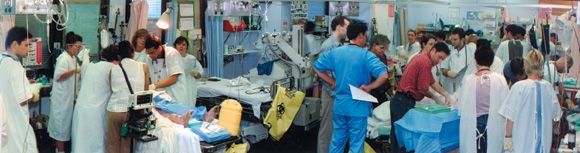
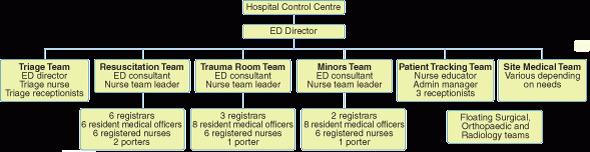
The ED was divided into four clinical areas and six teams (Box). The clinical areas comprised resuscitation (6 beds), majors (6 beds), minors (6–10 beds in an adjacent outpatient area) and a fourth area for “non-Bali” patients. An ED consultant led each of the disaster receiving areas. It rapidly became apparent that there were no “walking wounded” patients. One man with 50% burns was triaged to the minors area when there were 12 more seriously injured patients already occupying the resuscitation and majors beds. ED junior medical staffing was augmented with residents and registrars from non-ED areas to create 18 receiving teams. Medical students were used to provide a delivery service between areas, assist with investigations and look up results, and to help compile complete and accurate medical records for each patient. Important assistance was also provided by a floating general surgeon, orthopaedic surgeon and radiologist, facilitating rapid decision making.
After being assessed and resuscitated in the ED, patients were reassessed by surgical teams on entry to the receiving ward. It quickly became apparent that these teams were becoming overwhelmed, and a blanket referral was made to the hospital’s physicians for assistance. Four physician-led “metabolic” teams were rotated through the receiving ward, re-assessing, continuing fluid resuscitation and detecting some missed injuries.2 Despite ongoing resuscitation, two patients initially sent to the receiving ward were promptly identified by the medical teams as requiring ICU transfer.
Twenty ICU admissions resulted from the disaster. Offers of assistance came from interstate doctors in Darwin, but it was difficult to find tasks for them, and at times crowding in the ICU from staff without tasks made management more difficult. In contrast, late on the evening of 13 October a requested Royal Adelaide Hospital specialist burns team arrived. They immediately fitted into our teams and performed surgical burns care unstintingly for the next 24 hours, before returning to Adelaide to continue work on Bali victims.
Patterns of injury and resuscitative procedures
Twenty-eight of the 61 patients seen in RDH had major trauma (Injury Severity Scores of 16 or greater). The full range of blast injury sequelae were seen, including severe burns, missile injuries from shrapnel, limb disruption and pressure-wave injury to ears, lung and bowel. Several patients had undergone surgery in Bali, including escharotomy, amputation, laparotomy and suturing of blast wounds (which subsequently were laid open owing to overt infection). Only patients with injuries deemed of immediate surgical importance underwent surgery in Darwin. Fifty-five escharotomies were performed (mostly in the ED and ICU), and, in the operating theatres, 43 other surgical procedures (on 20 patients) were performed, using 50 hours of theatre time.
Three patients arrived intubated from Bali, a further 12 patients were intubated in RDH: two in the ED, four in the operating theatre and six in the ICU. Most were difficult intubations because of facial and airway burns and oedema. Suboptimal fluid resuscitation before arrival may have been fortuitous in maintaining patent airways, as increasing airway oedema with fluid resuscitation in RDH necessitated expert airway skills and ventilatory support that may not have been available in Bali. Despite fluid resuscitation, three patients with blast injuries required haemofiltration because of severe acidosis, rhabdomyolysis and rising serum potassium levels.
Evacuation to specialist burns units
Once the extent of the disaster was known, it was evident that patients would need to be evacuated from Darwin to specialist burns units throughout the country. No single hospital in Australia has the capacity to effectively manage 61 patients with severe burn and blast injuries. A teleconference between RDH and representatives from the Commonwealth and state health departments was held on Monday, 14 October, at 14:00 to coordinate the mobilisation of resources. The RAAF would evacuate the ward patients to their home states in Hercules C-130 aircraft.
Critical care trained retrieval teams from Queensland, New South Wales, Victoria, South Australia and Darwin evacuated ICU patients to interstate burns units. Within 24 hours of the initial teleconference, 14 ICU patients were evacuated. Three additional patients were evacuated to interstate burns units over the next few days. The Darwin ambulance service was pivotal in the ICU evacuations.
The ward patients were evacuated by four RAAF flights of about 10 patients each, with 2 hours to transport and load each flight. The flights went to Perth, Brisbane, Sydney, and Melbourne (via Adelaide). The first C-130 flight, at 24:00 on Monday, 14 October, also carried two ICU ventilated patients. In total, 48 patients were evacuated from RDH.
The evacuation was successful in achieving the aim of sending patients safely to definitive burns care, in most cases in patients’ home states.
Communication
Of critical importance in all phases of the response, from Level 1 (Alert) to Level 4 (Stand Down), was communication. While our emergency procedure manual clearly outlined communication protocols, as an offshore external disaster Bali presented a number of unique challenges.
From the earliest phases, communication was established with the Northern Territory External Disaster Committee and with national disaster coordinating bodies. Within the Northern Territory, although most of the activity occurred at the hospital and the airport, a central disaster command centre was established at the police headquarters, with the task of assisting in the coordination of the police, fire and emergency response, and local government and non-government agencies. From a federal perspective, communications needed to be maintained with various organisations, including the Australian Defence Force, the Commonwealth Department of Health and Ageing, the Australian Customs Service and the Australian Federal Police.
Initial information about the extent of the disaster was confused and inaccurate. The most accurate reports were those conveyed directly to the hospital from Bali. RDH army reservist medical officers were deployed to the disaster site on the first flights, resulting in improved information flow.
Direct communication within the hospital quickly exposed the pitfalls of electronic mail (too busy to check), mobile telephones (lack of reception) and land lines (not mobile), and revealed the future potential benefit of “hands free mobile communications devices” between key individuals. Directors of departments met in the control room every few hours, and this enabled effective anticipation, flexibility of planning, dissemination of information, and resource management.
Given the unique nature of the event, the hospital became a centre of national and international media convergence. The response involved round-the-clock media management, additional security, cleaning, catering, administrative and engineering services to deal with a range of contingencies.
Relatives and friends of those in Bali required a constant, up-to-the-minute information service. An RDH hotline was manned by finance staff and administrative officers.
Psychological aftermath
Overview debriefing sessions were centrally organised for all staff, starting on Tuesday, 15 October. These were run initially by lead clinicians, and continued by the hospital counselling service, until all involved staff within and outside the hospital had been given an opportunity to attend.
In debriefing staff, a cognitive approach was taken to dealing with acute stress disorder3 after the event, in the realisation that we were unlikely to be able to affect long term rates of post-traumatic stress disorder.4
Sessions aimed to put team efforts in perspective, so that people were able to see their role in the overall disaster management process. Focus was placed on coping with normal feelings of sadness and loss. Small group sessions were also held in all workplaces to give work colleagues the opportunity to share their feelings and coping strategies. It was also important for staff to get progress information on patients for whom they had cared.
Formal and informal debriefing continued for four weeks, during which time a sense of camaraderie and achievement developed. This was helped by messages of appreciation from other hospitals, professional bodies, people from all over Australia and the victims and their families.
Patient outcomes
At the time of writing, it is our understanding that, of the 61 patients retrieved to RDH, one died in RDH, three died after interstate transfer, and one remains hospitalised. The other 57 patients have been discharged home. It is our opinion that the survival rate is higher than expected given the nature of the injuries, the environment of the disaster and the time taken to delivery of definitive care. The successful outcome is attributable to teamwork at every link in the chain of care from Bali to the eventual discharge of patients.
One of the defining experiences of those 62 hours was the level of teamwork between organisations, departments, professional groups and individuals. It is a rare privilege to work in an environment completely stripped of hidden agendas and professional boundaries.
Conclusions
Effective federal command, control and communication for multijurisdictional disasters is crucial, and worked reasonably well in the Bali evacuation. However, these experiences must be built upon. An Australia-wide disaster plan should be reworked in the light of the Bali experience, especially for remote and offshore areas. In particular, the military–civilian interface needs development; there needs to be central coordination of non-government retrieval teams (especially in the initial response); and lines and methods of communication need reinforcement.
The concept of a “forward general hospital” to resuscitate injured evacuees is an established military model and worked well in this operation. The RAAF is the only organisation in Australia with the capability to evacuate large numbers of injured by air, and should be included in disaster planning for remote Australia. If a model of a “forward general hospital” is accepted for remote areas, then these hospitals should be designated and funded for the task. If there is no available forward general hospital, the Australian Defence Force has the capability to airlift a temporary tent hospital close to the disaster site, and this should be included in the disaster planning for those areas.
In disaster medicine at all levels, from federal government to individual emergency departments, detailed plans are in place for most contingencies, but these are rarely tested beyond tabletop exercises. In our experience, tabletop exercises are of limited value, as they only identify theoretical problems in communication, equipment, personnel availability and timing — real problems can remain hidden. Disaster exercises with mobilisation of assets and “real time” communication should be set as the benchmark for testing disaster plans. Such exercises, especially at the complex interorganisational interfaces, require funding.
In some ways, the Australian Bali response was straightforward — delayed patient arrival, single retrieval agency, single receiving hospital. If a bomb exploded in a crowded Australian nightclub, the required immediate response would be infinitely more complex.
RDH has acted as the advanced receiving hospital in Australia’s largest-ever offshore disaster requiring urgent evacuation. It recognised its limitations and acknowledged the need for assistance immediately, safely disseminating a large number of patients to home bases after clinical stabilisation.
References
- Hampson GV, Cook SP, Frederiksen SR. Operation Bali Assist. The Australian Defence Force response to the Bali bombing, 12 October 2002. Med J Aust 2002; 177: 620-623. i1082878
- Fisher D, Burrow J. The Bali Bombings of 12 October, 2002: lessons in disaster management for physicians. Intern Med J 2003; 33: 125-126. i1082880
- Harvey AG, Bryant RA. The relationship between acute stress disorder and posttraumatic stress disorder: a prospective evaluation of motor vehicle accident survivors. J Consult Clin Psychol 1998; 66: 507-512 i1082882
- Rose S, Bisson J, Wessely S. Psychological debriefing for preventing post traumatic stress disorder (PTSD) (Cochrane review). The Cochrane Library, Issue 1, 2003. Oxford: Update Software. i1082884
‘Once Bitten’: A Case of Tetanus Following Snakebite in Australia
Adrian A. S. Doherty, Naomi N. E. Clarke, Sarah Fletcher, Sarah Huffam, Camille V. Awburn, Eugene Athan
Epidemiology and Quality of Care for Aboriginal and Torres Strait Islander Peoples Treated by Emergency Medical Services for Stroke in Victoria, Australia: Retrospective Analysis of Linked Data
Candice Menezes, Ziad Nehme, Luke J. Burchill, Tegwyn McManamny, Angela Dos Santos, Michelle Crilly, Luke P. Dawson, Benjamin Clissold, David Anderson, Emily Nehme
Intranasal Adrenaline Use for the Management of Insect Venom-Induced Anaphylaxis
Thomas J. Young, Wilhelmina R. F. Johnson, Braydon L. Pennington, Troy Wanandy, Wun Y. Lau, Thanh-Thao A. Le
Gabapentinoid Poisoning Presentations to Victorian Emergency Departments: A 15-Year Trend Analysis
Bishaal Tej Gurung, Amy McNeilage, Angus Skeen, Tina Lam, Joanna F. Dipnall, Jane Hayman, Suzanne Nielsen, Ting Xia
They Brought the Hospital to Me
Hugh N. Burrill
Predictors of Ambulance Transport to Hospital for Older People Living in Tasmanian Aged Care Facilities: A Retrospective Cohort Study
Sharon Andrews, Pieter F. Fouche, Belinda Flanagan, Michael McDermott, Melanie Greenwood