




Volume 179 - Issue 6
A practical philosophy for doctors?
Author: Sidney Bloch
Med J Aust 2003 || doi: 10.5694/j.1326-5377.2003.tb05540.x
Published online: 22 May 2003
Published online: 22 May 2003
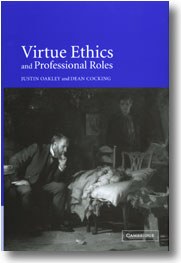
Virtue ethics and professional roles.
Justin Oakley, Dean Cocking. Melbourne: Cambridge University Press, 2002 (xii + 188 pp). ISBN 0 521 79305 X.
The novice moral philosopher is given a brief guide to the origins and variants of virtue ethics. We are introduced to the Aristotelian view that a specific set of character traits is needed in order to live a "flourishing life". We are also told that to live the good life we need to acquire phronesis — practical wisdom.
The authors then add their own concept of the "regulative ideal" to the Aristotelian argument. People are guided by a "regulative ideal" when they have "internalised a certain conception of correctness or excellence in such a way that they are able to adjust their motivation and conduct so that it conforms — or at least does not conflict — with that standard". The idea is aligned to Aristotle's practical wisdom in that it encompasses an appreciation of what constitutes the general good.
The book describes how virtue ethics and the "regulative ideal" apply to medical practice and links the concept of a "flourishing life" to the goals of the medical profession. Consideration is given to what constitutes desirable virtues in a doctor and what character traits enable them to achieve the goal of enhancing health and corresponding human "flourishing". The authors settle on a familiar catalogue of virtues: a deep capacity for compassion, truthfulness, trustworthiness, courage, humility and a consistent inclination to act justly.
Does the book convince the reader of the benefits of virtue ethics for the professions? Many would support the view that inculcating and promoting certain character traits in doctors would enable them to make a more positive contribution to their patients and patients families — but is this a sufficient basis for good practice?
Does virtue ethics provide the means to disentangle the myriad moral dilemmas that doctors encounter in their day-to-day practice? Does virtue-based ethics sort out complex issues like euthanasia, abortion, gene therapy, involuntary hospitalisation, respecting confidences, allocating resources, and many other quandaries?
All theories have their limitations. Ultimately, we may find common ground between various theories and achieve an integrative view where their advantages are harnessed.
Sidney BlochProfessor of Psychiatry University of Melbourne, VIC
Mending the Road: A Way Forward From Silence and Silencing
Ayman Hamdan, Anisa J. N. Jafar
Seven Vessel Spontaneous Coronary Artery Dissection and Concurrent Transient Global Amnesia After an Emotional Trigger
Michael J. Stewart, Tom R. Sutherland
Seven Vessel Spontaneous Coronary Artery Dissection and Concurrent Transient Global Amnesia After an Emotional Trigger
Virginia Barbour
Research Priority Setting Is Not Research: A Call for Ethical Clarity in Australia
Bec Jenkinson, Gordon McGurk, Jonathan Quicke, Janelle Bowden, Nadine E. Foster
Organ Donation After Oral Ingestion of a Voluntary Assisted Dying Substance
Joanne Kantianis, Helen I. Opdam, Rohit L. D'Costa
Equity, Diversity and Inclusion From the Start: Reforming Australia's Research Infrastructure for Inclusive Participation
Danielle M. Muscat, Kirsten J. McCaffery, Heather L. Shepherd, Marguerite Tracy