




Volume 179 - Issue 4
Addressing the shortage of rural physicians in Victoria: maximising rural trainee recruitment
Authors: David Simmons, Amanda Fieldhouse, Leslie E Bolitho, Grant J Phelps, Rob Ziffer and Gary J Disher
Med J Aust 2003; 179 (4): 219-220. || doi: 10.5694/j.1326-5377.2003.tb05509.x
Published online: 18 August 2003
Published online: 18 August 2003
David Simmons,* Amanda Fieldhouse,† Leslie E Bolitho,‡ Grant J Phelps,§ Rob Ziffer,¶ Gary J Disher**
* Professorial Fellow, Department of Rural Health, University of Melbourne, Shepparton; and Professor of Medicine, University of Auckland Waikato Clinical School, Waikato Hospital, Hamilton, New Zealand; † Health Care Consultant, South Yarra, VIC; ‡ Physician, Wangaratta, VIC; § Physician, St John of God Hospital, Ballarat, VIC; ¶ Physician, Sale, VIC; ** Deputy Director – Health Policy, Royal Australasian College of Physicians, Sydney, NSW. simmonsdATwaikatodhb.govt.nz
To the Editor: Rural Australia has a substantial shortage of specialist physicians. In 1999, Victoria had 52 specialist physicians for 1.3 million people (a physician to population ratio of 1:25 000).1 The Australian Medical Workforce Advisory Committee recommendation is 1:10 000.2 Although much has been written about the shortage of rural general practitioners, there is little about rural specialist physicians. However, evidence from Western Australia showed that advanced trainee physicians interested in rural practice were diverted to city-based practice during their training.3 Here, we outline a state-wide approach to encourage advanced trainee physicians to complete their training in rural Victoria.
The University of Melbourne Department of Rural Health in Shepparton provided support for rural Victorian physicians to develop a state-wide network, the Victorian Rural Physicians Network, under the Victorian State Committee of the Royal Australasian College of Physicians (RACP). A pilot survey in the 14 major rural Victorian centres demonstrated capacity for at least nine Advanced Physician Trainee positions across rural Victoria. The RACP accredited five positions initially, with others to be reviewed for accreditation if required. These positions were funded largely by the joint Federal–State Government Advanced Specialist Training Program in Rural Australia.
Four trainees completed 12 months of rural training in 1999–2000, and three are now working as rural physicians. These trainees were recruited through advertisements in the RACP newsletter and personal contacts. The trainees provided substantial benefits, both in service delivery, as their presence reduced the load on other doctors in the same hospital, and in medical education, as they provided more education and supervision for junior doctors and doctors from overseas. In 2001, a similar approach to recruitment identified eight potential applicants, but none came to interview.
In 2002, three new strategies were therefore introduced:
Flexible, joint rural–metropolitan positions were created;
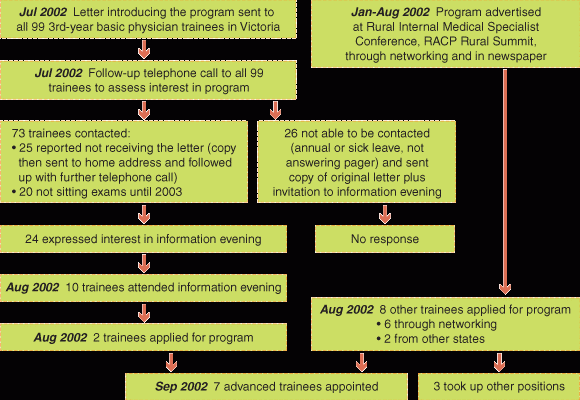
A management consultant was employed to contact personally all 99 Victorian basic physician trainees expected to enter advanced training.
The response to the new approach is shown in the Box. A third of contactable trainees indicated an interest in rural practice at the end of their basic training. Ten applications were received for the rural training positions, and seven trainees were appointed (three withdrew). We believe that our new strategies have merit, and that the personal touch has created goodwill which may improve the response for 2004.
References
- Simmons D, Bolitho L, Phelps G, et al. Dispelling the myths about rural specialist practice: The Victorian Physicians Survey. Med J Aust 2002; 176: 477-481. <eMJA full text>
- Australian Medical Workforce Advisory Committee. The medical workforce in rural and remote Australia. Sydney: AMWAC, 1996. CBBEJAHJ
- Kanaragarajah S, Page JH, Heller RF. Changes in job aspirations during physician training in Australia. Aust N Z J Med 1996; 26: 652-657. CBBHAHCA
- Simmons D. First World Rural Internal Medicine Specialist Conference. RACP News 2002; 21: 13. i1082824
- Royal Australasian College of Physicians. Report on the National Rural Summit 27–28 April 2002. Sydney: Royal Australasian College of Physicians, 2002. i1082826
Shifting focus to adolescent wellbeing and inclusive participation in the digital age
Allyson R Todd, Elena Wang, Stephanie R Partridge
The clinical presentation, investigation, and management of women diagnosed with endometriosis in Australian general practices, 2011–2021: an open cohort study
Danielle Mazza, Kailash Thapaliya, Sharinne B Crawford, Alissia Hui, Maryam Moradi, Luke E Grzeskowiak
The impact of the Breast Screen NSW transition from film to digital mammography, 2002–2016: a linked population health data analysis
Rachel Farber, Nehmat Houssami, Katy J L Bell
Non‐technical errors associated with deaths in surgical care, Australia, 2012–2019, by surgical specialty (Australian and New Zealand Audit of Surgical Mortality): a retrospective cohort study
Jesse Ey, Victoria Kollias, Octavia Lee, Kelly Hou, Matheesha Herath, John B North, Ellie Treloar, Suzanne Edwards, Martin Bruening, Adam J Wells, Guy J Maddern
The CURE Asthma roadmap
Gary P Anderson, Anthony Flynn, Phil G Bardin, John D Blakey, Shyamali C Dharmage, Paul Foster, Peter G Gibson, Adam Jaffe, Alan James, Christine R Jenkins, Sundram Sivamalai, Peter D Sly, Guy B Marks, Vanessa M McDonald, Judy Wetttenhall
Evidence from Australian cohort studies about asthma trajectories and transitions across the life course: a narrative review
Caroline Lodge, Xin Dai, Ingrid A. Laing, Michael P Menden, Anthony Flynn, Gary P Anderson, Sarath Ranganathan, Shyamali C Dharmage