




Volume 177 - Issue 11
Sojourn in Sweden: a GP activist goes to jail
Author: Elizabeth D Rickman
Med J Aust 2002; 177 (11): 627-628. || doi: 10.5694/j.1326-5377.2002.tb04988.x
Published online: 9 December 2002
Published online: 9 December 2002
How a peace-loving suburban Sydney GP, practising primary prevention her way, ended up in solitary confinement
I've always believed that it's part of my job description as a doctor for me to be aware of environmental issues and to address them as best as I can. So, I've been a long-time supporter of Greenpeace (www.greenpeace.org) and a member of the Medical Association for Prevention of War (in NSW, called Health Practitioners for Global Responsibility; www.mapw.org.au, mapwATmapw.org.au). And, since 1997, this desk-bound GP has worked as a volunteer "medic/deckhand" on Greenpeace ships, like the Rainbow Warrior, for a couple of months each year.
As medic, I ensure that the ship's hospital, which doubles as my sleeping cabin, is ready for emergencies, illness or injury. It's well stocked, with resuscitation equipment, surgical supplies and drugs; we are prepared for anything, from draining a pneumothorax to flying out someone with a spinal injury. For example, I've attended to crew after they were "rained on" with heavy metal tools as they climbed up an oil tanker and treated hypothermia after cold water immersion. I also train crew in first aid, including resuscitation (and working out team approaches in emergencies) and practise primary care and preventive medicine, from mosquitoproofing the ship to discussing outbreaks of worms.
When not working as a medic, I am under the charge of the bosun, who assigns me to deckhand jobs — for example, painting the mainmast, restacking the hold or standing watch (which involves working a night shift), with opportunities to improve navigation and radio skills.
When the ship is engaged in protest actions, I can either stay aboard as part of the back-up crew or volunteer to be involved as an activist. I've been directly involved in several campaigns. My first was in Central America after Hurricane Mitch swept through in October 1998, where I worked alongside locals, hauling bulk bags of rice and beans, tents and boxes of clothing and medicines into wharfside sheds for later distribution. My most recent expedition, to Sweden, provided a very different experience.
Protest
On 4 June 2002, the Rainbow Warrior and her crew embarked on a protest involving the cargo vessel ms Fagervik, which had dumped a large amount of oil into the Baltic Sea in February 2001. Although evidence suggested that the Fagervik's spill had been deliberate, the local Swedish court had decided to prosecute the ship's owners for an accidental spill (with a small fine) rather than for a deliberate spill (a criminal offence).
Greenpeace wanted to protest about the facts that deliberate oil spills are frequent (about 1000–2000 a year in the Baltic) and virtually go unpenalised. We believe that ship owners and industry should bear the full financial liability for the effects of oil discharges, whether or not intent can be proven. Our specific goal was to board the Fagervik en route to the port of Norrköping (about 160 km south of Stockholm).
The action took place in the usual non-violent manner that Greenpeace is committed to. We spent the first day of the protest in a rubber Zodiac boat doing action manoeuvres — painting slogans, hanging banners, and getting "climbers" (those who climb up ships' hulls) on board the Fagervik.
Arrest
In the early evening on that first day of the protest, I joined a few other protestors on board the Fagervik. As part of the protest, I chained myself to the boat, as did Kristina, a 27-year-old German. The Swedish police boarded the ship that same evening, and at 10 pm Kristina and I were arrested. We were charged with aggravated trespass and taken to the town lockup to be held in solitary confinement.
It was an unprecedented reaction to a Greenpeace protest. We had been told, in the routine legal briefing before the campaign, that such a charge, with a two-year prison sentence, was possible but unlikely. More likely was a charge of minor trespass, with release within four days. Under Swedish law, there is no bail; one can be held in custody indefinitely until trial — which, I was told, could be many months off.
In solitary
That night, I was put into a concrete basement cell, 1.5 m by 3 m, that boasted a floor mat to sleep on and a drain hole, which others had clearly used as a toilet. I, too, later resorted to using the hole for the same purpose, as it could take up to an hour after pressing a buzzer before a guard would respond to take me to the actual toilet.
The cell walls, floor and mat were encrusted with recent faeces and blood. Later, I found out that my dingy cell was more generally used as the "drunk cell", for those who were drug or alcohol affected when arrested.
My watch and warm boat suit and gumboots were confiscated and I was issued cotton pants, a shirt and plastic scuffs to wear.
I felt not only isolated but also powerless; contact with Kristina and my personal lawyer was denied me; later we presumed that this was because of a fear of terrorism; that there was a risk of "collusion" between my lawyer and myself (I was allocated a State lawyer). I was also denied direct contact with my family and it was days before I was finally able to make contact with the Australian consulate. The seamen's mission priest and the prison nurse were other eventual, permitted visitors.
In the first few hours, I observed my fear and confusion growing. Then, I remembered Victor Frankl's words in his book Man's search for meaning: 1
Everything can be taken from [us] but one thing: the last of the human freedoms — to choose one's own attitude in any given set of circumstances, to choose one's way.
I resolved to apply myself to keeping mentally clear and stable. I began by getting a rough idea of the time from my meal deliveries. Then, knowing the link between exercise and wellbeing, I began a workout program that encompassed every exercise I had ever learnt and devised ways of timing half-hour walking periods without a watch.
I'd practised yoga and meditation for many years, and drew on that practice to maintain an attitude of acceptance and calm. It became an incredible comfort to me when, each day, the inner reality of the meditation space became stronger as my small, shabby and uncertain external world shrank in importance.
Initially, what there was to read was in Swedish. Greenpeace members attempted to send books, music, and clothes, but not much was allowed through. So, I began drawing.
One kind guard gave me pencils and paper, and would sharpen them on his shift, saying that he trusted me not to use them as a weapon. By the time I was released, one whole wall of my cell was covered with paper and my own huge mural of Sydney Harbour.
The guards would stop by to see my drawings, and indeed they became friendlier during my imprisonment, sometimes offering me a second cup of tea in the day. A guard confided "I like what you do. Tonight I give 500 kronas ($100) to Greenpeace". Many asked whether I really was a doctor and one sought my advice concerning his dying father.
Meanwhile, the small fiord township of Norrköping was anticipating a large and complex trial and Greenpeace continued the Fagervik protest for several more days, with a flotilla of small boats and climbers on board (as well as continuing arrests). Greenpeace also mounted a networked international campaign calling for our release. The media took hold of the story, with incredibly supportive coverage of our stance.
Release
I was working at my wall, well prepared for a long stay, when a guard came into my cell to tell me that I was to be released forthwith. It was 14 June, ten days after our arrest. My reactions ranged from relief to confusion, knowing that a trial and possible further imprisonment lay ahead.
The police superintendent came to my cell, shook my hand, and apologised for keeping us in cells intended for overnight use only. The guard on duty farewelled me with a hug, sorry to see us go. I thanked him for the pencils.
Kristina and I emerged from the building to be met with banners, flowers and friendly faces I did not know from the Stockholm Greenpeace office. I still had no shoes and one large Swede gave me his sandals. Again, I found myself watching my reactions: ordinary things, like seeing the sky and breathing the air seemed wonderful. I'd been used to solitary silence and was now being interviewed by the mass media. On release, I learnt that during our imprisonment a large export company had announced it would not use the Fagervik or any "dirty" ships (ie, sea-polluters) for transport — I felt a deep sense of effort rewarded.
On trial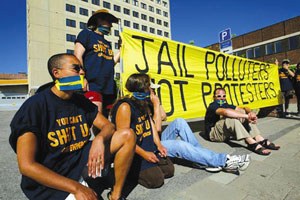
Two weeks later, four Greenpeace activists, including myself, were found guilty of aggravated trespass and given a two-year suspended sentence. This means that, if we work in any future protest actions in Sweden, we risk getting arrested and having to serve out our sentence.
We can understand some of the reasoning behind this sentence — a year ago, Sweden was shaken by violent anti-globalisation demonstrations in Gothenburg. However, we plan an appeal, as it's important to make a distinction between violent protest and the right to non-violent, thoughtful protest about community issues.
In the courtroom, I was asked if I regretted my actions. Through a translator, I replied along these lines:
I do not regret my actions. What I regret is the harsh reaction by this legal system to a peaceful protest. As a medical doctor in Australia, I see people dying of cancer and babies born with abnormalities. It isn't enough for me to just keep treating sick people — I also feel compelled to speak up about the issues behind some of these illnesses. I understand that pollution in the Baltic Sea is already so high that pregnant women are advised not to eat the fish from it. I believe it is important to encourage governments to enforce restrictions on industrial release of what is unsafe into the water, air and soil.
References
- Frankl V. Man's search for meaning. New York: Washington Sqaure Press, Simon and Schuster, 1963: 104. CACHGBFA
Designing Housing to Reduce Overcrowding-Related Harms: Rheumatic Heart Disease as the Canary in the Coal Mine
Simon Quilty, Veronica Matthews, Angus Baumann, James Marangou, Bo Remenyi, Gavin Wheaton, Serena Morton Nabanunga, Norman Frank Jupurrurla, Simon Robinson, Steve Mintern, Cary Duffield, Joshua R. Francis, Paul C. Memmott
Australian Climate Leadership in 2026: COP-Out or Step-Up for Health?
Catherine G. A. Pendrey, Angie Bone, Aletha Ward, Francis Nona, Michelle Isles, Paul M. Kelly, Nicholas J. Talley
The impact of the Breast Screen NSW transition from film to digital mammography, 2002–2016: a linked population health data analysis
Rachel Farber, Nehmat Houssami, Katy J L Bell
Shifting focus to adolescent wellbeing and inclusive participation in the digital age
Allyson R Todd, Elena Wang, Stephanie R Partridge
The CURE Asthma roadmap
Gary P Anderson, Anthony Flynn, Phil G Bardin, John D Blakey, Shyamali C Dharmage, Paul Foster, Peter G Gibson, Adam Jaffe, Alan James, Christine R Jenkins, Sundram Sivamalai, Peter D Sly, Guy B Marks, Vanessa M McDonald, Judy Wetttenhall
Protecting public interest journalism as a public health good
Bronwyn Fredericks, Neha Lalchandani, Melissa A Sweet, Alex Cramb, Carmel Williams