




Volume 177 - Issue 1
Power to the old and arthritic
Author: Keith Hill
Med J Aust 2002; 177 (1): 31. || doi: 10.5694/j.1326-5377.2002.tb04631.x
Published online: 1 July 2002
Published online: 1 July 2002
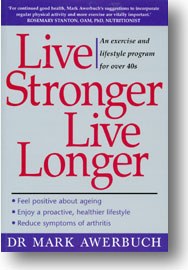
Live stronger live longer: An exercise and lifestyle program for over 40s
Mark Awerbuch. Sydney: McGraw-Hill, 2001 (xviii + 230 pp). ISBN 0 074 71087 7
This is a timely book on progressive strength training for older people which is made doubly useful because the program can be modified for people with arthritic conditions.
The book is divided into two sections. The first provides a foundation for understanding changes to the body caused by ageing and arthritis. It discusses the impact of these changes on physical and psychological health, and presents the evidence supporting the benefits of strength and cardiovascular fitness training programs. Issues of nutrition and the importance of ensuring an appropriate diet are also discussed. Information is provided in an easy-to-read style, a user-friendly manner, and it is suitable for either health professionals or the interested layperson. A particularly useful chapter focuses on the barriers and motivators to starting and sustaining ongoing participation in exercise programs.
The second section provides a step-by-step framework for conducting a strength and/or cardiovascular fitness training program — the book argues that these programs are complementary. Exercises are simply described, with many photographs. One criticism is that all of the photographs show only two participants, who appear quite fit. To older people, or people with mild to moderate arthritis, the photos may make them think the program is not suitable for them. (The book argues strongly that the program is appropriate for these groups as long as the framework is followed.)
There is a very useful list of contact details on where to find further information (such as Fitness Australia-accredited gymnasiums), and a comprehensive bibliography of recent research in the area of exercise training for older people and people with arthritis.
Overall, the book is a useful text for health practitioners, older people generally, and those with mild arthritic problems. People with more severe arthritis should discuss the issues with their medical practitioner, specialist or physiotherapist before beginning this type of program, as there is a need in this group to closely monitor initial response to exercise to avoid aggravation of joint pain.
Respiratory Syncytial Virus Disease Burden and Evidence Gaps in Australia Before Immunisation Introduction: A Retrospective Population-Based Study Using 2016–2019 Hospitalisation and 2023 Laboratory Surveillance Data
Chisato Imai-Boulter, Jean Li-Kim-Moy, Clayton Chiu, Sanjay Jayasinghe, Kristine Macartney
Multimorbidity Clusters Among People Aged 65 Years and Over in Australia: A Nationwide Cross-Sectional Data Linkage Study
Weisi Chen, Christine Y. Lu, Sarah N. Hilmer, Alice A. Gibson, Edwin C. K. Tan
Predictors of Ambulance Transport to Hospital for Older People Living in Tasmanian Aged Care Facilities: A Retrospective Cohort Study
Sharon Andrews, Pieter F. Fouche, Belinda Flanagan, Michael McDermott, Melanie Greenwood
Deprescribing in Older People: A Clinical Practice Guideline Summary
Stephen Tucker, John D. G. Watson, Donna Wellins, Tim Whitmore, Christopher Etherton-Beer, Amy T. Page
Emergency Department Presentations and Hospitalisations for Elder Abuse in People Accessing Aged Care Services in Australia: A Retrospective Cross-Sectional Study
Stephanie L. Harrison, Sahar Barmomanesh, Bryan Morden, Maria C. Inacio, Gillian E. Caughey, on behalf of the ROSA Consumer and Community Advisory Committee
A future for the hospital‐in‐the‐home (HITH) deteriorating patient: shifting the paradigm
Davide R Tomassoni, Iftah Amith