




Volume 198 - Issue 11
The drama of zoonoses
Author: Charles S Guest
Med J Aust 2013; 198 (11): 634. || doi: 10.5694/mja12.10169
Published online: 17 June 2013
Published online: 17 June 2013
MY CAREER choice was based on non-fiction reading as a teenager. Starting with American journalist Berton Roueché, who adapted material from the terse Morbidity and Mortality Weekly Report covering investigations by the US Centers for Disease Control, I have been reading popular accounts of epidemics for a while.And epidemics fascinated the earliest writers: pestilence as one of the horsemen of the Apocalypse in the Bible; ...
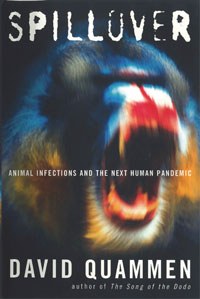
Spillover: animal infections and the next human pandemic.
David Quammen. New York: Norton, 2012 (589 pp. $28.95). ISBN 978039066807.
MY CAREER choice was based on non-fiction reading as a teenager. Starting with American journalist Berton Roueché, who adapted material from the terse Morbidity and Mortality Weekly Report covering investigations by the US Centers for Disease Control, I have been reading popular accounts of epidemics for a while.
And epidemics fascinated the earliest writers: pestilence as one of the horsemen of the Apocalypse in the Bible; Daniel DeFoe’s experimental Journal of the plague year, mistaken for reality by 18th century readers; 20th century disease “biographies”, with Hans Zinsser’s Rats, lice and history (on typhus), and countless others since. Australia has contributed to this literature, of course; Frank Bowden’s Gone viral is a recent example.
For such books, short words are preferred in the title — certainly not “epidemiology”. There is Robin Cook’s Vector, or the current entry into this crowded field, David Quammen’s Spillover, which was nominated for a 2013 Pulitzer Prize.
For me, popular epidemiology in a bookshop is always worth perusing, but is only purchased when necessary. What moved me from perusal to purchase in this case? I had to find out if Quammen had done justice to the story and memory of Brisbane horse trainer Vic Rail. And, indeed, the second paragraph of the opening chapter started thus: “The emergence of Hendra virus didn’t seem very dire or newsworthy unless you happened to live in eastern Australia.” In 1994, the disease killed Rail and his horse, and captured the attention of the Australian press, and students of communicable disease. Linda Selvey, then working as an epidemiologist in Queensland, investigated bats as a host of this disease. Years later, Quammen reconstructed the story, with careful interviews, and presents the “spillover”, from bats, with amplification in horses, and then to humans.
Spillover focuses on the passage of pathogens from one species to another. It is a book about emergence of animal disease and human disease as “strands of one braided cord” (p 13). Here, Quammen is not afraid of technical detail, explaining, for example, the Anderson and May model of parasite-host interactions (p 305), how the evolutionary success of a bug is directly related to its lethality, the rate of recovery from it, and the normal death rate from all other causes.
Quammen’s survey results from years of travel and interviews, and extensive reading of the original literature, and in general seems to fairly consider many old papers; this book does not derive from the latest multi-author textbooks. But would you be in safer hands turning to those modern texts? With the availability of collaborative online resources now, how many books like this one, the result of so much individual effort, will appear in the future?
The book is in the style of National Geographic, to which the author has contributed for many years. Alongside moments of drama, Quammen also takes the time to examine competing theories. The book’s subtitle points to the Next Big One — after a detailed examination of SARS, and a bit less on influenza — but there is so much more here. Good for a holiday read, Spillover will also be a valuable companion to anyone with a professional interest in zoonoses. Students needing the salient facts in a concise summary will start elsewhere, however.
Gambling is always a big subject, and currently more prominent with betting on Australian sports, while the flu season has many of us reassessing our disease risk, with or without this year’s vaccine. In the United States, there has been extravagant praise for Spillover, but I lost my bet that it would win a Pulitzer Prize.
Costs of Delivering the Hep B PAST Model of Care in Remote Australia: A Retrospective Pre–Post Study
Hoa Nguyen, Anh Le Tuan Nguyen, Paula Binks, Melita McKinnon, Emily Vintour-Cesar, Karen Wills, Nicola Stephens, Benjamin Cowie, Joshua S. Davis, Yuejen Zhao, Peter Nihill, Julie A. Campbell, Andrew J. Palmer, Jane Davies, Barbara de Graaff
Buruli Ulcer Acquired From Ringtail Possum Rescue
Daniel P. O'Brien, Naomi Clarke, Sara Bonnici, Mohammad A. Hussain
Q Fever Visceral Abscesses After Contact With Native Australian Marsupials
Samantha J. Laws, Enzo Binotto, James Stewart, Jennifer Ho, Trent Yarwood, Josh Hanson, Simon Smith
Hospital-Admitted Injection-Related Infections Among Incarcerated People Who Inject Drugs in Australia: A Retrospective Cohort Study
Andrew Palmer, Matthew Carter, Jeremy Yeo, Cecilia Shim, Jason Connor, Jeremy Hayllar, Gerald Holtmann, Naomi Moy, Elliott G. Playford, Naomi Runnegar, Paul J. Clark
The Live Attenuated Influenza Vaccine in Australia: An Additional Tool for Influenza Prevention
Cyra Patel, Alexis Pillsbury, Tran Nguyen, Xia Wang, Helen E. Quinn, Clayton K. Chiu, Allen C. Cheng, Katie L. Flanagan, Zhicheng Wang
Reflex Testing for Hepatitis D Infection: A Unique Opportunity to Reduce Hepatitis D-Related Chronic Liver Disease Deaths in Australia
Jessica Howell, Lauren Andersson, Miriam T. Levy, James O'Beirne, Leon Adams, Katharine Irvine, Avik Majumdar, Golo Ahlenstiel, Kathy Jackson, Krispin Hajkowicz, Joseph Doyle, Jane Davies, Sarah Cherian, Wayne Dimech, Alexander J. Thompson